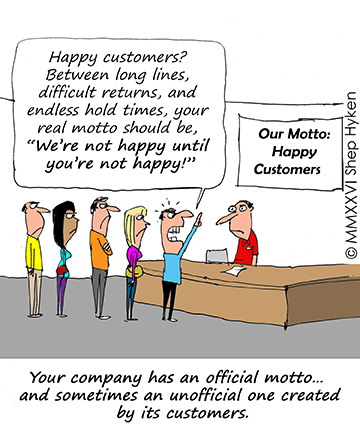
Customers decide what they think about a company based on the total of their interactions, not the advertising. Ten years ago I wrote a piece called "We're Not Happy Until You're Not Happy." It was a joke aimed at companies that delivered poor service. The idea was that if you don't give customers the experience they want, they will write their own motto for you.
Every company has a motto. The real question is who writes it. Is it the marketing team, or is it the customers? A bad experience produces lines like "They don't care about me" or "They make everything difficult." No business would use those as a tagline, but that is what customers remember when service fails. Those sarcastic phrases are the sum of the experiences a company consistently delivers.
Good service does the opposite. Customers who are treated well say things like "They always take care of me" or "They are so easy to do business with." Those statements do not show up in advertisements, but they show up in online reviews, social media posts, and conversations with friends.
That is why every single interaction matters. Customers do not form an opinion based on one slogan. They base it on every phone call, email, purchase, delivery, and support call. Each interaction either reinforces the brand promise or rewrites it.
Companies spend millions crafting slogans. Those slogans are promises. The question is whether the experience matches the message. If it does not, customers will create a slogan of their own. Marketing may write the tagline, but customers write the reputation. If the experience is consistently disappointing, the unofficial motto becomes, "We're not happy until you're not happy."
Shep Hyken is a customer service and customer experience expert, award-winning keynote speaker, and New York Times bestselling author.