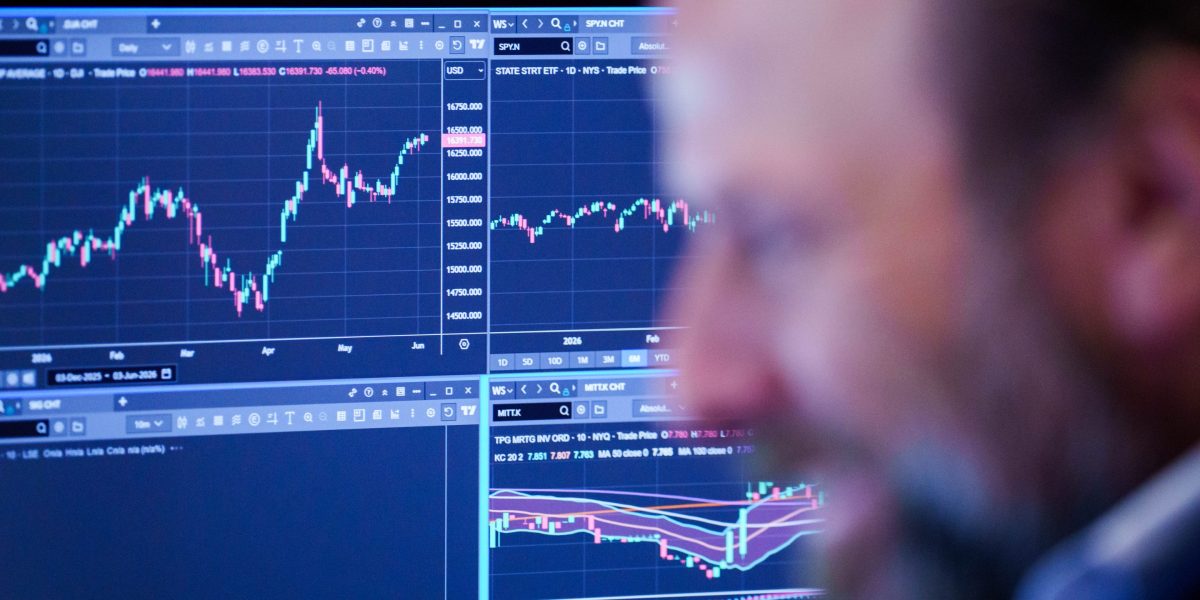
The Nasdaq Composite traced a V on Tuesday. Down more than 4% by midday, it closed off just 1%.
The intraday swing hit the highest-beta names first. Strategy (MSTR), the leveraged bitcoin vehicle that jumped Monday, reversed. AppLovin (APP) and photonics maker Lumentum (LITE) sold off alongside it. The densest cluster was the chipmakers: Marvell Technology dropped 10% a day after jumping 10% on news it is joining the S&P 500.
Rather than fleeing equities altogether, the market rotated. JM Smucker jumped double digits. Home Depot and Sherwin-Williams led. Real estate, staples, and utilities finished up – the classic ballast against tech froth.
"You're seeing money flow into consumer names that have been unwanted and unloved," Richard Steinberg, senior global market strategist at Focus Partners Wealth, told the WSJ.
The Trigger Wasn't Clear, the Mechanics Were
No single headline caused the midday flush. The selling looked more like an absence of buyers than a rush for the exits. Founder ETFs' Michael Monaghan described it as buyers stepping back, dropping the price faster than the volume would suggest.
Why Chips Got Hit First
The Parabolic 7 – a group of semiconductor stocks that ran up nearly 100% in weeks – carried the most crowded positioning. When buyers step back, the highest-beta names fall fastest because they have the thinnest bid support below the market. Marvell's 10% drop was the extreme case: a stock that had just doubled in a month on index-inclusion momentum had no natural buyers at the old price.
The rotation into staples tells a cleaner story. JM Smucker and Sherwin-Williams are the opposite trade: low beta, high dividend yield, no AI narrative. Money flowing into those names signals a risk-off rotation within equities, not a macro flight to cash. Treasuries barely moved, which confirms the rotation thesis. Funds sold tech to buy defensives. They did not raise cash.
The Real Catalyst: Three IPOs and an Inflation Print
Wall Street has to make room for SpaceX, set to be the largest IPO ever on Friday. OpenAI and Anthropic have both confidentially filed. Annex Wealth's Brian Jacobsen called the tech run an Icarus trade with the wings melting. Alphabet's rare capital raise was the first warning. SpaceX is the "shiny new toys" pulling money out.
The SpaceX Oversubscription Wrinkle
SpaceX is already oversubscribed, with multiple $10 billion orders in. That means institutional funds that want allocation have to sell existing positions to free up cash. The highest-beta, most liquid names – chips and AI proxies – are the easiest to sell.
Brian Jacobsen at Annex Wealth called the tech run an Icarus trade with the wings melting. Alphabet's rare capital raise was the first warning. SpaceX the shiny new toys pulling money out. Though even that story has a wrinkle: SpaceX is already oversubscribed, with multiple $10 billion orders in.
Inflation Data Lands Wednesday and Thursday
A strong May jobs report last week pushed expectations for rate cuts further out. Funds tend not to sit in their most crowded, highest-beta positions going into an inflation reading that could move the Fed's path. The midday selloff may have been portfolio managers trimming ahead of the print.
Oil Went the Other Way
Crude oil fell about 3% to roughly $88, even after President Donald Trump said the U.S. would have to respond to Iran's downing of a U.S. Army Apache helicopter near the Strait of Hormuz. The energy secretary said traffic through the Strait was picking up meaningfully, which undercut the supply-risk premium.
What Confirms or Weakens the Rotation Thesis
Confirms: A second day of consumer-staples outperformance with tech underperformance. Higher volume on the rotation names. SpaceX pricing above its target range.
Weakens: Tech bounces back on Wednesday without a catalyst. Treasuries sell off, which would suggest the move was macro-driven rather than rotation-driven. SpaceX prices below its target range, reducing the cash-raising pressure.
The AlphaScala Read on the Three Most-Hit Names
Strategy (MSTR) carries an Alpha Score of 12/100, labeled Weak. The stock is a leveraged bitcoin proxy, not a tech company. When the AI trade unwinds, MSTR gets caught in the crossfire because it trades on momentum, not fundamentals. See the MSTR stock page for the full profile.
AppLovin (APP) scores 45/100, labeled Mixed. The advertising-tech platform has real revenue, its beta to the AI narrative is high. A rotation out of frothy tech hits APP harder than its fundamentals would justify. The APP stock page has the details.
Lumentum (LITE) scores 54/100, also Mixed. The photonics maker has a clearer catalyst path in optical networking, it trades like a semiconductor name. When chips sell off, LITE sells off with them. Check the LITE stock page for more.
For a broader view of how the sector is moving, see the stock market analysis page.
The midday V-shape was a rotation, not a crash. Funds sold the highest-beta tech names to buy defensives and free up cash for the SpaceX IPO. The inflation print Wednesday and Thursday will determine whether the rotation continues or reverses. Watch the consumer-staples-to-tech ratio for the signal.