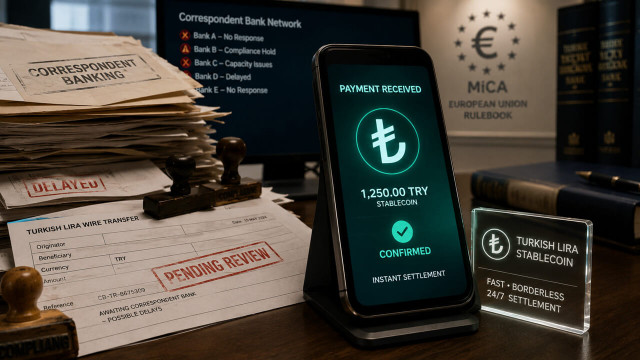
Zodia Markets processed $3.4B in lira stablecoins in 2025, dwarfing euro tokens. The reason: friction, not regulation. Euro rails are too efficient for a token to solve a real problem.
Zodia Markets, the crypto subsidiary majority-owned by Standard Chartered, processed $3.4 billion in transactions involving Turkish lira stablecoins in 2025. The lira became its second-most-used stablecoin currency behind the dollar. It outpaced the euro and every other G10 currency.
Dollar-pegged tokens, led by Tether and Circle's USDC, still dominated at $110.5 billion. Euro-pegged stablecoins came in at only tens of millions, a fraction of a currency whose home economy is a fraction of the eurozone's size.
This does not look good for Europe. A consortium of banks is preparing to launch a regulated euro stablecoin under MiCA. The European Central Bank is working toward a digital euro. The eurozone might have the rules and the bank balance sheets. Turkey has the people actually sending money.
Nick Philpott, Zodia's co-founder and interim chief executive, explained the lira's success in operational terms. His clients reached for lira-pegged stablecoins instead of pushing lira through correspondent banking to reach Zodia's bank account. The tokens settled faster and more reliably. Zodia could liquidate them on receipt.
The demand came from the friction in a specific payments corridor: the slow timelines and layered fees that correspondent banking imposes on anyone moving lira across borders.
The euro generates almost none of that friction for the people who might otherwise hold a euro stablecoin. Euro banking rails are already clearing quickly and cheaply. A tokenized euro solves a problem that nobody has.
The dollar holds its position as the unit of account across crypto markets. This keeps dollar tokens dominant regardless of where the user sits. Euro stablecoins end up squeezed between a currency that people already move easily through banks and a currency that already runs the on-chain economy. Little open ground remains.
CryptoSlate covered the supply side of this gap when a consortium of 37 banks across 15 countries backed the Qivalis project to issue a MiCA-compliant euro token in the second half of 2026. Europe also moved to slow the dollar stablecoin takeover through tighter rules and plans for a digital euro.
Europe accounts for roughly 38% of global stablecoin transactions. Euro-denominated tokens make up around 0.3% of total stablecoin supply. The euro stablecoin shortfall is a demand and distribution problem rather than a regulatory one. Zodia's data turns that abstract gap into a concrete ranking: a single emerging-market currency outran the entire euro token category by a wide margin.
The lira result fits a broader division forming inside stablecoin demand. Standard Chartered's research team, led by Geoffrey Kendrick, estimated last year that up to $1 trillion could move out of emerging-market bank deposits into stablecoins over three years. Dollar tokens would draw savings out of local banks in countries exposed to currency stress.
Turkey sat among the 16 high-risk economies the bank flagged, alongside Egypt, Pakistan, Nigeria, and others with histories of sharp currency depreciation. In their cases, dollar stablecoins serve as a substitute for a dollar bank account. They capture savings that residents want to hold outside a weakening local currency.
Local-currency tokens have a different role. They work as the settlement layer that connects domestic money to global crypto liquidity. That is what the lira-backed stablecoins showed: clients used them to move Turkish fiat into Zodia's dollar settlement. Lira tokens can rank second in usage while remaining tiny relative to the dollar.
Nobody at Zodia treated the lira as a competitor to the dollar for storing value. The dollar remains where money sits. The lira token is the on-ramp that brings domestic funds to it.
Global stablecoin firms have started building directly into that bridge. Ripple recently brought its dollar-backed RLUSD token to Turkey through partnerships with BiLira and Bitexen. BiLira's TRYB lira stablecoin is backed by reserves held in local Turkish banks and routes through the country's largest local OTC desk.
Turkey processes close to $200 billion in annual crypto volume. That gives its local infrastructure real weight as it links up with global issuers. The IMF reported this week that Nigeria has become sub-Saharan Africa's leading cross-border stablecoin corridor, with roughly $59 billion in inflows. The digital-dollarization concerns that follow dollar tokens into any economy with a fragile currency are real.
This leaves a question about regulation. Reserves backing lira tokens now sit within Turkish banks. This ties stablecoin stability to local bank balance sheets. Rapid swapping between lira and dollar tokens during a period of currency stress could move money out of those banks faster than supervisors are accustomed to managing.
A local-currency stablecoin that becomes a serious payments rail also becomes something a central bank has to account for in its own monetary transmission. The IMF has already raised that concern about dollar tokens displacing local currency in Nigeria. Turkish authorities will have to decide how far to let lira tokens grow before they start shaping domestic bank funding in ways that draw a supervisory response.
Europe is building the currency's on-chain relevance because the currency carries geopolitical weight that policymakers want to preserve in digital settlement. Turkey's lira activity took the other route. A currency earns on-chain usage because residents and businesses have an immediate reason to move it. Friction they feel directly. A bridge they need into dollar liquidity.
That distinction, between what European institutions want to promote and what emerging-market users actually reach for, will shape which currencies end up doing real work on-chain.
Prepared with AlphaScala editorial tooling from the source reporting linked above. Indexable analysis may include a cited Alpha Score value. Publishing checks screen each story before release. Educational coverage, not personalized advice.