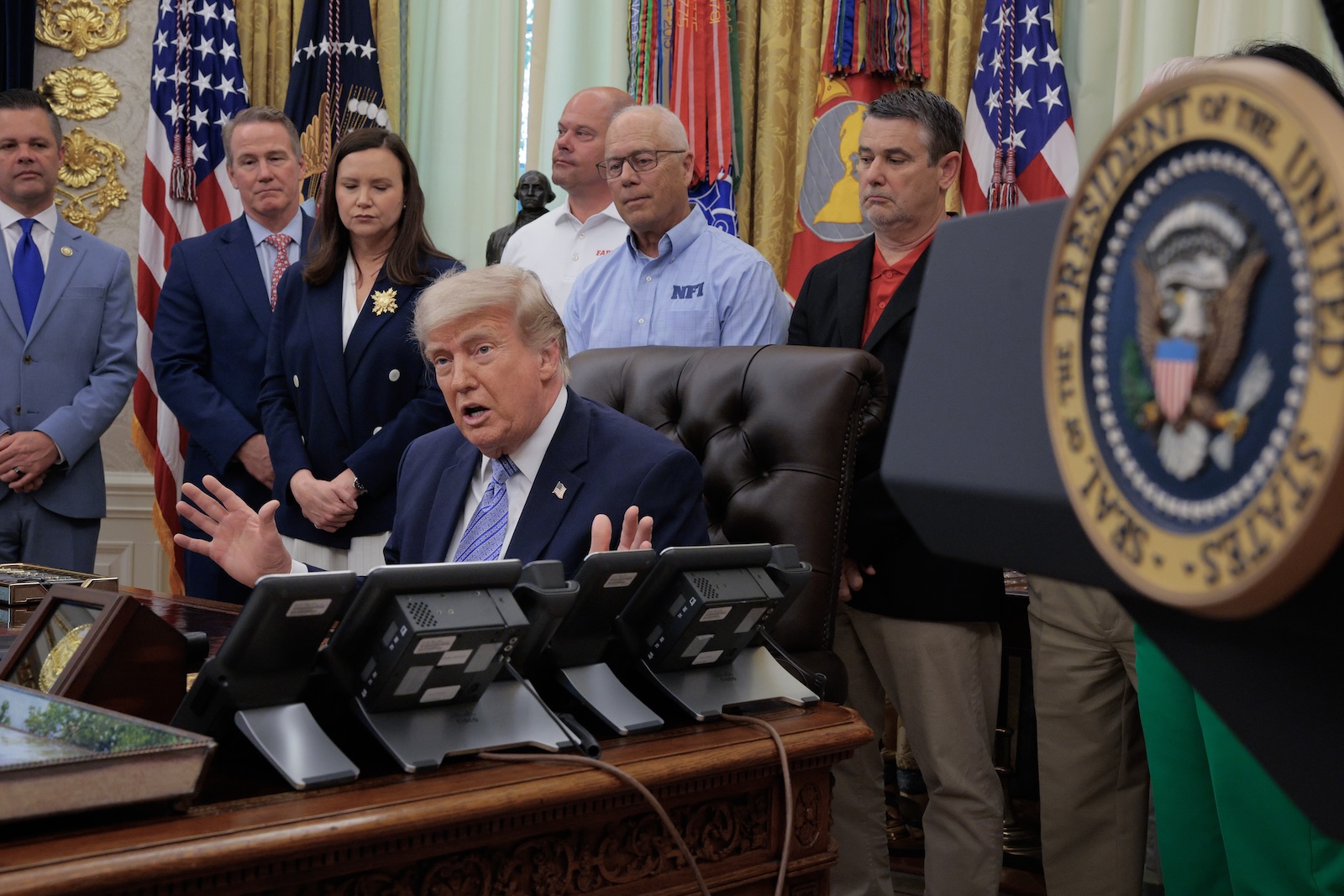
President Donald Trump signed the American Innovation and Manufacturing Act in 2020, a bipartisan law that began phasing out hydrofluorocarbons (HFCs) – potent greenhouse gases used in commercial refrigeration and air conditioning. At that signing, Trump praised the measure as a win for U.S. manufacturers producing alternative refrigerants. The Environmental Protection Agency (EPA) under Joe Biden then spent four years implementing rules to enforce the law, targeting an 85% reduction in HFC production and use by 2036.
Now Trump has reversed course. At a White House press conference last month, flanked by EPA Administrator Lee Zeldin and executives from the country's largest grocery chains, he announced the administration would loosen two of the EPA's refrigerant rules. One rule delays the deadline for grocery stores and air-conditioning companies to begin reducing HFC use. The other exempts transport companies from repairing HFC leaks in refrigeration equipment. Trump estimated the changes would save U.S. businesses and families more than $2.4 billion and promised the move would have "no environmental consequence" while bringing down supermarket bills.
There is a problem with that claim. Economists, former EPA officials, and even the agency's own internal assessment say the rollbacks are more likely to raise costs for grocers and consumers. Some industry groups warn that the administration's turnabout will drive up demand for equipment using the most climate-damaging HFCs – equipment that the sector had been steadily retiring. Instead of lowering prices, the supply and demand dynamics may push prices higher.
The Policy Shift That Broke the HFC Phase-Down
The American Innovation and Manufacturing Act (the AIM Act) created a schedule for reducing HFC production and consumption via an allowance system. The EPA's implementing rules set specific deadlines for end-users – grocery stores, cold-storage warehouses, and transport refrigeration operators – to adopt lower-GWP alternatives and fix leaks. Those compliance checks carry costs: retrofitting equipment, purchasing newer refrigeration units, and installing leak-detection systems.
What the rollback changes
Trump's executive action delays the compliance deadlines for grocery stores and HVAC companies by at least one year and exempts transport refrigeration from leak-repair requirements entirely. For a Kroger (KR) or Albertsons (ACI), that means the immediate pressure to replace HFC-based systems is removed. The underlying allowance system remains – the EPA still caps total HFC production. What changes is the demand side.
The mechanism that flips the cost story
By temporarily exempting major users from conversion deadlines, the rule boosts demand for HFC-based equipment that would otherwise have been phased out. That has two effects. First, the price of legacy HFC refrigerants – already rising as allowances shrink – could spike as more users compete for a shrinking pool of allowed supply. Second, suppliers of alternative refrigerants (hydrofluoroolefins, HFOs, and natural refrigerants) scale back investment because the regulatory tailwind weakens, keeping those alternatives expensive or hard to source. The EPA's internal analysis, obtained by environmental groups, concluded that the net effect could be higher grocery prices, not lower ones.
Trump's statement contradicts the agency's own analysis. The disconnect matters for anyone holding positions across the food retail, HVAC, and chemical sectors.
Why the $2.4 Billion Savings Claim Falls Apart
The $2.4 billion figure Trump cited appears to derive from avoided compliance costs – money retailers would not have to spend on leak repairs, system retrofits, and new equipment. That line-item view misses the offsetting costs that arise from the policy change.
The leak-repair exemption creates hidden expense
Transport refrigeration units – the containers and truck trailers that move perishable goods – leak HFCs at a high rate. Trump's rule exempts them from mandated leak repair. For a fleet operator, that saves the immediate cost of fixing a leak. The leaked refrigerant must be replaced. As HFC allowances shrink, replacement gas becomes more expensive. The net effect is a recurring cost that does not appear on the compliance budget. It shows up on the cost of goods sold line for grocers and logistics providers.
Delayed retrofits compound later
A grocery chain that defers a refrigeration upgrade benefits from lower capital expenditure this year. The upgrade will still be necessary before 2036. In the interim, the chain operates older, less efficient equipment. Higher electricity consumption, more frequent breakdowns, and lost product from temperature excursions eat into the savings. Over a five-year horizon, the cumulative cost of delay can exceed the upfront retrofit cost. Economists at the University of California, Davis and the Climate Leadership Council have modeled such policy shifts and found a net consumer cost increase of 0.5% to 1.2% on perishable goods.
| Scenario | HFC price change | Grocery operating cost change | Consumer price impact |
|---|
| Full phase-down on schedule | +8% per year (declining allowances) | +0.2% (efficiency gains offset) | +0.1% |
| Rollback with one-year delay | +15% per year (demand surge) | +0.7% (higher refrigerant + energy) | +0.5% |
| Extended exemptions (2+ years) | +20%+ (supply crunch) | +1.2% (retrofit catch-up later) | +0.9% |
Source: Compiled from EPA regulatory impact analysis and third-party models.
How This Hits Grocery Stock Margins
Grocery retailers operate on thin margins – typically 1% to 3%. Refrigeration accounts for 30% to 50% of a store's electricity bill. Refrigerant leaks and replacement costs add another 0.3% to 0.5% of revenue. A permanent net cost increase of 0.5% to 1.2% on perishables would pressure margins for every publicly traded chain.
Which names are most exposed
- Kroger (KR): operates 2,700+ supermarkets, each with multiple refrigeration circuits. Kroger has invested heavily in natural refrigerants (CO₂, ammonia) as part of its sustainability goals. A delay in the phase-down reduces the incentive for further conversions, potentially slowing Kroger's progress toward its stated 30% reduction in refrigerant emissions by 2030.
- Albertsons (ACI): similar store count, a higher proportion of legacy HFC systems. The rollback buys time for ACI. It raises the risk of a sharp retrofit spike later.
- Sprouts Farmers Market (SFM): smaller footprint, many stores use HFC-based open cases. The exemption on transport refrigeration also affects its supply chain.
The refrigerant producers' angle
- Honeywell (HON): a major manufacturer of HFO alternatives (Solstice). The rollback slows adoption of its products, directly hitting growth in its Advanced Materials segment.
- The Chemours Company (CC): produces both HFCs and HFOs. Near-term demand for HFCs rises, boosting sales in the old product line. Long-term uncertainty depresses investment in next-gen refrigerants.
Bottom line for traders: The rollback buys short-term cost avoidance for grocers. It delays structural cost reduction. The net effect over 12–24 months is inflation in perishable goods pricing, which tests consumer elasticity and compresses retailer margins.
The trade implication
A trader looking at grocery stocks should watch for margin guidance in the next two quarters. Companies that signal higher refrigerant costs or slower efficiency improvements may face multiple compression. Grocers that continue converting to natural refrigerants despite the regulatory pause can differentiate on long-term cost structure.
Confirming vs. Invalidating the Thesis
Factors that would confirm the price-up thesis
- Monthly CPI for food at home shows an acceleration in dairy, meat, and produce prices beyond general food inflation.
- Kroger or Albertsons cite refrigerant costs as a drag on gross margin in their next earnings call.
- Spot prices for R-404A and other common HFC blends rise more than 20% year-over-year.
- Alternative refrigerant producers (Honeywell, Chemours) report slower-than-expected adoption of HFO products.
Factors that would weaken or invalidate the thesis
- HFC prices remain flat or decline because of weak demand from other sectors (e.g., automotive AC).
- Grocery chains announce accelerated conversions to natural refrigerants despite the delay, using the extra time to negotiate better capital expenditure terms.
- Consumer demand for perishables softens, reducing the volumetric impact on margins.
- The administration extends the rollback to allowances themselves – allowing more total HFC production – which would lower refrigerant prices. That would increase long-term regulatory risk.
The Next Catalysts for This Setup
Two concrete events will test the conflicting narratives. First, the EPA's final rule implementing the rollback must be published in the Federal Register within 60 days. The language around leak-repair thresholds and allowance-setting will reveal whether the rollback is a one-year pause or a deeper retreat.
Second, Kroger's next quarterly earnings (expected in June) will be the first with a full quarter under the announced policy. The margin section of the earnings call and any mentions of capital expenditure on refrigeration upgrades are the key data points. A better-informed market will adjust positions on the numbers, not the political claims.
For now, the simplest reading – that eliminating compliance costs cuts prices – is the one that fits the press release. The better reading runs through refrigerant supply chains and delayed efficiency investment. That route points to higher long-term costs for grocers and consumers, and a trading angle in the companies most exposed to the transition.