The Declaration dissolved the colonies' ties to Britain and asserted a right to withdraw from sovereign authority. Jefferson defended it into his presidency.
The Declaration of Independence was a formal act of secession. The 13 colonies dissolved their political connection to the most powerful empire in the world. Capturing the British state was never the aim. Joshua Mawhorter, writing in the July/August 2026 issue of The Misesian, argues that the document stands as one of the earliest major challenges to the modern sovereign nation-state, and that its central claim was the right of a people to withdraw from an existing political union.
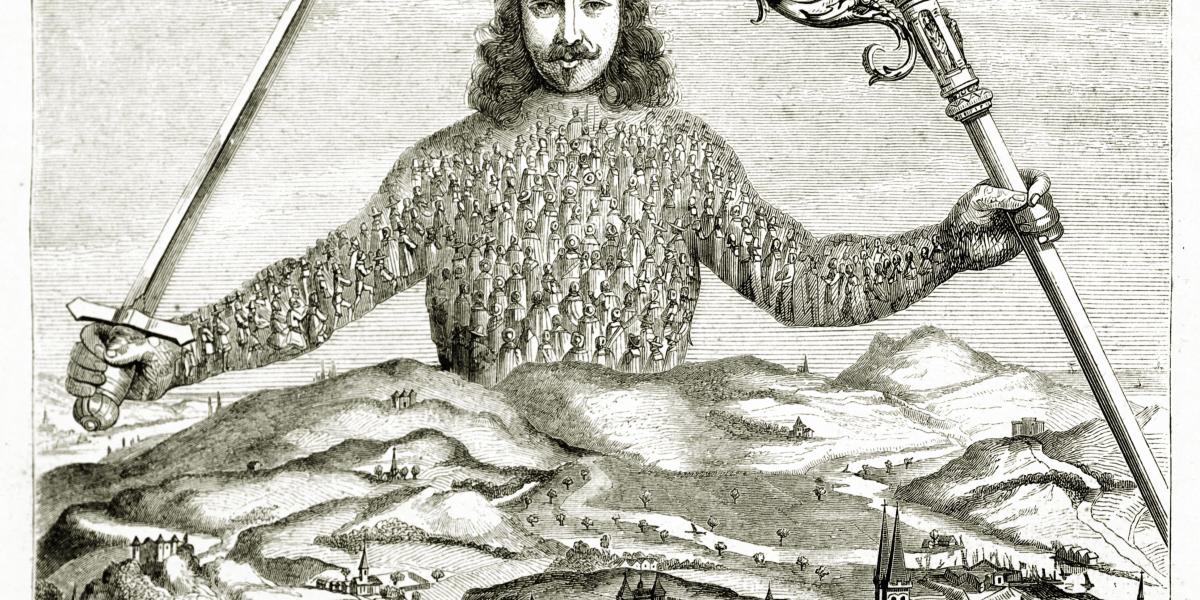
Thomas Hobbes, in his 1651 book Leviathan, gave the modern nation-state its theoretical foundation. Martin van Creveld, in The Rise and Decline of the State, writes that Hobbes "deserves the credit for inventing the 'state'" as an abstract entity separate from the sovereign who carries it and from the ruled, who transferred their rights to him by contract. Hobbes's sovereign, van Creveld adds, was far more powerful than any Western ruler since late antiquity. Hobbes shifted the debate from the person of the ruler to the structure of the state. The Leviathan was a corporate body representing all citizens.
Hobbes built his case on a grim premise. In the state of nature, everyone has a right to everything, even to others' bodies, and because everyone may do whatever they think necessary to survive, no one is safe. Peace and security, he argued, require individuals to give up that liberty to an absolute sovereign who enforces order.
The social contract makes the sovereign's acts consensual. Since the state is said to have received its power from the consent of the people, the individuals under it have agreed to obey under any and all circumstances. Its actions are the subjects' actions, because the state represents them.
John Locke used the same theory in the opposite direction, as a limit on state power. He grounded legitimate government in the protection of natural rights and in the requirement of consent for state actions. Jefferson borrowed Locke's theories in the Declaration.
Murray Rothbard, in Economic Controversies, wrote that social contract theory can set an ideal toward which government should be transformed, which was Locke's use, or it can place a stamp of approval on all or most of the actions of an existing government.
Under the second reading, nothing limits the state.
Secession in the modern sense could only emerge once the nation-state came to be regarded as the exclusive and indivisible locus of sovereignty over a defined territory, Mawhorter argues. Political communities had long separated from kingdoms and empires. The Declaration, in his reading, added a new claim: a people may withdraw from a state that claims supreme authority over them, without that state's permission.
Altering the government of Great Britain was not the colonists' objective. The aim was to dissolve their connection to it and establish independent states. In ordinary political terminology, a civil war is a violent conflict over control of the government within a state. A revolution ordinarily involves a fundamental alteration of a state's governing institutions.
The Americans attempted neither. They did not try to seize Parliament or depose the British government.
Crane Brinton, in The Anatomy of Revolution, treats the American Revolution as unusual because it never advanced as far down the path of radical centralization as the French or Russian Revolutions. In America, he writes, "a struggle between moderates and radicals had been fought out, and had ended with victory for the radicals." The fruit of that victory, he says, was the Declaration of Independence.
The signers openly challenged British authority by affixing their names to the document. They knew that failure would likely result in charges of treason, the loss of their property, imprisonment, or death.
Jefferson held to the secessionist reading long after 1776. His August 23, 1799, letter to James Madison put the condition in writing: "were we to be disappointed in this, to sever ourselves from that union we so much value, rather than give up the rights of self government which we have reserved." In his First Inaugural Address on March 4, 1801, he said that anyone who wished to dissolve the Union or change its republican form should "stand undisturbed as monuments of the safety with which error of opinion may be tolerated where reason is left free to combat it." He affirmed the right of secession in writing as late as 1816, and there is no evidence he ever abandoned the principle.
The language of the Declaration itself supports the secessionist reading, Mawhorter argues. The colonies declared themselves "Free and Independent States," with "full Power to levy War, conclude Peace, contract Alliances, establish Commerce." Sovereign states hold such powers, as The Encyclopaedia Britannica confirms. In the founding era, he argues, the United States were not commonly understood as a single consolidated nation-state. They were a collection of distinct political societies that had united for common purposes while retaining their separate identities and, in many respects, their sovereignty. The name itself was plural, "the United States are" rather than "the United States is."
Plural usage faded. Lincoln's Gettysburg Address in 1863 spoke of "a new nation." Francis Bellamy's Pledge of Allegiance, written in 1892, pledged loyalty to "one Nation, indivisible, with liberty and justice for all."
Neither the Second Continental Congress nor the Declaration had the authority to create a nation, in Mawhorter's telling. The United States is a modern nation-state today, yet the Declaration did not produce that outcome. The path from British colonies to a modern nation-state ran through a decentralized confederacy of sovereign states. The Declaration itself was a joint act of secession by distinct colonies that declared themselves to be free and independent states.
Mawhorter describes an irony in the document's later career. A secessionist text championing natural rights and the consent of the governed was transmogrified into a legitimating document for a centralized American nation-state with almost unlimited power.
Bernard Bailyn, in "The Central Themes of the American Revolution," wrote that the revolutionary leaders infused American political culture with a belief that power is evil and infinitely corrupting, a necessity that must be controlled and limited in every way compatible with a minimum of civil order. Written constitutions, the separation of powers, bills of rights, and restrictions on the right to coerce and wage war all expressed, in his words, "the profound distrust of power that lies at the ideological heart of the American Revolution and that has remained with us as a permanent legacy ever after."
Drafted by a large language model from the source reporting linked above, then screened by automated publishing checks. It is not read by a journalist before publication. Some articles cite our Alpha Score. Verify prices and figures against the original source. Educational coverage, not personalized advice.