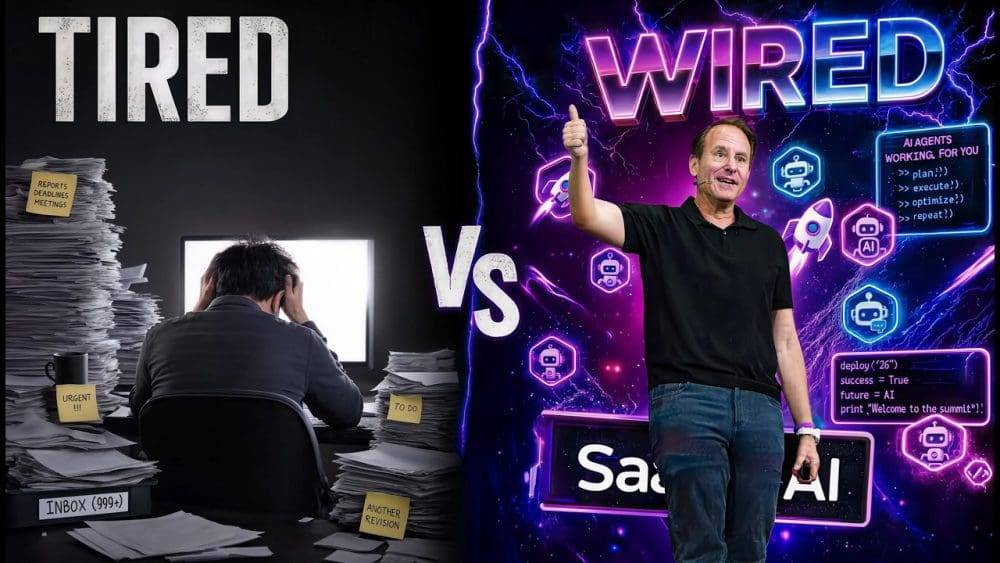
Two things are true in B2B right now, and they look like they can't both be true. Total software spend is accelerating – Gartner puts it at $1.4 trillion this year, up 15% from last year, the fastest growth in a decade. At the same time, roughly half of SaaS companies are dying. The contradiction resolves the moment you stop looking at "software" as one thing.
The market has split. One group is tapping AI budget and re-accelerating to numbers never seen at scale. The other is running the same playbook from 18 months ago, waiting for a recovery that is not coming. There is very little in the middle.
Jason Lemkin, founder of SaaStr, laid out the mechanics at the SaaStr AI 2026 event. "About half of what CIOs are spending is net new for AI, and a lot of it goes to Anthropic and friends," he said. "To fund it, they're cutting and consolidating older vendors. So it may not feel like spend is accelerating if you're an older vendor. You have to tap AI budget or you feel none of it."
The pattern is simple: be the API or the platform that everything blowing up in AI also has to buy. Companies that fit that description are winning. Those that don't are getting sold off hard. Public software is now trading at a discount to the overall S&P 500 for the first time ever. The whole point of software was that it was the best business model – write once, sell everywhere. It always traded at a premium. Now the markets are saying it is worse than almost any other business they can find.
They stopped believing 110% net revenue retention is trustworthy. They decided the budget in the CIO's office is going to AI spend, and that three-year contracts are hiding the fact that nobody renews in three years. They sent epic products like Monday, HubSpot, and Atlassian down 60% to 70% in a couple of months.
Atlassian (TEAM) is a case in point. The stock has been hammered as investors question whether its legacy collaboration tools can hold ground against AI-native alternatives. Our Alpha Score rates TEAM at 23 out of 100, a Weak label, reflecting the structural headwinds. The company's core products – Jira, Confluence – are not the API layer that AI agents need. They are the kind of software CIOs are cutting to free up budget for Anthropic and OpenAI.
Lemkin's own experience running SaaStr with three humans and 21 agents illustrates the shift. "Our AI VP of Marketing and AI VP of CS cost $257 a month combined," he said. "They replaced roughly $500K of employees, and productivity went up, not down. Call it productivity or call it deflation. Either way it's a lot to reflect on."
He walked through what separates the winners from the rest. "A great AI that solves the problem today beats a mediocre human who needs an engineer and an appointment next week," he said. "Build the great AI."
The key is not just building AI features. It is making your product the easiest to build on. Lemkin moved SaaStr's email to Resend because it was the most agent-friendly platform. He is leaving Marketo because it runs out of API calls in an hour and makes you wait to get more. SaaStr built an API Report Card that grades leading APIs. Stripe got the only A+. "If you don't score a B+ or better, go make your API more agent-friendly," Lemkin said. "It's often a couple days of work: let agents pull more data, pull more often, and structure output the way they want. That couple days can turn you into the winner in your market."
The implication for investors is straightforward. The software sector is bifurcating. Old SaaS – products that require humans to configure, integrate, and maintain – is dying. New B2B plus AI – products that are themselves the API layer for agents – is exploding. Niche markets are 10x to 100x larger now because agents add so much value. Categories that took four years to attract a competitor now get one accidentally next week as sales, marketing, and support blend into a single agent and a single interface.
Lemkin's closing advice to founders applies equally to investors. "It's the best time ever to be in B2B. It's the worst time to be selling your grandpa's software. Decide which one you're building, and go."
For those tracking the TEAM stock page, the Alpha Score of 23 reflects the risk. The broader stock market analysis shows the same pattern: companies that sit at the center of AI agent workflows are re-rating higher, while legacy SaaS continues to de-rate. The line between the two camps gets wider every quarter, and the cost of being honest about which one you are in keeps going up.