Why L&G Says Short-Termism Misses Energy Transition
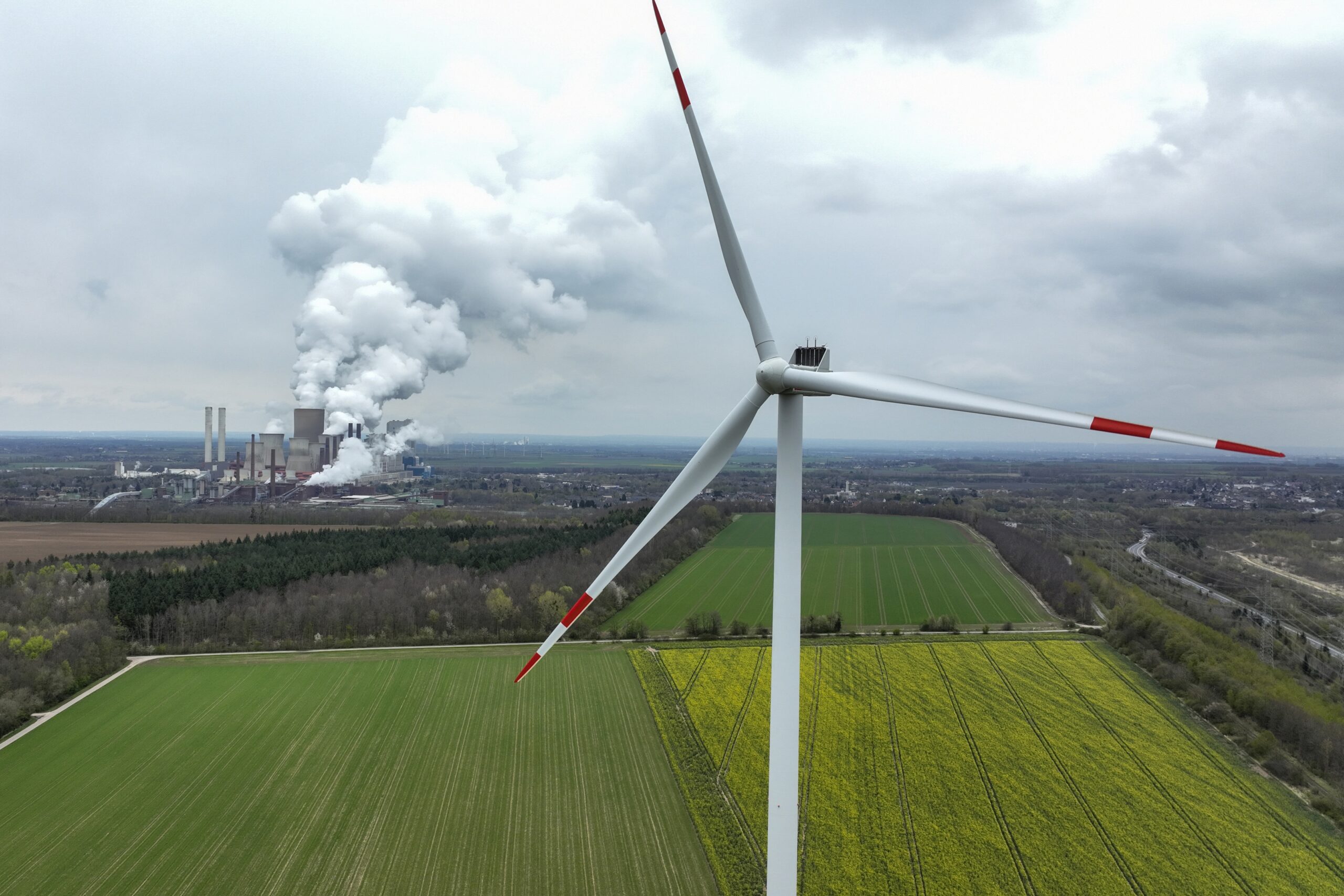
Legal & General's updated climate scenarios show global emissions peaking before 2030. The report directly challenges the 'transition stalled' narrative and warns short equity holding periods blind investors to structural shifts.
Legal & General Group Plc published a report Monday that directly challenges the market narrative that the energy transition has stalled. The UK insurer and asset manager updated its climate scenarios to show global emissions peaking before 2030 and the worst-case warming projection falling from 3C to 2.5C above pre-industrial levels. The read-through for energy sector allocation: short-term equity holding periods averaging about one year are blinding investors to a structural repricing already underway.
Nick Stansbury, head of climate solutions in L&G's asset management unit, described the gap between perception and reality. "There has been this market narrative developing in the background that essentially the energy transition has slowed, has screeched to a halt, and perhaps is even heading into reverse in some places," he said. "From what we can see of the data and the evidence in the modeling that we've done there, the energy transition is alive and well."
Why the 'Transition Stalled' Narrative Is Wrong
L&G's Updated Scenarios Show Faster Decarbonization
L&G refreshed the data behind its suite of climate scenarios over the past year. The firm examined clean-energy deployment rates, electric-vehicle adoption trajectories, and policy assumptions. The conclusion: clean-energy costs are falling faster than anticipated, and the electrification of transportation and industry is advancing despite political headwinds from the Trump administration and an AI-driven data center boom that boosted natural gas demand.
Justine Schafer, head of climate modeling at L&G, noted that projected emissions under the firm's "inaction" scenario have declined with each successive iteration. The 2026 version marks the first time the modeling shows global emissions peaking before 2030 even without new government policies. That milestone shifts the probability distribution for long-duration asset values.
Short-Term Equity Holding Periods Create a Blind Spot
L&G identified the average equity holding period of roughly one year as a structural reason investors are missing the shift. "The energy transition is a question of when, not if," Stansbury said. "If you don't look at what the data is telling us about the long-term opportunities, there is a real risk that, as an investor, you may miss out on one of the most exciting investment opportunities of our generation."
Practical rule: A one-year holding period cannot capture a multi-decade structural shift. Capital allocated to fossil fuel assets under the assumption that demand will remain flat for decades is likely mispriced relative to scenarios where coal, oil, and gas consumption peak earlier than consensus expects.
The mechanism is straightforward. Short-term investors overweight near-term cash flows and policy headlines. They underweight the cumulative effect of cost declines in solar, wind, and batteries that compound annually. The result is a capital allocation gap–money flows into assets that look safe over one year are actually high-risk over ten.
Where Clean Energy Costs and EV Adoption Are Outrunning Policy
Solar and Wind Now Competitive Without Subsidies
L&G's models show that solar and wind energy costs have fallen far enough that they are competitive without subsidy in most large markets. This changes the transmission mechanism: even without additional government mandates, the economic incentive to switch is self-sustaining. The Trump administration's hostility to climate regulation does not reverse those cost curves. It only delays the marginal project.
EV adoption is the clearest example. L&G said deployment has advanced faster than its previous assumptions, meaning transport-related oil demand is likely to plateau earlier than current market prices reflect. The effect compounds as battery costs fall and charging infrastructure scales. Each new EV sold reduces gasoline demand permanently, pulling the demand peak closer.
Electrification Creates a Self-Reinforcing Loop
The shift is not just about renewable generation. Electrification of heating, industrial processes, and transportation creates a feedback loop. More electric demand pushes grid operators to add clean capacity. Storage technology improves the reliability of intermittent sources, lowering the cost of grid integration. L&G's scenario analysis treats electrification as a durable structural trend, not a policy-dependent cycle.
The 'Inaction' Scenario Shifts: Peak Emissions Before 2030
From 3C to 2.5C: A Half-Degree Gap Without New Regulation
L&G's "inaction" scenario assumes governments introduce no additional climate policies beyond what is already on the books. The previous version projected about 3C of warming. The updated model, reflecting faster clean technology adoption, now projects about 2.5C. That is still above the Paris Agreement targets. The gap has narrowed by half a degree without any new regulation.
Emissions peaking before 2030 is the marker. If the inaction scenario–the most conservative path–now shows a peak in this decade, then any plausible policy improvement drives emissions down even faster. Asset valuations that assume endless growth in hydrocarbon demand are likely built on the old scenario, not the current data.
Implications for Fossil Fuel Project Paybacks
L&G did not name specific oil or gas producers. The read-through is direct. Companies with long-life, high-cost assets–tar sands, deepwater, LNG export projects that rely on 20-year offtake contracts–face the highest risk of becoming stranded. The inaction scenario itself now implies a shorter demand plateau than the typical project payback period.
Carbon capture and offsets do not change the arithmetic. Even if those technologies scale, the lower-warming projection means less carbon budget available for continued extraction. The margin for error in fossil fuel project economics has narrowed.
Sector Read-Through: Which Parts of the Market Are Most Exposed
Renewables and Grid Infrastructure Benefit from Cost Declines
The direct beneficiaries are solar, wind, and battery storage companies, along with grid equipment and transmission providers. L&G's data indicates that the deployment rate is already above the levels needed to hit the 2.5C inaction path. That implies capital expenditure in clean energy will continue to grow regardless of which party holds the White House.
Utility-scale developers with long-term power purchase agreements have revenue visibility that extends well beyond the one-year equity holding horizon. Distributed solar and EV charging networks benefit from the same structural cost declines.
Natural Gas: Bridge Fuel or Permanent Growth Story?
Natural gas is the most nuanced sector. The AI data center boom has lifted near-term gas demand, and L&G acknowledged that tailwind. The report's logic implies that gas is a bridge fuel with a finite window. Data centers will eventually be powered by renewables plus storage, not by 20-year gas contracts. Investors treating gas as a permanent growth story may be extrapolating a cyclical spike into a structural decline.
Data Centers: Near-Term Gas Boost vs. Long-Term Clean Commitment
The AI-driven electricity demand surge is real. L&G's models embed a technology learning curve that shifts new data center builds toward clean energy within a decade. Hyperscalers like Microsoft, Google, and Amazon have net-zero commitments that will eventually constrain their gas procurement. The transition path for gas is not a straight line down. The peak decade is closer than the market prices.
What Confirms the Thesis – and What Breaks It
Catalysts to Watch
- Clean energy cost declines: If solar and battery costs continue falling at 10%+ per year, the inaction scenario emission path could shift to 2C or better.
- EV market share: A sustained push above 30% in new vehicle sales globally would pull oil demand peak forward by several years.
- Corporate procurement: If non-utility clean energy purchases by data center operators accelerate, the gas-demand narrative breaks early.
- Policy surprises: Even modest U.S. or EU carbon pricing could accelerate the transition beyond L&G's inaction scenario.
Risk Factors That Would Weaken the Setup
- Technology disruption: A breakthrough in small modular nuclear reactors could change the clean energy mix. That is not currently in L&G's model as a downside for renewables.
- Commodity price spikes: A sustained oil or gas price rally could lengthen the demand plateau by making alternatives less competitive on total cost of ownership. For a deeper look at what a $120 oil spike means across time frames, see A $120 Oil Spike: One-Year vs Three-Year Scenarios.
- Capital allocation reversal: If short-termism intensifies–if equity holding periods shrink further–capital may continue to flow to near-term oil and gas cash flows, delaying the reallocation. That is a market inefficiency, not a negation of the structural trend.
- Political rollback: While L&G's inaction scenario already assumes no new policy, actual deregulation that removes existing subsidies could slow deployment rates. The cost curve advantage limits the damage.
Key insight: The energy transition is a multi-decade structural shift that current equity holding periods are too short to capture. The risk is not that the transition stalls. The risk is treating it as a cyclical theme.
Practical Trade: Positioning for Long-Duration Structural Shifts
Avoiding the Short-Term Bias in Portfolio Allocation
L&G's report is a reminder that the average equity holding period of about one year distorts institutional perspective. A trader screening for quarterly momentum would miss the signal from L&G's scenario update. Clean energy exposure should be sized as a long-duration allocation, not a tactical bet on the next election or CPI print.
Portfolio construction needs to separate cyclical clean energy stocks–installers, project developers with two-to-three-year backlogs–from structural plays like technology companies with proprietary cost curves and grid infrastructure with regulated revenue. L&G's analysis supports overweighting the structural layer because it is less exposed to political noise and more leveraged to the cost-decline mechanism.
Fossil fuel exposure should be stress-tested against the inaction scenario demand profile. If an upstream producer's development plan requires oil at $70/barrel and stable demand through 2040, the position is now misaligned with L&G's model. That gap is a source of portfolio risk.
The energy transition is not a consensus bet. L&G is explicit that challenging the market narrative is part of "monetizing the investment opportunities we see." The report offers a framework: let the data on costs and adoption rates drive capital allocation, not the headlines from Washington or Houston.
Legal & General has placed a marker. The next step for investors is to compare their portfolio assumptions against the updated scenario data–and decide whether a one-year holding period is the right horizon for an asset class that will be reshaped over the next 20.
Drafted by a large language model from the source reporting linked above, then screened by automated publishing checks. It is not read by a journalist before publication. Some articles cite our Alpha Score. Verify prices and figures against the original source. Educational coverage, not personalized advice.