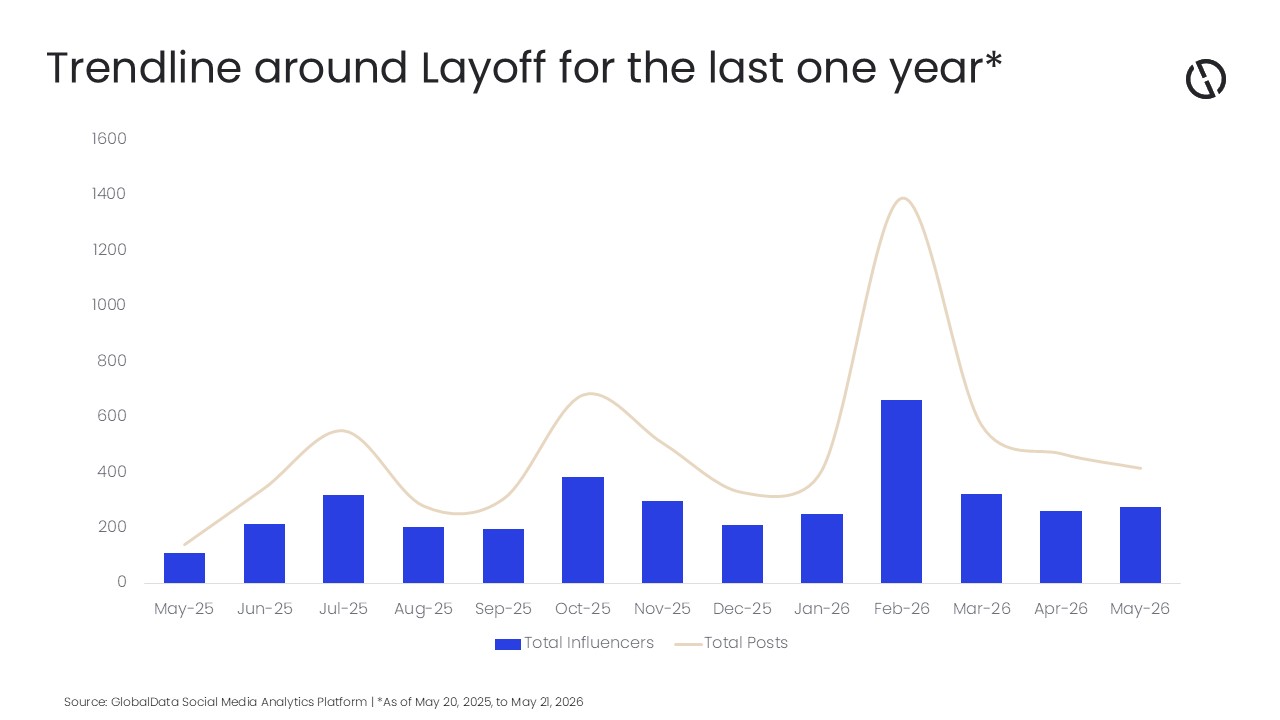
The conversation about layoffs on X over the last 90 days is not a normal cycle of cost-cutting. According to GlobalData, which analyzed influencer sentiment from 20 February to 21 May 2026, workforce budgets are being systematically diverted into massive digital infrastructure to stay ahead in the tech race. This is a structural shift in how organizations allocate capital, moving money that once supported personnel into the physical and software backbone of the intelligence age.
Shreyasee Majumder, Social Media Analyst at GlobalData, says influencer sentiment reveals a growing suspicion of corporate narratives, with many observers labeling the trend as AI washing. The broader market implication is that investors now reward smaller workforces as a symbol of innovation, pressuring even stable organizations to automate roles before the technology is fully ready.
The 90-Day Signal: Capital Rotates from Payroll to Infrastructure
Layoff Sentiment Spikes on X
GlobalData's social media database tracked a surge in layoff discussions among influencers. The dominant theme is that capital is flowing away from traditional human resources toward data center and computing infrastructure. Influencers argue that the standard corporate career is no longer a guaranteed path to stability. It has become a variable cost, subject to the rapid growth of automated systems.
The 'AI Washing' Label Gains Traction
Many observers on X accuse corporations of using AI as a cover for layoffs. The charge is that companies are cutting roles not because AI is ready to replace them. The market rewards the optics of automation. Majumder notes this creates a disruptive dynamic: “For the broader market, this represents a disruptive shift where investors now reward smaller workforces as a symbol of innovation, which pressures even stable organizations to automate roles before the technology is fully ready.”
Shreyasee Majumder, Social Media Analyst at GlobalData
Flatter Structures Replace Middle Management
Autonomous Agents Replace Manual Coordination
Influencers point to a permanent flattening of corporate hierarchies. Middle management is being removed. Manual coordination is being replaced with autonomous software agents. The old ladder of promotion and oversight is giving way to a structure where rapid decision-making requires fewer human layers.
The Vanishing Career Ladder
Dev Khanna, a technology expert quoted in the analysis, captures the shift succinctly: “The career ladder didn't break. It disappeared. AI isn't causing layoffs. It's causing non-hiring... Junior roles? Quietly disappearing. Training grounds? Shrinking. The pyramid is turning into a diamond, heavy middle, no base.” This transformation fundamentally changes what it means to build and run a company.
Dev Khanna, Technology Expert
The same flattening that boosts short-term efficiency creates a long-term talent pipeline problem. Khanna highlights the paradox: “No juniors -> No future seniors. The real shift? From execution -> orchestration.” The junior roles that normally serve as training grounds for future leaders are being archived. The next generation of corporate leadership may not exist.
The Doom Loop: Automation Threatens Aggregate Demand
Short-Term Efficiency vs. Long-Term Revenue Collapse
Influencers warn of a systemic AI layoff trap. Replacing personnel with software may boost margins at the individual firm level. The collective effect is a self-reinforcing doom loop. Widespread job losses reduce discretionary spending. That cuts corporate revenue. That drives further automation and more layoffs.
Chris Martenson, an economic researcher, frames the risk sharply: “The doom loop -- AI-driven layoffs leading to reduced spending, leading to reduced revenues, leading to further automation, leading to AI-driven layoffs -- is already underway. Our economy might be able to handle this if spread over 5-10 years, not under the accelerated timeline we're seeing.”
Chris Martenson, Economic Researcher
Martenson's Accelerated Timeline Warning
The concern is not that automation will eventually destroy demand. The speed of the transition is too fast for the economy to absorb. Influencers suggest that if the shift were stretched over a decade, retraining and new industries might compensate. Under the current pace, the consumer base that sustains corporate revenue is being hollowed out before new income streams can emerge.
The Orchestration Economy: Human Role Shifts to Coordination
Entry Points Vanish, Junior Roles Archived
As traditional entry-level positions disappear, the human role in the economy moves from execution to high-level orchestration of autonomous systems. The workforce is splitting into two tiers: a small set of managers who oversee AI agents and a larger pool of displaced workers whose skills are no longer needed.
Calls for Universal High Income as Safety Net
Prominent voices in the analysis argue that machine productivity is becoming the primary engine of wealth creation. They call for new social contracts, such as universal high income, to maintain stability. The implication for investors is that policy risk is rising. If automation proceeds faster than demand adaptation, government intervention to stabilize consumption becomes more likely. That could redirect tax burdens onto corporate profits.
Institutional Risk: The Knowledge Drought
Cutting Junior Roles Creates Future Talent Gap
Majumder identifies the primary risk facing companies: an impending institutional knowledge drought caused by cutting junior roles. This threatens future leadership pipelines in the orchestration economy. She concludes: “This strategic error creates a critical talent gap for the future, rather than just immediate staffing issues.”
Risk to watch: The accelerated automation timeline Martenson describes could compress the period between efficiency gains and revenue collapse. Companies that cut too aggressively may find themselves with no customers and no junior talent to rebuild.
What This Means for Investors
The structural shift from personnel to digital infrastructure is not neutral. It rewards companies that can automate effectively. The macro risk is demand destruction. Investors should watch consumer spending data and hiring trends as forward indicators. A sustained drop in discretionary spending while AI investment rises would signal the doom loop is accelerating. If consumer demand holds steady, the automation thesis remains intact.
The conversation on X is not always actionable on its own. The persistence of these themes across a 90-day window signals a conviction among influential voices that this capital rotation is permanent. The naive interpretation is that layoffs are a cyclical reaction to AI hype. The better market read is that money is moving one way – out of payroll and into infrastructure – and that the incentives for companies to keep doing it are only strengthening.
AlphaScala's stock market analysis suggests that investors should map this trend into portfolio construction by overweighting data center and AI infrastructure plays while underweighting sectors that depend on broad middle-class consumption. The risk is not that AI fails to deliver. It is that it delivers too fast for the demand side to keep up. For now, the capital rotation is real, the layoff trend is accelerating, and the long-term implications for corporate structure, consumer demand, and policy are just beginning to price in. Companies like NVIDIA (see NVIDIA profile) represent the infrastructure side of this trade, while consumer discretionary names face headwinds from the same trend.