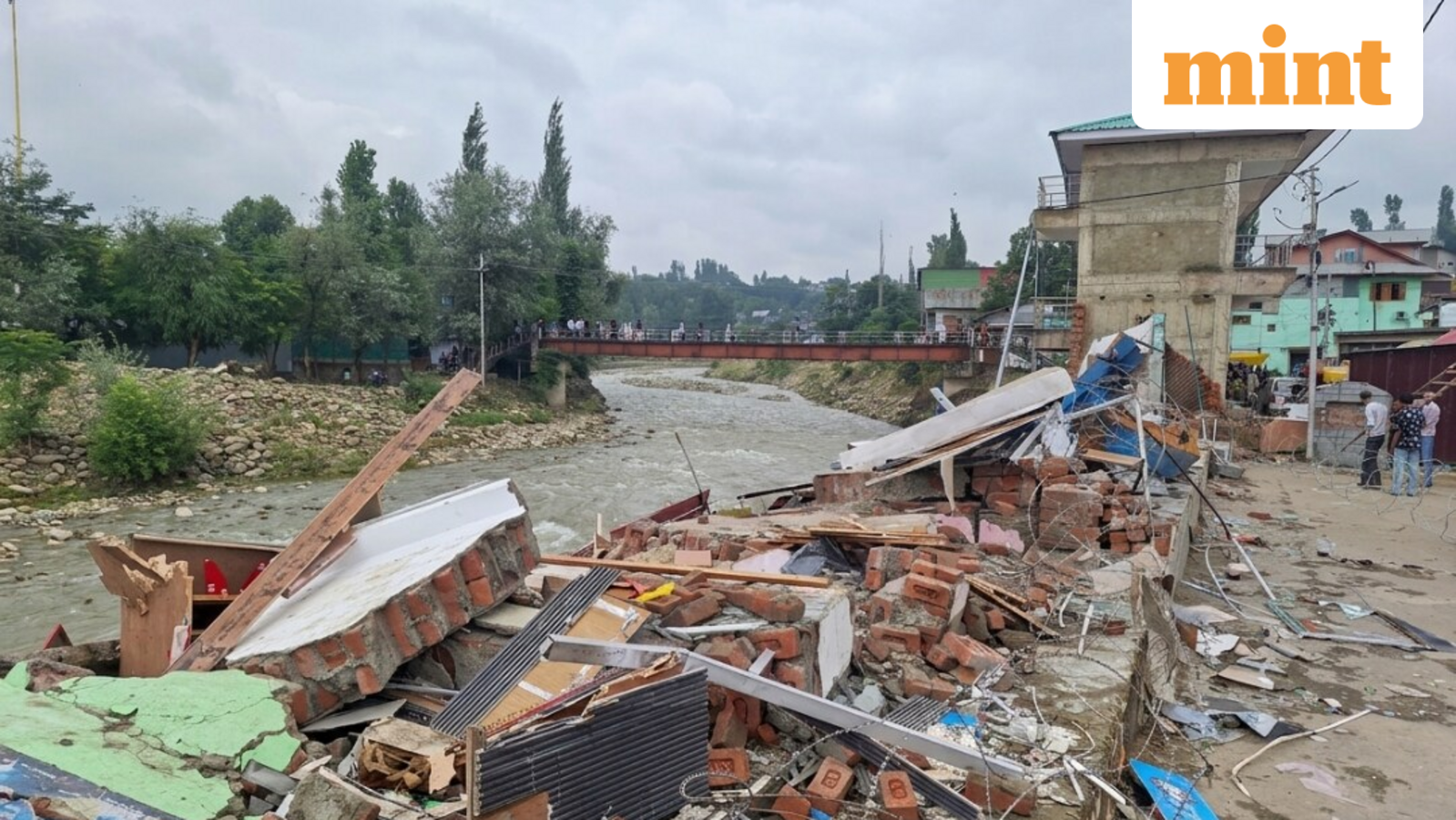
J&K recorded 25 cloudburst incidents in July killing 28 people. Warming Himalayas, lost wetlands and river encroachment are turning rare storms into recurring disasters.
The India Meteorological Department’s Srinagar centre recorded around 25 cloudburst or cloudburst-like incidents in July this year. At least 28 people died in the first three weeks of the month as repeated cloudbursts, flash floods and landslides battered the Union Territory.
Aadil Qayoom Wani, a 22-year-old shopkeeper in Beerwah, Budgam district, had returned to his hosiery shop on 21 July with fresh stock worth ₹1.5 lakh. Within minutes, the Sukhnag stream became a roaring torrent. The shopping complex his family built in 2011 collapsed into the water. He lost merchandise worth ₹8.5 lakh. “None of us imagined it could happen so quickly,” he said.
What is unfolding across Jammu and Kashmir is no longer a rare mountain calamity confined to remote valleys. Cloudbursts and intense short-duration rainfall events have become more frequent and more destructive. They now strike both rural catchments and urban centres during the tourist and pilgrimage season.
The region has swung between prolonged dryness and sudden deluge. Data compiled by Kashmir’s independent weather analyst Faizan Arif shows 2024 was J&K’s driest year in nearly five decades – 870.9 mm against a normal 1,232.3 mm, a 29% deficit and the fifth straight below-normal year. Arif told Mint that dry soil absorbs less water, degraded wetlands lose their capacity to store floodwater and drainage systems are more easily overwhelmed when intense rain arrives.
Scientists describe this pattern as climate whiplash. The western Himalayas have warmed roughly twice as fast as the rest of the subcontinent since 2000. “For every 1 degree C rise in temperature, the atmosphere can hold about 7% more moisture,” said Mukhtar Ahmad, director of the IMD’s Srinagar centre. That additional moisture provides more fuel for storms, allowing them to produce heavier rainfall over shorter periods.
Rising Arabian Sea surface temperatures strengthen moisture flow into northwestern India. The Tibetan Plateau has warmed rapidly, changing upper-atmospheric circulation. The Subtropical Westerly Jet now retreats later in the season. Together these shifts increase the overlap between Western Disturbances and the southwest monsoon, creating prolonged periods of moisture convergence that favour high-intensity rainfall over small areas, say experts.
Ground-level changes have stripped away natural buffers. A University of Kashmir study found nearly 20 wetlands around Srinagar have vanished over five decades. The wetland area in the Jhelum basin shrank from 288.96 sq km in 1972 to 266.45 sq km by 2018. The Comptroller and Auditor General has documented the loss of hundreds of lakes since 1967, erasing nearly 2,900 hectares of flood storage. Global Forest Watch data show the region lost roughly 4,090 hectares of tree cover between 2001 and 2022.
Shakil Ahmad Romshoo, a leading Kashmir earth scientist, told Mint that deforestation and construction do not cause cloudbursts. They increase the severity of flash floods, landslides and debris flows that follow. Degraded catchments convert a much larger proportion of intense rainfall into rapid surface flow. Urbanized areas can generate 20-60% more runoff than natural landscapes during the same rainfall event.
Where people place structures matters as much as how much it rains. “When the water level in the rivers declined during dry years, people started encroaching on their banks and constructing houses,” said Showkat Ali, a government teacher in Poonch. This July, a single cloudburst sent mud, rocks and floodwater through a residential house beside a stream in the Loran area of Poonch, killing eight members of one family.
The economic toll stretches beyond immediate loss of life and property. Tourism is usually the first sector hit. July’s floods in Pahalgam damaged around 20 hotels and washed away a 100-metre stretch of road at the height of the season and the Amarnath Yatra. Agriculture supports nearly 70% of the population. Intense rainfall washes away topsoil, damages orchards and destroys irrigation channels. Last year’s monsoon floods alone caused agricultural losses estimated at ₹209 crore, according to government data.
Hydropower infrastructure is equally vulnerable. An early July downpour sent mud, boulders and debris into the under-construction 540 MW Kwar project site in Kishtwar. The 2014 floods killed more than 100 people and caused losses estimated at ₹1 trillion.
“We need a sustainable tourism policy on priority,” said Kashmir-based climate activist Raja Muzaffar Bhat. “There should be limits on the number of tourists and pilgrims visiting high-altitude areas, and governments must avoid further infrastructure development in fragile mountain regions.” Chief Minister Omar Abdullah has called for climate-resilient infrastructure, better flood management and scientific planning.
Mint contacted Javed Ahmad Rana, J&K minister for Jal Shakti, Forest, Ecology and Environment, seeking his response. Repeated calls to the minister remained unanswered.
Drafted by a large language model from the source reporting linked above, then screened by automated publishing checks. It is not read by a journalist before publication. Some articles cite our Alpha Score. Verify prices and figures against the original source. Educational coverage, not personalized advice.