Stocks● Neutral
Why Janus Electric’s Swappable Battery Model Could Reshape Heavy Freight Electrification
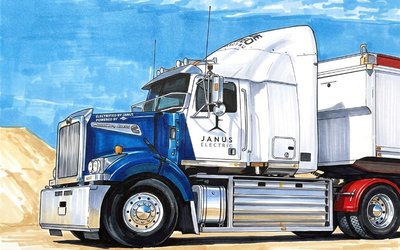
Janus Electric (ASX:JNS) has completed 25 truck conversions and A$1.7m FY25 revenue, shifting toward recurring income from battery hire and energy at early stage.
Continue with
Janus Electric (ASX: JNS) wants to turn diesel trucks into electric ones using swappable batteries and charging hubs, then keep collecting revenue from battery hire, energy use and service contracts. The company's model is a full-stack system: a conversion module that retrofits existing diesel chassis, side-mounted batteries that swap in minutes, Charge and Change Stations, and a software platform that ties it all together. Management's objective is broader than selling one-off conversion kits. The aim is to build an operating system for heavy road transport electrification, with recurring revenue flowing from each active truck.
The strategic logic is straightforward. Fleets that balk at replacing entire truck fleets can convert their existing chassis through the Janus Conversion Module. They then use Janus Side Batteries and Janus Charge and Change Stations as part of the same ecosystem. The integrated stack creates a lock-in effect: fleets adopting one part of the system have reasons to stay inside the broader ecosystem for batteries, charging, monitoring and asset management.
Heavy freight is one of transport decarbonisation's harder categories. Fleets need high utilisation, minimal downtime and practical depot or corridor infrastructure. Janus is built around those constraints through conversion, swap-ready batteries and charging infrastructure. The model aims to lower adoption friction for operators that prefer to retrofit existing trucks rather than replace them outright, especially where operational downtime and capital budgets are major barriers. The company already describes an Australian charging-station network across New South Wales, Victoria, South Australia, Western Australia and Queensland.
The cautious bull case is that Janus becomes more valuable as installed-base density rises. Each truck conversion can pull through battery hire, energy consumption, service, maintenance and software-linked usage revenue. The central debate is not whether the concept is interesting. It is whether Janus can move from a low-volume conversion business to a repeatable operating platform with enough utilisation, reliability and capital support to scale.
Revenue mix is beginning to show the shape of the platform thesis. FY25 total revenue was A$1.70m, with A$1.04m coming from product sales and A$660k from ongoing and service revenue. The December half-year added more detail: total revenue was A$1.24m, including A$586k conversion revenue, A$287k battery hire and A$151k energy consumption revenue. The March-quarter update reported A$896k of operational income, including A$472k of truck conversion and charge-station sales and A$424k of recurring and subscription revenue. Recurring revenue is becoming more visible even at small scale.
The company had completed 25 truck conversions as of the prospectus date. That base had reached 25 converted trucks in operation, 3,360 swaps, 591,073 commercial kilometres and 1.13m kWh of energy used. The disclosed Australian nodes had collectively recorded 1,103 battery swaps and 408,244 kWh of charged energy. Moorebank recorded 553 swaps and 221,244 kWh charged year to date. Port Melbourne recorded 450 swaps and 150,000 kWh charged to date. Port Adelaide recorded 100 swaps and 37,000 kWh charged to date. Moorebank's charging setup was also expanded with an existing 180kW JCCS and a new 360kW quad-bay charger, adding stated capacity of 6.2 MWh per day to the existing 3.1 MWh per day. Janus is building infrastructure ahead of fuller utilisation.