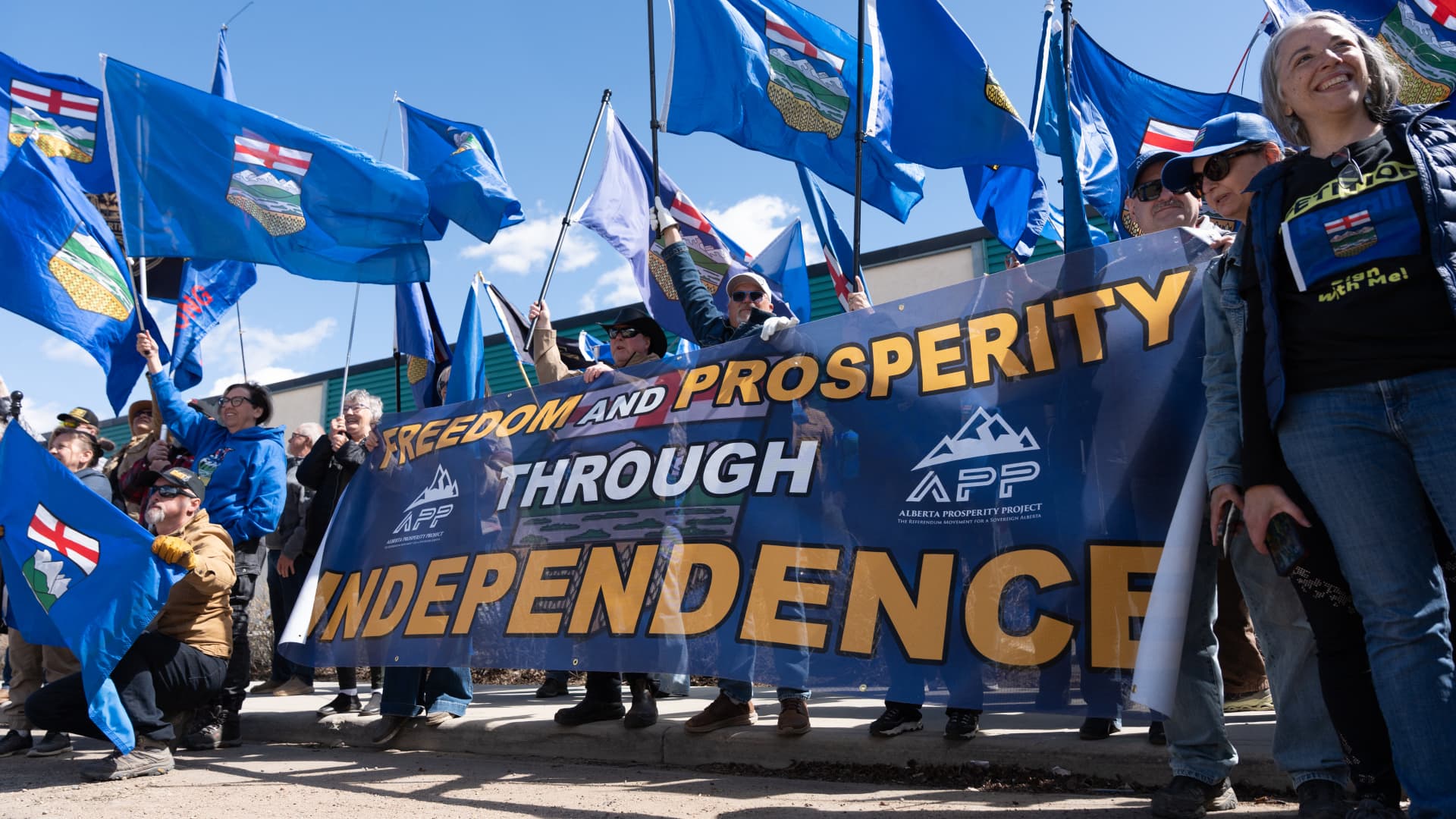
Alberta Premier Danielle Smith announced a non-binding vote on October 19 on whether the province should begin the legal process for separation from Canada. For crude oil traders, the headline raises a question: does this political uncertainty justify a risk premium on Canadian supply?
The naive read is straightforward. Alberta holds the fourth-largest oil reserves in the world at 158.9 billion barrels, mostly in oil sands. Any political uncertainty around that jurisdiction should be bullish for crude benchmarks like West Texas Intermediate and Brent. The better market read requires a closer look at the mechanics.
The vote is non-binding. Even if Albertans vote to begin the legal process, the outcome is a mandate for the provincial government to negotiate under the Canadian Constitution, not a declaration of independence. A second binding referendum would follow only if the legal process clears multiple hurdles – a timeline measured in years, not months. The probability of actual separation is low. Opinion polls show limited public support. A competing petition to remain in Canada has gathered more signatures (404,000) than the separatist petition (301,000).
The Supply Risk Premium: Small, Short-Lived, Already Priced
The real trading question is whether Alberta-specific risk will price into crude oil futures. The short answer is a qualified yes. The premium is likely small and short-lived, and it may already be discounted.
How the market should price this
The dominant drivers of crude oil prices are global demand, OPEC+ production decisions, and US inventory levels. Canadian supply is a relatively small part of global liquids production. Alberta oil sands output is largely committed to long-term contracts and pipelines (Enbridge Mainline, Trans Mountain Pipeline). Physical supply disruption is not imminent. The risk is legislative – potential regulatory delays for new projects, or a long-term renegotiation of fiscal terms with Ottawa. These are slow-moving, not sudden shocks.
The referendum does introduce a new layer of regulatory and political risk for investors exposed to Canadian heavy crude. This can translate into a modest widening of the discount for Western Canadian Select (WCS) relative to WTI. Many traders already price this type of event as a $0.50 to $1.00 premium. A sustained widening beyond $1.50 would be out of proportion.
Petition Signatures Comparison
| Position | Signatures Collected |
|---|
| Separate from Canada (Stay Free Alberta) | 301,000 |
| Remain in Canada (counter-petition) | 404,000 |
A petition supporting the union has more signatures than the separatist one, reinforcing the low probability of secession.
Confirmation and Invalidation Triggers
For traders considering positioning around this event, the confirmation signal is not the headline. It is the follow-through in actual price data.
Confirmation signals
- A sustained widening of the WCS/WTI spread beyond $1.50, with increasing volume in Canadian crude contracts.
- A drop in Alberta drilling permits or a rise in regulatory compliance costs flagged by producers like Suncor Energy or Canadian Natural Resources.
- A material shift in opinion polls showing a majority in favour of beginning the legal process. Current polling suggests the opposite.
Invalidation signals
- The vote produces a strong majority for remaining in Canada, closing the political question.
- The federal government quickly dismisses the referendum as non-binding, reasserting its jurisdiction over secession. This is the most likely outcome.
- Global supply-demand dynamics dominate, as they always do. A Saudi production increase or a Chinese demand miss would overwhelm any Alberta-specific premium.
Risk Check and Next Catalyst
The biggest risk for traders here is mistaking political noise for a fundamental supply event. Alberta’s oil sands are a massive resource, the political pathway to separation is extremely narrow. The referendum is a pressure-release valve for a vocal minority, not a credible threat to Canadian sovereignty or energy exports.
Traders should watch the weekly Alberta oil sands production data and the WCS differential. If the spread remains flat through the campaign, the market is telling you the risk is zero. If it does widen, the move will likely be small and fade after the vote – unless the result surprises to the upside for separatists. A clear majority against separation on October 19 would remove the headline risk entirely.
For a broader view of crude oil technicals and the long-term outlook from BMI for Brent at $90 in 2026, see the Weekly Oil Loss Masks BMI $90 Brent 2026 Forecast. For a general profile on crude oil as an asset class, visit the crude oil profile.
The Alberta referendum is a catalyst worth noting, not a reason to reposition a crude oil book. Watch the spread, ignore the headlines, and wait for confirmation before acting.