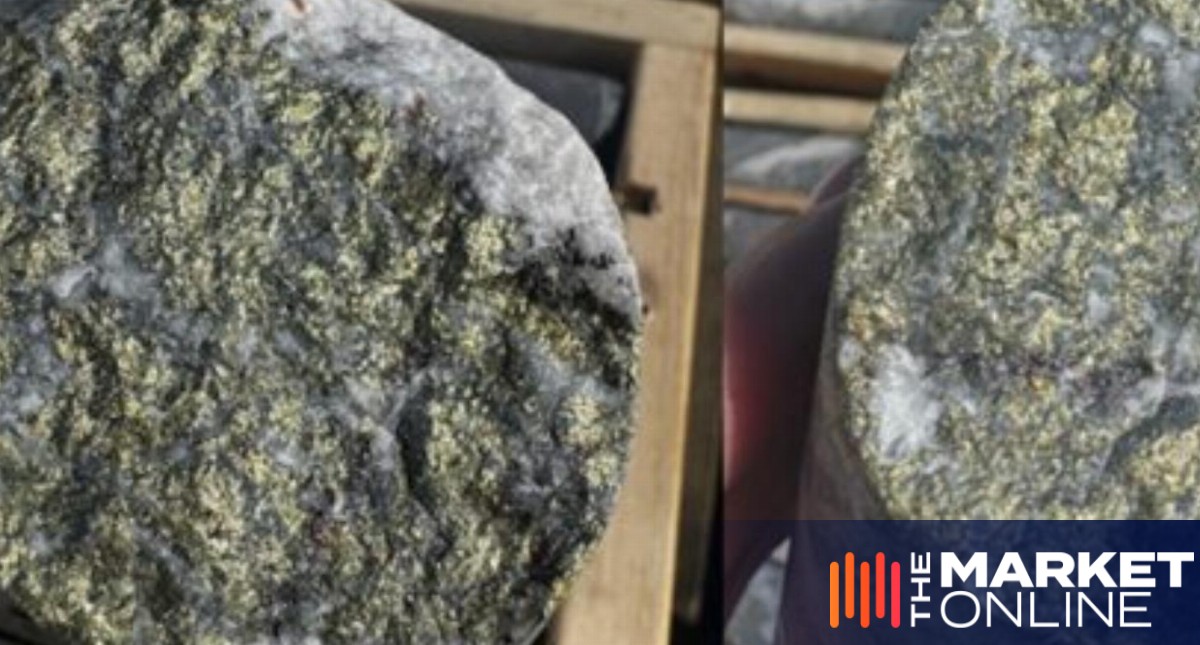
White Cliff Minerals (ASX:WCN) is bringing in a second diamond drill rig after confirming a new high-grade copper discovery outside the main Teshierpi Fault Zone at the Rae project in Nunavut, Canada. Assays from hole DAN26015 returned 79.24 metres at 1.59% copper from 67.06 metres, including 24.38 metres at 3.05% copper from 120.4 metres. The interval sits outside the previously mapped ore shoot.
Managing Director Troy Whittaker told shareholders the result proves mineralisation is not confined to a single structure. “We are now seeing copper zones expanding materially around Danvers 1, with new drilling extending the system 462 metres to the southwest, 686 metres to the northeast, and identifying a parallel mineralised zone 606 metres to the north at DAN26022,” he said. The 2026 assay program has confirmed a copper mineralised footprint of roughly 3.1 kilometres along strike. Visual observations push that number to six kilometres of copper sulphides exposed at surface.
Whittaker noted these results still come from wide-spaced drilling into largely untested ground. “With high-grade copper now being discovered around an existing high-grade deposit, and with a second diamond drill rig on site to follow up the ultra-high-grade DAN26012 discovery, we believe Danvers is rapidly emerging as a much larger and more significant copper system than previously understood.”
The second rig will focus on step-out holes from DAN26012, which earlier returned ultra-high-grade intercepts still waiting full assay release. The initial diamond program aims to collect oriented core to determine vein orientations, which will inform future step-out and infill drilling. Scissor holes across key 2026 RC drillholes will help define orientation of the newly discovered mineralisation.
Investors should weigh the scale of opportunity against the stage of development. Rae sits in the remote Kitikmeot region of Nunavut, a jurisdiction with limited infrastructure and a short operating season. Advancing from wide-spaced discovery holes to a resource estimate requires significant capital: three to five drill programs over 18 to 24 months, plus metallurgical test work and baseline environmental studies. The current market cap of $56.9 million reflects optimism about the Danvers system. The stock has already gained 7% on the news. The next batch of assays from the second rig will be the real test.
White Cliff has a tight register and no hedge-book pressure. Exploration success brings trade-offs. Any resource definition program will require equity issuance. The company raised capital in 2025 for earlier work. The burn rate on two diamond rigs in Nunavut runs north of $2 million a quarter. Investors looking at the discovery should track the pace of drill permit extensions and the timing of a maiden resource estimate. Whittaker has not yet committed to a timeline for that.
The structural story is clear: the Teshierpi copper system is larger than the company originally mapped. The question is whether the grade and geometry support a standalone mine in one of the world's most expensive jurisdictions. The second rig will help answer that.
White Cliff Minerals shares closed at 2.3 cents, giving the company a market cap of $56.9 million. See the WCN stock page for the latest price data. For broader context on copper market dynamics, read our commodities analysis.