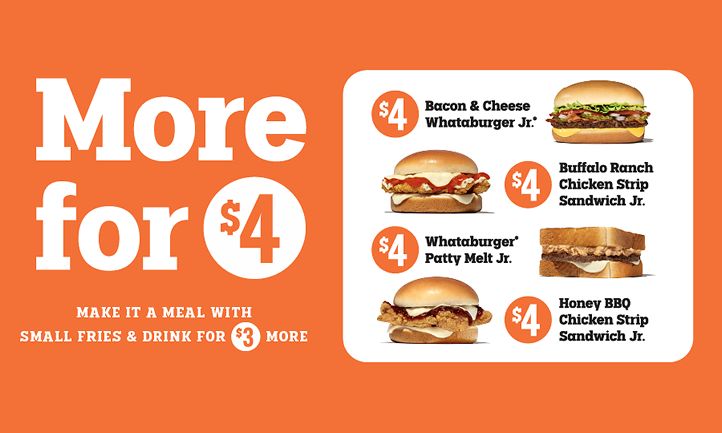
Whataburger is rolling out a new value menu starting Aug. 18, offering four items at $4 each. The chain calls the push "More for $4," pitching burgers, grilled sandwiches, and chicken items at a price point that undercuts much of the fast-food competition.
The move comes as McDonald's, Burger King, and Wendy's have all leaned harder into value meals and discount bundles this year. Traffic data from industry consultants shows low-income diners pulling back on fast-food visits since late 2023, a trend that has pushed chains to compete more aggressively on price.
Whataburger's Chief Operating Officer Jessica Reicher framed the launch as a response to customer demand for affordable versions of its core menu. "More for $4 gives them exactly that: more choice, more big flavor, and the made-to-order quality they expect from us," she said in a statement.
Alongside the value platform, the chain is also streamlining its Jr. Whatameal lineup. Starting Aug. 18, those meal bundles will include a small fries and small drink by default, a change Reicher said will create "a more consistent experience across the menu."
The $4 price point is notable because it sits below the $5 range that McDonald's and Burger King both use for their core value bundles. Wendy's still offers a $3 breakfast bundle but prices its lunch combos higher. For Whataburger, a regional player with about 1,200 locations concentrated in the South and Southwest, the pricing could help draw customers who have been trading down from casual dining or skipping lunch out entirely.
Whataburger has been expanding beyond its Texas base. The chain now operates in 17 states and has pushed into grocery aisles with bottled sauces and retail products. The company was acquired by a Chicago-based investment firm in 2019 for about $4 billion, and the new owners have accelerated new-store openings.
Analysts at consulting firm Revenue Management Solutions said in a June note that fast-food traffic fell 2.1% year over year in the second quarter, with the steepest declines among households earning under $50,000 a year. Chains that offer sub-$5 items have generally held up better, the firm found.
The $4 menu launch does not include a drink or fries by default. Customers can add a small fries and a small drink for $3 more, which brings the total to $7 for a full meal. That is still cheaper than Whataburger's standard combo prices, which typically run $8 to $10 depending on the entree.
The chain is also leaning on its app to drive repeat visits. App users get a free Whataburger on account creation and earn points toward future purchases. Digital orders now account for roughly 20% of sales at most fast-food chains, and operators see loyalty programs as a way to protect market share during a price war.
"Whataburger is positioning itself as a quality alternative at a price point that forces competitors to respond," said David Henkes, a senior principal at food-service research firm Technomic. "The question is whether they can sustain the pricing without squeezing franchisee margins."
Whatabburger operates largely through company-owned stores, not franchisees, which gives it more control over pricing decisions. The chain employs roughly 50,000 people.
Reicher said the $4 items will be available "at participating Whataburger locations nationwide, with prices and participation varying by location." The national rollout suggests the chain expects the promotion to last beyond a typical limited-time window.