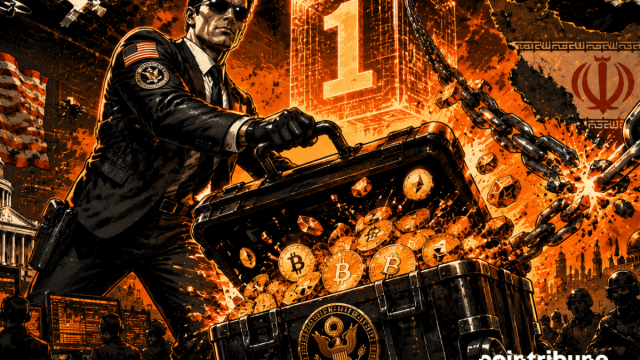
The U.S. Treasury has confirmed the seizure of roughly $1 billion in cryptocurrency wallets linked to Iranian entities. Treasury Secretary Scott Bessent announced the operation at the Reagan National Economic Forum 2026 in Simi Valley, California, telling Fox Business’s Larry Kudlow: “We simply took possession of their wallets. Some may be writing right now, without realizing that their wallet has been hacked.”
The event lands as the two countries reportedly edge closer to a peace agreement that could ease tensions around the Strait of Hormuz, a chokepoint for nearly 20% of global oil flows. Bessent did not specify the exact dates of the seizures, the cryptocurrencies involved, or whether the wallets were tied to the Hormuz Safe System, a bitcoin-based maritime insurance platform that Iranian state media Fars presented this month as a tool to bypass Western sanctions.
For traders and compliance teams, the seizure rewrites the risk calculus around crypto assets linked to sanctioned jurisdictions. The Treasury’s message is direct: the blockchain does not offer Iran the anonymity its strategists assumed.
Scott Bessent’s Wallet Seizure Confirmation
The Treasury Secretary’s Reagan Forum appearance provided the first on-the-record confirmation of a large-scale crypto forfeiture by the U.S. government. Bessent’s language emphasized the element of surprise: holders of the wallets may not yet know their balances are gone.
We simply took possession of their wallets. Some may be writing right now, without realizing that their wallet has been hacked.
Key details remain undisclosed:
- The specific blockchain networks and token types (Bitcoin, Ethereum, stablecoins) involved in the seizure.
- Whether the wallets were custodial (exchange-controlled) or self-custody (private keys held by the entity).
- The legal mechanism – whether the U.S. obtained a court order or used administrative seizure authority under sanctions laws.
The lack of dates matters. If the seizures occurred weeks or months ago, the Treasury may have already deployed the funds. If they happened recently, the asset recovery could signal an escalation in surveillance capability.
The Strait of Hormuz Context
The seizure cannot be separated from the military-diplomatic backdrop. Iran has repeatedly used its geographic leverage over the Strait of Hormuz, where about 20% of global oil transits. In April, the Financial Times reported that Tehran was considering imposing transit fees in bitcoin on tankers crossing the strait, arguing that such payments “cannot be traced or confiscated due to sanctions.”
The $1 billion seizure contradicts that claim. The blockchain may not offer the anonymity Iran’s strategists assumed.
Exposed Assets: Which Tokens and Wallets Are at Risk?
The Treasury did not name the affected cryptocurrencies. The Cointribune report and wider public documentation point to two primary assets:
- Bitcoin (BTC): The Hormuz Safe System is built on bitcoin. Iran has publicly explored using BTC for sanctions evasion for years.
- USDT (Tether): Last year, the Israeli National Bureau for Combating Terrorism Financing stated that the Islamic Revolutionary Guard Corps received $1.5 billion in USDT via transfers identified by authorities. Scammers impersonating Iranian authorities have also targeted shipping companies, demanding fraudulent payments in bitcoin and USDT, per Reuters.
The wallets at highest risk are those with direct links to Iranian exchange accounts, Iranian government entities, or the Revolutionary Guard. The seizure method (wallet access rather than exchange freeze) suggests the U.S. may have identified self-custody addresses and used technical or legal means to drain them.
Third-Party Exposure
Any crypto broker, exchange, or OTC desk that has processed transactions for Iranian counterparties now faces elevated compliance risk. The U.S. Treasury could trace funds beyond the initial wallets using chain analytics. Traders who hold assets that passed through Iranian-linked addresses – even unknowingly – may see those funds frozen on compliant platforms.
Why the Seizure Is a Custody Risk, Not a Tech Failure
The simplest read is that blockchain’s pseudonymity failed. Iran tried to use crypto to evade sanctions, and the U.S. seized $1 billion. That conclusion is incomplete. The real mechanism is custody risk, not a flaw in the technology itself. The U.S. did not break Bitcoin’s cryptography. It obtained access to wallets – likely through exchange compliance cooperation, court orders, or compromised key management. The same chain that recorded the transactions also recorded the addresses. Once a wallet is linked to a sanctioned entity, the U.S. can apply pressure on the custodian (or the key holder) to surrender access.
Key insight: The $1 billion seizure does not prove that crypto is inherently traceable. It proves that large-scale state use of crypto requires on-ramps and off-ramps that are vulnerable to legal and technical pressure.
What This Means for Asset Pricing
- Bitcoin and Ethereum: The headline seizure is unlikely to move BTC or ETH prices directly. Markets have already priced in U.S. capabilities via the CFTC’s approval of crypto perpetual futures and previous large-scale forfeitures.
- USDT: Tether faces heightened scrutiny. If U.S. authorities seized USDT wallets by coordinating with Tether, it raises the question of whether USDT is a sanctions-compliant stablecoin by design – or whether the Treasury simply controlled the smart contract. Tether has not commented.
- Privacy coins (Monero, Zcash): Demand may increase among users seeking actual anonymity, liquidity is thin, and most exchanges delist them.
Scenarios That Reduce Risk and Scenarios That Worsen It
Peace Agreement and Risk Reduction
A peace agreement between the U.S. and Iran that formally lifts crypto-related sanctions would make further seizures unlikely. Axios reported negotiations are close to a deal subject to President Trump’s approval. If Iran abandons the Hormuz Safe System and stops using crypto for sanctions evasion, the threat to wallet holders diminishes.
Expanded Surveillance and Risk Escalation
The Treasury publishes wallet addresses or transaction hashes tied to the seizure, enabling exchanges to blacklist them. That would freeze any funds still flowing into those addresses. The U.S. could expand surveillance to layer-2 networks and cross-chain bridges, which Iran could try to use next. If executed, the compliance burden spreads to DeFi protocols. Retaliatory seizures by Iran are possible, though speculative. Tehran could attempt to block or seize assets of U.S.-linked entities in the region.
The Timeline Question
Traders should monitor Treasury sanctions announcements and OFAC list updates in the coming weeks. If the seized funds are officially forfeited, the U.S. government could auction them, adding selling pressure. The U.S. Seized $1B of Iran's Crypto history – covered in a previous AlphaScala analysis – shows that past seizures took months to process.
The $1 billion seizure validates a core thesis: crypto is not a sanctions loophole for state actors. For individual traders, the risk is not that the government will hack your wallet. The risk is that you unknowingly hold assets that passed through a sanctioned address, and your broker or exchange freezes your account. The practical takeaway: run your own wallet screening before transacting with any counterparty linked to Iran, and avoid any token that touches Hormuz Safe System addresses.
The U.S. Seized $1B of Iran's Crypto: Custody Risk, Not Tech event is a demonstration of enforcement capability, not a systemic crypto flaw. For anyone dealing in large volumes near sanctioned jurisdictions, the margin for error just narrowed.