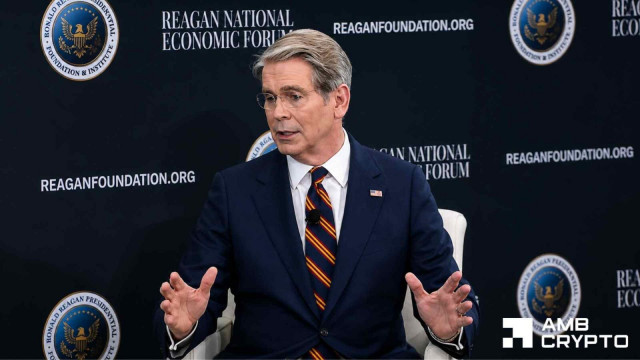
U.S. Treasury Secretary Scott Bessent disclosed at the Reagan National Economic Forum that the government had seized approximately $1 billion in cryptocurrency from Iranian wallets. The operation targeted wallets linked to the Bank of Iran and military proxies in Lebanon, according to blockchain analytics firm TRM Labs.
"We've seized about $1B of their (Iranian) crypto. Just outright grabbed the wallets. Some of them may be typing right now and may never realize that their wallets have been grabbed," Bessent said.
The seizure follows a smaller operation in April where the Treasury, working with Tether (the issuer of USDT), froze $344 million in Iranian crypto assets. Bessent vowed to "target all financial lifelines" of the Iranian government as part of U.S. diplomatic pressure over the West Asia crisis. That pressure may explain why Iran briefly explored accepting Bitcoin (BTC) for tolls at the Strait of Hormuz: frozen stablecoin liquidity had cut off a key payment channel.
The Simple Read: Bitcoin Is Not Confiscation-Proof
The seizure challenges the argument that BTC and other cryptocurrencies serve as a hedge against government seizure. Iran's government accounts for nearly half of the country's $8 billion crypto volume, with heavy exposure to BTC. The Treasury's ability to identify and freeze these wallets suggests that state-level actors can still reach crypto assets.
Analyst Eric Yeung responded directly: "Bessent is proving to the world that cryptocurrencies and Bitcoin provide no confiscation-proof security. True safety comes only from physical #Gold and #Silver that you hold in your own possession."
The Better Market Read: Mechanism and Execution Risk
The seizure reveals a more nuanced picture. The Treasury did not hack private keys or break Bitcoin's cryptography. It targeted wallets held at centralized exchanges or custodians where KYC/AML compliance gives law enforcement a point of entry. The collaboration with Tether to freeze USDT on the Ethereum network shows that stablecoins, which rely on centralized issuers, are the most vulnerable to state action.
For BTC held in self-custody with no on-chain links to sanctioned entities, the risk profile is different. The Treasury's action does not demonstrate a technical ability to seize coins from non-custodial wallets. It demonstrates the ability to identify and freeze assets at the points where crypto touches the traditional financial system.
Exposure: Who Is Affected and How
Iranian Government and Military Proxies
The frozen wallets were linked to the Bank of Iran and Lebanese military proxies, per TRM Labs. The seizure likely targeted what the U.S. designates as terrorist financing networks. This may explain why Iran briefly explored BTC tolls for the Strait of Hormuz: frozen USDT reduced their stablecoin liquidity, forcing a search for alternatives.
Broader Crypto Market Confidence
The seizure adds to a growing list of U.S. government crypto confiscations. In 2025, the Treasury seized $13 billion worth of BTC (127,000 coins) linked to a Cambodian conglomerate accused of fraud. Each operation reinforces the message that crypto assets are not beyond the reach of U.S. sanctions enforcement.
Self-Custody vs. Exchange-Held Assets
The practical distinction matters for traders. Assets held on exchanges or in custodial wallets remain subject to the same legal frameworks as bank accounts. Assets held in self-custody with privacy coins like Zcash (ZEC) or through non-custodial wallets present a higher bar for seizure, though they are not immune to chain analysis.
Timeline and Next Catalysts
| Date | Event |
|---|
| April 2025 | Treasury seizes $344M in Iranian crypto with Tether's help |
| Reagan Forum (2025) | Bessent discloses $1B total seizure figure |
| Ongoing | Treasury continues targeting Iranian financial lifelines |
Key dates to watch:
- Any new sanctions designations targeting crypto exchanges or wallets
- Tether's compliance disclosures regarding future freeze requests
- Iran's response, including potential shifts away from USDT toward privacy coins or gold
Affected Assets and Market Dynamics
Bitcoin (BTC)
The seizure reinforces that BTC held on exchanges or with known wallet clusters is traceable. The U.S. government's ability to identify and freeze Iranian-linked BTC does not extend to all BTC, it applies to any address that can be linked to sanctioned entities through chain analysis.
Tether (USDT)
USDT's centralized issuance model makes it the most vulnerable to government freeze requests. The April seizure demonstrated that Tether will cooperate with U.S. authorities. This creates execution risk for any trader or entity using USDT in jurisdictions that may face U.S. sanctions.
Privacy Coins (ZEC, XMR)
The seizure has renewed interest in privacy-focused cryptocurrencies. Some market participants argue that only private coins combined with self-custody provide meaningful seizure resistance. Privacy coins face their own regulatory headwinds and limited liquidity on major exchanges.
What Would Reduce the Risk
- Clearer legal frameworks defining when crypto assets can be frozen or seized
- Technical developments that make chain analysis harder for state actors
- Increased adoption of decentralized exchanges and privacy tools
- Diplomatic resolution reducing the incentive for sanctions enforcement
What Would Make It Worse
- Expansion of the Treasury's targeting to non-Iranian wallets with indirect links
- Additional exchange compliance requirements that mirror traditional banking
- Legislative action expanding the Treasury's authority over self-custodied assets
- A precedent-setting court case that validates the seizure methodology
Practical rule: The seizure risk for any crypto asset is a function of its custody model and its traceability. Self-custodied privacy coins face the lowest seizure risk from state actors. Exchange-held USDT faces the highest.
The Treasury's $1 billion seizure does not break Bitcoin's cryptography. It breaks the assumption that crypto assets exist outside the legal frameworks that govern the financial system. For traders building watchlists, the distinction between technical security and legal exposure is the one that matters.
BlackRock and other major asset managers have pitched BTC as a "unique diversifier" and geopolitical hedge. The Iran seizure does not invalidate that thesis for all holders. It does invalidate it for any holder whose wallet can be linked to a sanctioned entity through the centralized points in the crypto ecosystem.
Related reading: U.S. Seizes $1B in Crypto Assets Tied to Iran Sanctions and Bitcoin (BTC) profile.