The United States struck targets in Iran's Gilan Province on July 23-24, damaging the port of Bandar Anzali, Iran's largest Caspian Sea port and a rail link to the national grid. Ukraine followed on July 25 with an attack on an Iranian commercial vessel in the Caspian. The strikes mark the first direct US military action on the Caspian coast, widening the theater of conflict beyond the Middle East and into a region that holds key energy transit routes.
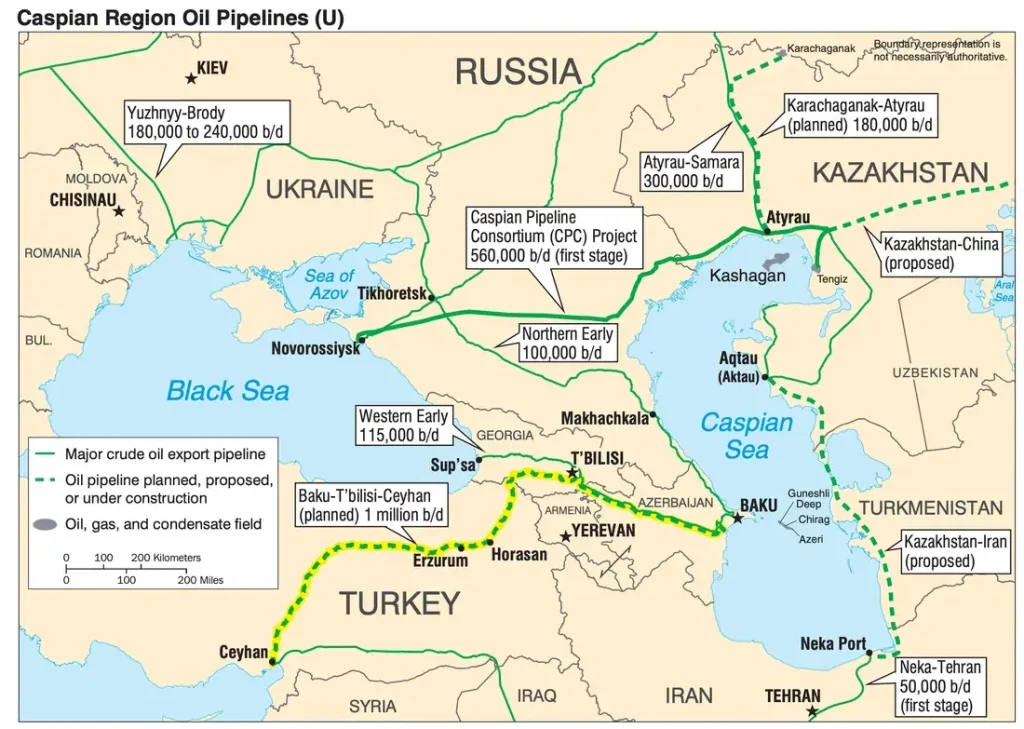
The immediate market concern centers on Kazakhstan's oil exports. Roughly 80% of Kazakhstan's crude reaches global markets through the Caspian Pipeline Consortium (CPC), which runs from Kazakhstan's Caspian fields to Russia's Black Sea port of Novorossiysk. CPC operations have already been disrupted multiple times during the war in Ukraine by Ukrainian drone strikes on pumping stations and the loading terminal. Kazakhstan recently denied a complete shutdown, but the cumulative damage is slowing flows to a trickle. The US strikes on Iran's Caspian coast raise the risk of further disruption to shipping in the Caspian itself, where tankers move Kazakh and Turkmen oil to Baku for onward transit.
Western powers have long sought alternative routes that bypass Russia and Iran. The Trans-Caspian pipeline, connecting Kazakhstan or Turkmenistan to Azerbaijan and then to Europe via the Baku-Tbilisi-Ceyhan (BTC) pipeline, has been discussed for decades but never built due to opposition from Russia and Iran and unresolved legal status of the Caspian seabed. The diplomatic groundwork is accelerating. Montana Republican Senator Steve Daines toured Azerbaijan, Kazakhstan and Turkmenistan in July to underscore Washington's support for closer collaboration. US President Donald Trump has backed a side-shoot of the Middle Corridor, the Trump Route for International Prosperity and Peace (formerly the Zangezur Corridor), a 40-kilometer stretch through Armenia connecting Azerbaijan to its Nakhchivan exclave and Türkiye. Turkmenistan's president Serdar Berdimuhammedov made a landmark trip to Baku in June, reviving speculation about a subsea gas pipeline.
Iran's position is pivotal. The 2018 Convention on the Legal Status of the Caspian Sea, signed by all five littoral states, has never been ratified by Iran's parliament. President Masoud Pezeshkian recently reintroduced the bill despite internal opposition. Critics argue the convention could allow Kazakhstan and Turkmenistan to build pipelines on the Caspian seabed without Iran's consent. Russian Foreign Minister Sergey Lavrov said earlier this year that ratification would "fix the principle of non-interference into the affairs of this region by non-Caspian states." But Article 14 of the convention requires pipeline projects to comply with environmental standards under the 2003 Framework Convention, which Russia and Iran have used to block construction. A tanker fleet, as proposed by Nurul Rakhimbekov of the Center for Global Civic and Political Strategies, could circumvent the pipeline issue but faces challenges from the shrinking Caspian Sea, which has already receded 50 kilometers off Kazakhstan's coast.
The risk of military escalation is rising. Israel already has a significant intelligence presence in Azerbaijan. Kazakhstan joined the Abraham Accords at the end of 2024. Turkmenistan and Israel are warming ties. Iran views the Zangezur corridor as a NATO "Turan corridor" aimed at fomenting ethnic unrest in Iran's Turkish-speaking regions and bringing NATO to its northern border, according to the Strategic Council of Foreign Relations in Tehran. Moscow, while publicly supporting the convention, has been burned by similar agreements – the 2020 peace deal it brokered between Armenia and Azerbaijan was effectively rewritten by Washington and now bears Trump's name.
For markets, the key variables are the integrity of the CPC pipeline and the safety of Caspian shipping lanes. Any further strikes on port infrastructure or tankers could push oil prices higher by tightening supply from Kazakhstan. Iran's parliament is expected to debate the Caspian convention later this month; ratification would remove one legal obstacle to alternative pipelines but would not guarantee construction, given environmental objections. The broader trajectory points toward a contest for control of the Caspian energy corridor that will be settled, as in Ukraine and the Middle East, by force.