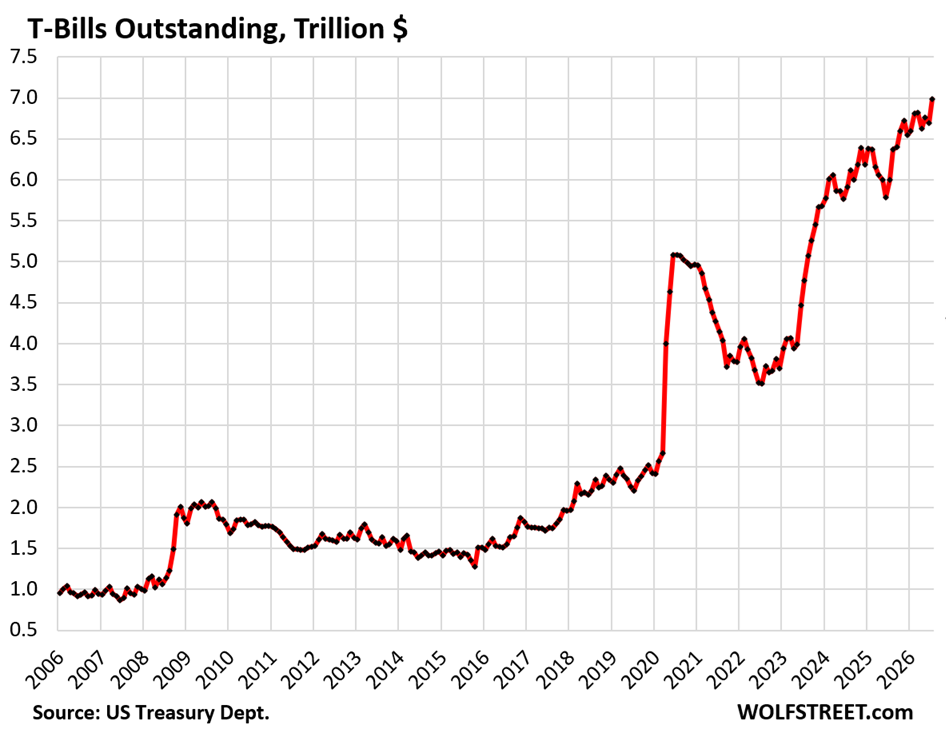
Treasury sold $638B in bills across seven auctions. Yen intervention by US and Japan drove 10-year yield down 10bp to 4.65%. T-bill stock hits $7 trillion.
The Treasury Department auctioned $638 billion in bills this week, with maturities from one month to one year. Seven auctions were held. Three of them sold more than $100 billion each. A fourth came in at $99 billion. No Treasury notes or bonds were offered during the week.
Short-term yields moved lower after the Federal Reserve held its policy rate steady at the July meeting. The 6-month bill sold at Monday's auction at a high yield of 3.855%, down roughly 10 basis points from the auction just before the FOMC decision. In the secondary market, the 6-month yield slipped to 3.96% by Friday afternoon, the Treasury Department reported.
The spread between the 6-month yield and the effective federal funds rate now stands at 33 basis points. That gap suggests the market still prices in a rate hike, though the expected timing has shifted from July to the September meeting.
Long-term yields fell after the U.S. and Japan intervened together to support the yen, the first joint intervention since 1998. The Treasury Department bought yen and sold euros, an unusual move that removed, at least temporarily, the risk that Japan would sell U.S. Treasuries to raise dollars for its own intervention. The 10-year yield dropped 10 basis points on the week to 4.65%. The 30-year yield declined 8 basis points to 5.19%, retreating from a two-decade high set the prior week.
The total stock of Treasury bills outstanding reached $7.0 trillion at the end of July, up $1 trillion from a year ago, according to Treasury data. Marketable securities overall rose $2.5 trillion year-over-year to $31.4 trillion. T-bills' share of total marketable debt ticked up to 22.2% in July, holding near the 22% level it has occupied for nearly three years.
The joint currency intervention targeted a specific threat to the bond market. If Japanese authorities had sold Treasuries to fund their yen buying, that selling could have pushed long-term yields higher. The coordinated action put a lid on that pressure for now.
Inflation expectations remain a concern. The Fed has cut rates twice in 2025, with the last three cuts coming while inflation was re-accelerating. Some analysts view that as a sign the central bank is allowing the economy to run hot to manage the growing federal debt. At the July press conference, Fed Chair Kevin Warsh pushed back against that interpretation. The market will watch whether the Fed follows words with action.
The 10-year yield matters more than the 30-year because it serves as the benchmark for mortgage rates and corporate bonds. A move above 5% would raise borrowing costs across the private sector. The 30-year yield lacks that benchmark role, and its issuance runs roughly half that of the 10-year note. The U.S. went years without issuing 30-year bonds.
The 10-year yield ended the week at 4.65%, down from 4.75% the prior week. The next inflation print will test whether the intervention and the pause in note auctions can keep yields contained.
Drafted by a large language model from the source reporting linked above, then screened by automated publishing checks. It is not read by a journalist before publication. Some articles cite our Alpha Score. Verify prices and figures against the original source. Educational coverage, not personalized advice.