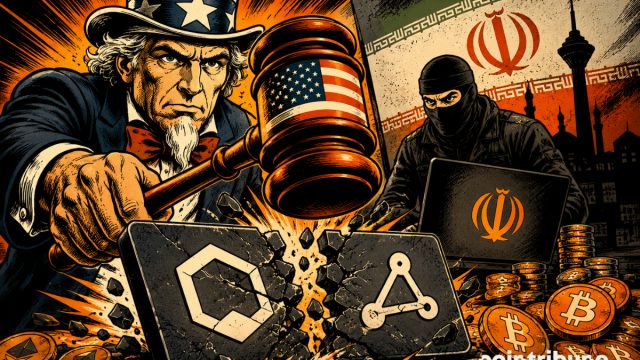
OFAC sanctioned Shelbit and Aban Tether for alleged Iran-linked crypto flows. The Treasury also targeted a network of companies and betting sites, expanding pressure on intermediaries.
Washington sanctioned Shelbit and Aban Tether on August 7, 2026, accusing the two crypto platforms of supporting financial networks linked to Iran. The Office of Foreign Assets Control, a branch of the Treasury that enforces economic sanctions, also listed Siavash Kayvanpour as the head of a network of companies spanning Georgia, the United Arab Emirates, and Poland.
Shelbit was already under scrutiny before the designation. OFAC said the platform processed more than $1 million from wallets controlled by the Islamic Revolutionary Guard Corps, and more than $2 million from Shelbit to the IRGC. Another $2 million moved from addresses linked to Kayvanpour to Nobitex, an Iranian exchange already sanctioned by the United States. The agency described Shelbit as the gateway for a network of Persian betting sites run by two Iranian influencers convicted in 2023 for illegal gambling. Tens of millions of dollars from that group are said to have passed through Shelbit, the Treasury said.
Aban Tether followed a different mechanism, according to OFAC. The Iranian platform processed millions of dollars in transactions with Nobitex, Wallex, Bitpin, and Ramzinex – four Iranian exchanges already designated by Washington. OFAC sanctioned Aban Tether under its activity in the Iranian financial sector.
The Treasury linked several companies to Kayvanpour: SHPS Shelbit in Georgia, Shelbit General Trading in the UAE, Shelbit Technologies in Poland, and Crypto Home DMCC and NFT Home DMCC in Dubai. The UAE regulator VARA had already taken measures against Shelbit General Trading in January 2025 and July 2026, but the activity continued, OFAC said.
The new sanctions expand a broader campaign. In May, Treasury Secretary Scott Bessent said the United States had recovered $1 billion in crypto linked to Iran. The State Department is offering up to $15 million for information that can disrupt the IRGC's financial mechanisms.
Being listed on OFAC's sanctions list has immediate effects. Properties and interests held in the United States, or controlled by Americans, must be blocked and reported. The rule extends to entities owned 50% or more, directly or indirectly, by a sanctioned person. Restrictions also apply to foreign financial institutions and companies that conduct certain operations with designated persons. OFAC can impose civil penalties based on strict liability, without proving intent to circumvent rules.
For crypto exchanges, the risk is exposure to sanctioned addresses. Transfers on a public blockchain leave traces, but identifying beneficial owners depends on internal controls, customer data, and cooperation between authorities. A platform that maintains relationships with a sanctioned address or company can lose access to banking partners and the U.S. market, the Treasury has warned. The State Department's $15 million reward underscores the priority given to tracking these networks.
Drafted by a large language model from the source reporting linked above, then screened by automated publishing checks. It is not read by a journalist before publication. Some articles cite our Alpha Score. Verify prices and figures against the original source. Educational coverage, not personalized advice.