The United States has used virtually all of its Army Tactical Missile Systems and Precision Strike Missiles during the five-month campaign against Iran, Reuters reported Tuesday, citing multiple sources familiar with internal military data. The disclosure, which the news agency said has not previously been made public, adds a new layer of uncertainty to the conflict's trajectory and the stability of global energy flows.
The Army's two principal surface-to-surface precision weapons have been central to the strategy of striking targets from long distances while limiting risk to pilots. Each missile costs more than $1 million. The rapid consumption has fueled concern within the Trump administration over the ability to sustain prolonged operations while maintaining deterrence against China and Russia, according to three sources familiar with internal discussions.
A fourth source said U.S. Central Command has continued replenishing operational stocks by drawing weapons from inventories positioned elsewhere around the world. The report also noted that approximately 65% of Patriot interceptors have been expended since February, and THAAD interceptor inventories have fallen by at least 38%, according to a Center for Strategic and International Studies study that two Reuters sources said closely matched classified figures. The United States has consumed nearly half of its global inventory of Tomahawk cruise missiles.
The depletion story has not been widely picked up by major outlets. The Wall Street Journal's lead Iran piece focused on Tehran's strategy to control the Strait of Hormuz, while the Financial Times ran a piece headlined "Donald Trump trapped between escalation and an Iran deal on Tehran's terms." The New York Times landing page was dominated by Michigan election results and Ukraine.
Strait of Hormuz: No Talks With Washington
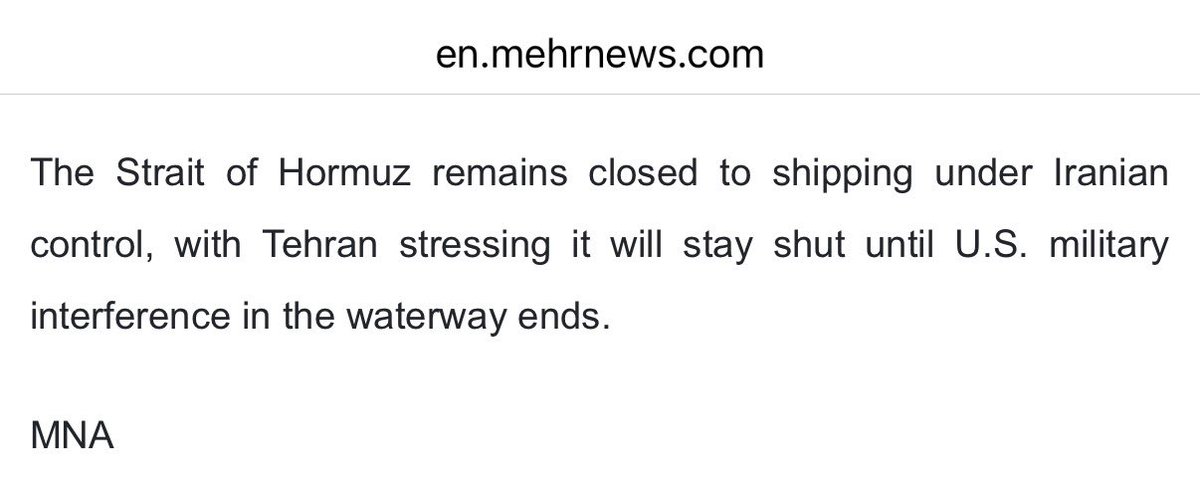
Iran has repeatedly denied that it is negotiating with the United States over the Strait of Hormuz. Iranian Foreign Ministry spokesperson Esmaeil Baghaei said discussions with Oman are focused solely on establishing a safe and temporary shipping corridor. A senior Iranian political and security source told Al Mayadeen that Iran is not holding any negotiations with the United States. The source said the strait lies entirely within the two countries' territorial waters and that the United States "has always been a disruptive and destabilizing force."
On the strait's status, the source said whether it stays open or closed "depends on the broader situation in the region" but stressed it will not reopen "as long as US aggression, the blockade, and other provocative measures against Iran continue."
U.S. Treasury Secretary Scott Bessent told CNBC on Tuesday that Washington could reach a deal with Iran to reopen the strait as soon as "today or tomorrow." Axios followed with a report that the U.S. was nearing a Hormuz deal and aiming for a Wednesday announcement. Iran's PressTV dismissed the claims, citing an informed source who said any potential Iran-Oman agreement is unrelated to immediate reopening. The reopening is contingent on a change in U.S. conduct, the source said.
The Iran-Oman talks have entered a new and decisive phase over the past two weeks, according to a PressTV report. The remaining obstacle is the continued obstruction by the United States and its regional accomplices, an official told the outlet. The goal is to reach agreement on a new central corridor that would replace the northern and southern routes. Iran has previously claimed to have mined that route, meaning interim provisions would be needed while clearance is underway.
Implications for Energy and Shipping
The combination of depleted U.S. munitions and the standoff over Hormuz creates a precarious backdrop for oil markets. Brent crude has already pierced $100 a barrel as the U.S.-Iran conflict escalated. The Strait of Hormuz handles roughly 20% of the world's oil supply. Any prolonged closure would squeeze global supply just as the U.S. faces constraints on its ability to project force in the region.
Shipping disruptions extend beyond Hormuz. The Red Sea and Suez Canal remain effectively closed due to Houthi attacks. The Houthi military spokesman said the group has imposed a maritime blockade on Saudi Arabia, striking the Saudi oil tanker Wafaa with ballistic missiles off the coast of Yanbu. In Dubai, multiple explosions were reported around Jebel Ali Port, with Iranian outlets attributing the blasts to a Houthi missile. UAE authorities described the incident as an industrial accident.
The Panama Canal is also facing reduced transits due to low water levels, with no new auctions from July 25 onward. Global shipping is facing simultaneous bottlenecks at multiple chokepoints, a scenario with no historical precedent, according to analysts. Rerouting around Africa adds 4,000 miles one way for ships traveling between Asia and Europe, pushing bunker fuel costs above $800 per ton because of the Hormuz closure.
For energy companies, the risks are twofold. Upstream producers face potential output disruptions if the strait remains closed. Refiners in the U.S. and Asia could see feedstock costs spike. The Department of Energy has warned that Strategic Petroleum Reserve caverns may be at risk of collapse at higher reserve levels than anticipated, though that scenario remains speculative. The broader market impact will depend on whether the U.S. can sustain its current military posture and whether Iran and Oman finalize their corridor agreement.
Traders are watching for any sign of a diplomatic breakthrough. The FT noted that any settlement would likely give Tehran control over some of the waterway and the ability to eventually charge fees, conditions that would have seemed unthinkable a year ago. For now, Iran's position remains that nothing is settled until everything is settled, including a full outline of updated terms, release of frozen assets, and Israeli withdrawal from Lebanon.
Oil Pierces $100 as US Strikes Iran From Caspian to Gulf