US Interest Payments Rose to $312B in Q2, 32.5% of Tax Receipts
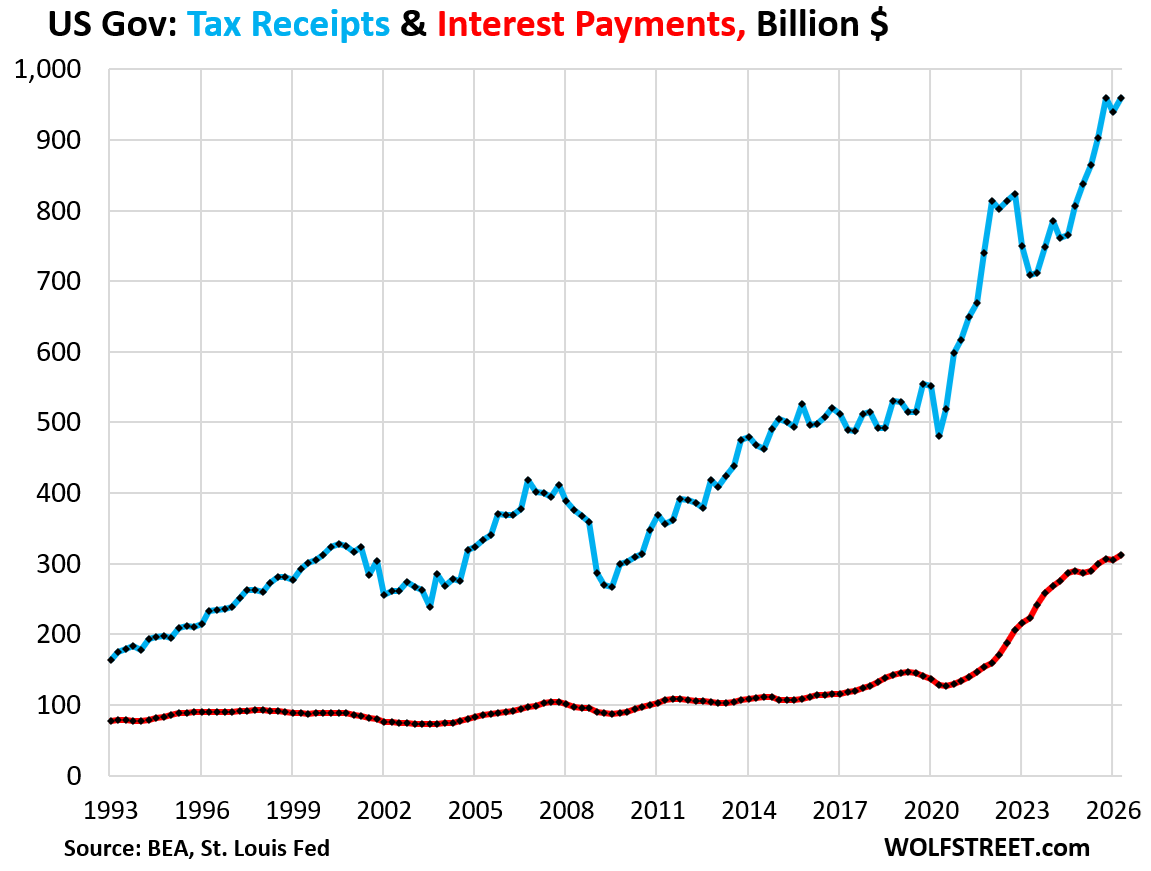
US interest payments on $40T debt rose to $312B in Q2, consuming 32.5% of tax receipts. Debt-to-GDP dipped to 121.5% as GDP grew faster than debt. CBO sees deficit at 6% of GDP for fiscal 2026.
Alpha Score of 40 reflects weak overall profile with moderate momentum, poor value, moderate quality, moderate sentiment.
Interest payments on the $40 trillion in federal debt rose to $312 billion in the second quarter, up $7 billion from the first quarter, according to Bureau of Economic Analysis data. Over the past 12 months, interest payments totaled a record $1.22 trillion, a 240% increase from the peak of financial repression in Q2 2020.
Tax receipts reached a record $952 billion in Q2, up $20 billion from Q1 and $95 billion year-over-year. For the 12-month period, tax receipts jumped 14.9% to $3.76 trillion. The measure excludes Social Security and disability contributions that go into off-budget Trust Funds.
Interest payments consumed 32.5% of tax receipts available for general budget expenditures in Q2. The recent high of 37.5% came in Q3 2024, the worst ratio since 1996.
Net tariffs turned negative $3.5 billion in Q2, after the Supreme Court scuttled part of the tariffs and the government paid refunds starting in May. New tariffs under a different law are being imposed, and net tariffs should become substantially positive again in the second half of 2026, Wolf Street reported.
The average interest rate on Treasury debt ticked higher to 3.45% in July, from 3.41% in June, as low-rate maturing securities were replaced with higher-rate ones.
The Treasury-debt-to-GDP ratio ticked down to 121.5% in Q2, as current-dollar GDP rose 1.9% quarter-to-quarter to $32.5 trillion, while debt rose 1% to $39.5 trillion. The ratio dipped because the economy grew faster than the debt. The Federal Reserve has cut rates with inflation still high, a policy that Wolf Street described as supporting higher nominal economic growth to reduce the debt burden over time.
The Congressional Budget Office projects the federal deficit will hover around 6% of GDP for fiscal 2026, consistent with the past four years despite above-average economic growth. The bond market has reacted negatively to the fiscal trajectory, Wolf Street noted.
For more on the market's response to fiscal and monetary policy, see Gradual Policy Build-Up Is the Market Risk Hiding in Plain Sight.
Drafted by a large language model from the source reporting linked above, then screened by automated publishing checks. It is not read by a journalist before publication. Some articles cite our Alpha Score. Verify prices and figures against the original source. Educational coverage, not personalized advice.