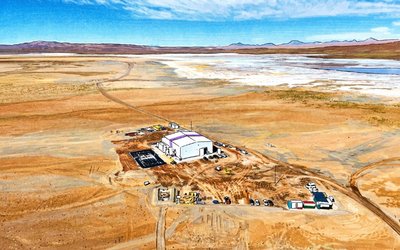
The US Department of Energy awarded US$500 million across seven critical mineral projects to expand domestic processing, recycling, and battery-material manufacturing. The biggest single grant in the round went to Lilac Solutions, a California-based unlisted technology company that picked up US$100 million to advance its direct lithium extraction (DLE) commercial project in Utah.
The funding, part of the Infrastructure Investment and Jobs Act's battery materials and manufacturing programs, is the third round of allocations under the framework. Cobalt producer Jervois and battery recycler NthCycle each got US$100 million as well, with the balance spread across developers of cathode recycling, electrolyte chemicals, and silicon-anode materials.
Lilac's proprietary technology uses engineered ceramic beads that selectively absorb lithium ions from brine while rejecting sodium, potassium, and magnesium. Once the beads are saturated, they are washed with acid to produce a concentrated lithium sulphate or chloride stream that can be refined into battery-grade lithium carbonate or lithium hydroxide. The company says the process achieves high recovery rates and allows the depleted brine to be reinjected into its natural aquifer, which cuts net freshwater consumption and surface footprint.
Traditional evaporation ponds can take up to 24 months to extract lithium and consume large amounts of water and land. Lilac's ion-exchange approach is designed to operate in weeks rather than years.
The grant comes as Western governments push to build domestic supply chains for critical minerals, reducing reliance on Chinese processing infrastructure. For Australian investors, Lilac's commercial progress carries direct implications. The company is the primary DLE technology partner for Lake Resources (ASX: LKE), which is developing the Kachi lithium brine project in Argentina's Catamarca Province. Lilac's ion-exchange system is the core processing technology for the site, replacing evaporation ponds under a joint partnership agreement.
Lilac has an earn-in agreement to take an equity stake of up to 25% in the Kachi project once it hits operational and technology-testing milestones. Previous joint field testing confirmed that Lilac's process produced battery-grade lithium carbonate exceeding 99.8% purity from Kachi brine samples.
Lilac Solutions was founded in 2016. It is unlisted and specialises in proprietary ion-exchange DLE technology. The company's Utah project at the Great Salt Lake is now the proving ground for scaling the technology beyond pilot stage. Whether the process can deliver at commercial scale for both Utah and partner projects like Kachi is the open question the grant money is designed to answer.