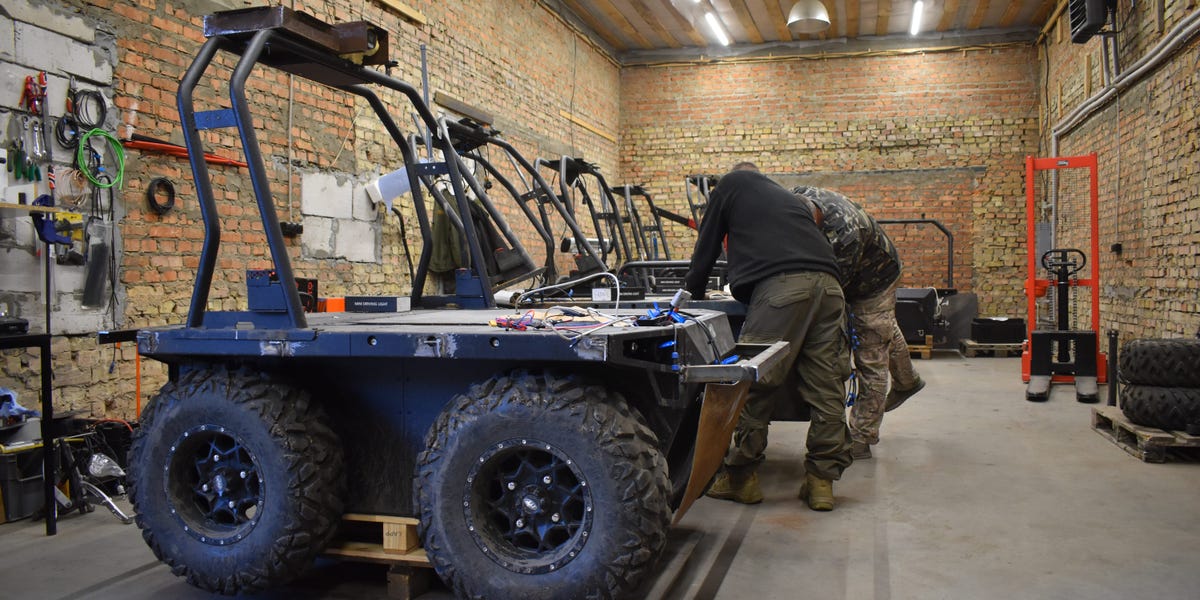
Near the front lines in eastern Ukraine, a routine supply run can be a death sentence. Mines, artillery, and drone-saturated skies have made simple logistics lethal. Business Insider went inside a Ukrainian factory that is building ground robots to take on those missions. The factory produces tracked and wheeled machines designed for cargo hauling, casualty evacuation, and remote weapons operation. Soldiers no longer have to risk the trip.
The war has accelerated a shift already underway in military procurement. Drones have dominated the air war. Ground robots are now filling the gap where manpower is too expensive to lose. The factory, located in the Kyiv region, turns out dozens of units each month. The robots are remote-controlled or semi-autonomous, guided by an operator from a protected position. They can carry supplies, extract wounded troops, or lay down cover fire.
Defense contractors outside Ukraine are watching closely. Lockheed Martin and General Dynamics have long invested in unmanned ground vehicles. The war has created a real-world testing ground. The Ukrainian military is buying these robots with state funds and international donations. The need is immediate: Ukraine's army suffers hundreds of casualties per day in some sectors, and every mission that can be automated saves lives.
Investors have priced in a broad defense spending increase. The shift to unmanned systems is uneven. Companies with existing robotics programs may see faster orders. Smaller firms specializing in drone and ground-robot manufacturing have drawn attention from venture capital and government contracts. The Pentagon's Replicator initiative, which aims to field thousands of autonomous systems, has already pushed money toward similar technology.
Business Insider's report highlights a specific production line. The pattern has wider implications. A stock market analysis of defense contractors shows that traditional tank and artillery makers are losing relative weight in portfolios. The war in Ukraine has proven that cheap drones and ground robots can disrupt armored columns and resupply routes. The next phase of procurement may favor speed and modularity over heavy armor.
The Iran War Aftermath Reshapes Defense and Oil Risk Premiums piece earlier this year noted how geopolitical shocks change the risk calculus for defense stocks. Ukraine's robot factory is another data point. Production lines that can turn out unmanned ground vehicles quickly are now strategic assets. European defense budgets are rising, and many countries are looking at off-the-shelf robotic solutions rather than long development cycles.
The factory's output is already reaching units near the front. The next wave of orders will test whether the Ukrainian supply chain can scale. For defense investors, the question is which companies can deliver proven hardware within months, not years.