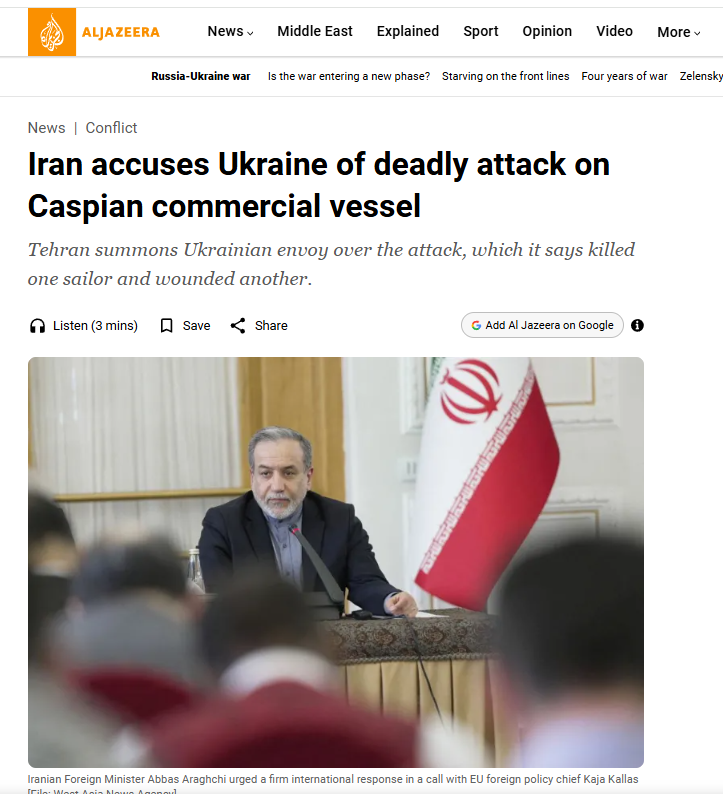
Ukraine struck at least one vessel in the Caspian Sea on July 25. The attack drew two separate conflicts closer to a direct collision. Ukrainian officials said the strike hit a Russian warship and vessels carrying military cargo between Russia and Iran. Iran’s government described the target as an Iranian commercial vessel carrying steel from Russia’s Astrakhan port to Iran’s Anzali port. The attack killed one sailor and injured three others, Iran said.
The competing accounts underscore the risk of the Ukraine-Russia war bleeding into the broader US-Iran confrontation. The Caspian Sea has become a logistics corridor for Russia and Iran, both under Western sanctions. The strike is the first known Ukrainian operation in that body of water. Its reach – more than 600 miles from the front line in Ukraine – suggests the use of long-range drones, likely with targeting support from the United States, the commentary said. That raises the question of whether Washington gave the green light for Ukraine to engage Iranian assets.
Brent crude has already topped $100 a barrel. The US Strategic Petroleum Reserve has fallen to 319 million barrels, the lowest level in over 40 years, according to the Energy Information Administration. At the current withdrawal rate, the reserve would hit a minimum operational threshold of 250 million barrels in about 11 weeks, the EIA data showed. OECD oil inventories are projected to fall to their lowest since 2003, the International Energy Agency said. Western refining margins are at record highs.
The twin chokepoints of the Strait of Hormuz and the Bab el-Mandeb Strait remain blocked. Together they normally carry about a quarter of the world’s seaborne oil and gas. The closures are blocking an estimated 15-17% of global supply, the commentary noted. The Houthis, backed by Iran, hit two Saudi oil tankers in the Red Sea last week, prompting Saudi strikes on the Yemeni port of Hodeida.
Iran has threatened retaliation. Tehran could recognize Crimea and the Donbas as Russian territory, or strike Ukraine-linked vessels in other sea lanes, the commentary said. Ukraine has already signed a security agreement with Saudi Arabia to develop defenses against Iranian-designed drones. Zelensky has visited the United Arab Emirates and Qatar for similar deals. The next misstep could involve China, the commentary warned.
The clock on emergency oil reserves is ticking. The US SPR is approaching a minimum operational threshold needed to maintain the physical integrity of its storage caverns. The IEA has said there is no room for complacency on oil security. The rising oil price is already damping demand, a natural market mechanism that comes at the cost of recession risk. The same computer model that warned of a possible world war in 2027 now projects a global recession into 2028, the commentary said.