Ukraine's drone operators fly from hundreds of miles away, but ground crews still face the front. Wild Hornets tech shows the gap. Defense sector risk explained.
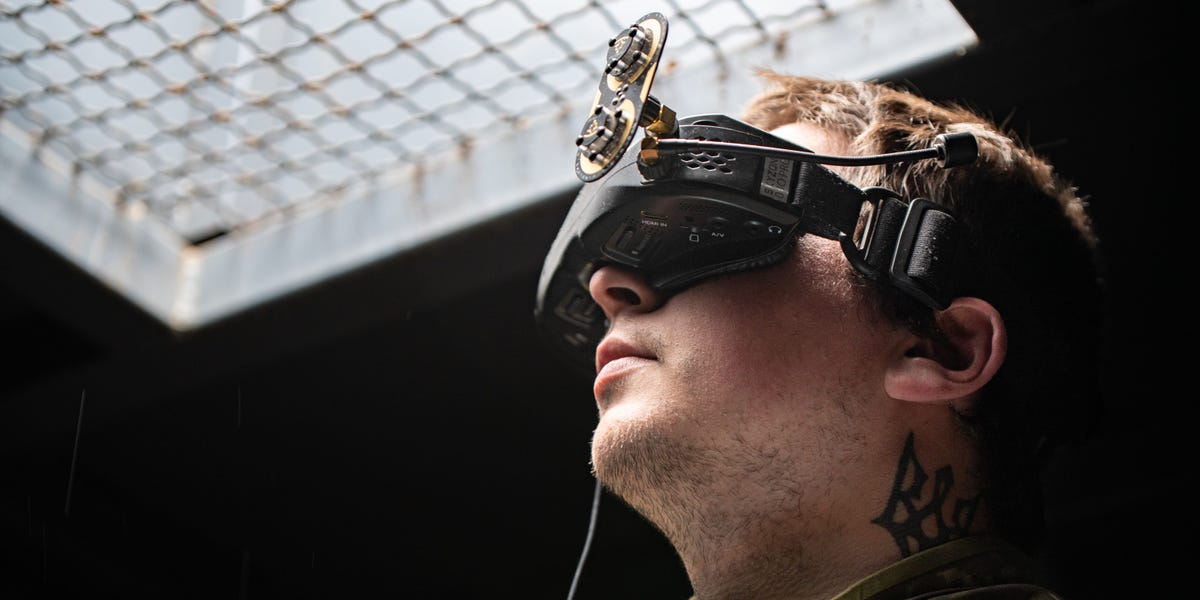
Ukraine's drone operators fly missions from hundreds of miles away using satellite connections. The makers of the tech say it protects pilots who are top Russian targets. Ground support crews still transport and launch the drones near the front lines. The human support tail remains exposed to front-line danger.
Wild Hornets, a Ukrainian drone maker, developed the satellite-control technology for its interceptor drones. The company told Business Insider that ground forces still transport and prepare the aircraft. Dmytro "Liber" Zhluktenko, a former drone operator who now serves as a lessons-learned analyst with Ukraine's 413th Unmanned Systems Regiment "RAID," said the satellite connection removes the pilot from the launch point. "But this doesn't remove the need for the ground groups, people who actually attach the explosive, put the drone outside of the bunker, et cetera," he said.
With satellite communications for combat drone operations, "we are able to put our pilots in any place when there is a stable internet connection for them," Zhluktenko said.
Russia treats drone operators as priority targets, Zhluktenko and other military officials said. Ukraine's drones destroy more Russian targets than any other weapon. One operator can fly repeated missions to collect intelligence and launch attacks. The remote piloting technology protects these force multipliers. The ground support tail remains a bottleneck. Troops must unload the drones, assemble them, attach explosives and communications gear, and position them for launch.
On missions using radio frequency connections, operators generally need to remain closer to their drones. Units try to move operators farther back when possible, Zhluktenko said, even at the expense of capabilities. "The first principle, the first rule, is the safety of them, but it's a very tough balance. We want to keep them extremely safe, but, at the same time, there is some work to be done."
Wild Hornets is one example of a company developing technology to address the pilot risk. Companies providing autonomous ground vehicles for military logistics are seeing increased interest from the defense ministry. The ministry said the primary task of ground robots is "to bolster our units and replace soldiers in the most dangerous areas."
Ukraine is investing heavily in technology to close this gap. The investment spans drones and ground robots. President Volodymyr Zelenskyy said in April that Ukraine's ground robot force had carried out more than 22,000 front-line missions over three months. "Lives were saved more than 22,000 times when a robot went into the most dangerous areas instead of a warrior," he said.
Then Commander-in-Chief Gen. Oleksandr Syrskyi said in October that Ukraine was prioritizing high-tech systems to reduce the presence of soldiers directly on the battlefield. Efforts are underway to use ground robots as motherships for launching interceptors and first-person-view drones.
These robotic launchers are not yet ubiquitous along the front lines. Russian forces can target the support infrastructure, including bunkers and transport routes. The tempo of drone operations depends on the support crews. Their attrition is a direct constraint. Ukraine wants to replace certain human tasks, such as front-line logistics, with fully robotic systems. This protects lives and offsets Russia's manpower advantage.
Then-defense minister Mykhailo Fedorov said in April that satellite control makes it possible to scale capabilities without being tied to the front. "The pilot is no longer tied to the position. The drone is in the sky, while control takes place from a protected environment in Kyiv, Lviv, or even abroad." He said the technology increases interception effectiveness and minimizes risks to operators.
Zhluktenko said protecting everyone involved in a drone operation by keeping them far from the fighting is "impossible so far." Ukraine's ultimate goal is to have fewer people on the direct battlefield. "For now, at least, human beings are still in the mix. It's not total robotic warfare."
Drafted by a large language model from the source reporting linked above, then screened by automated publishing checks. It is not read by a journalist before publication. Some articles cite our Alpha Score. Verify prices and figures against the original source. Educational coverage, not personalized advice.