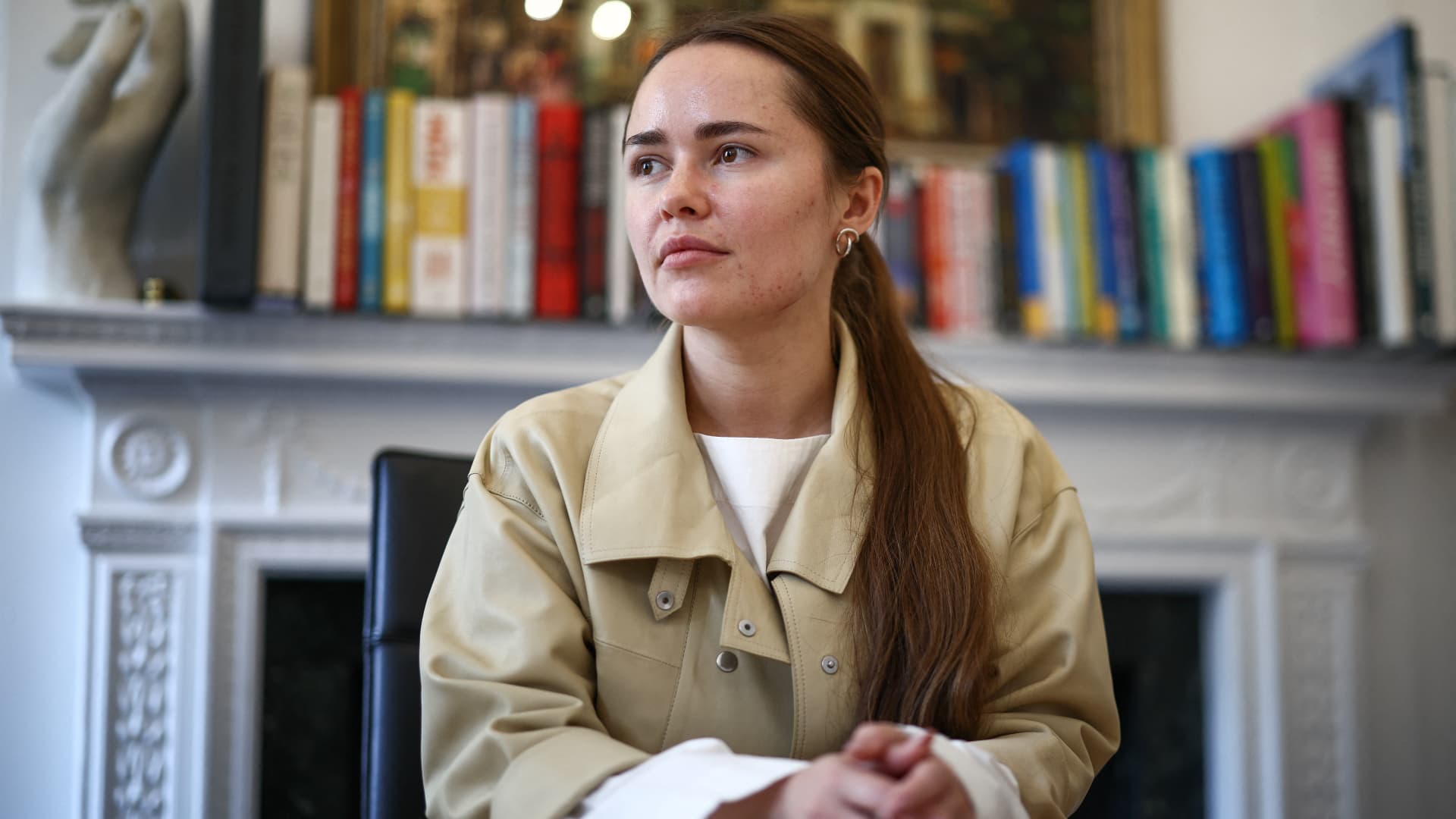
The CEO of Ukraine's leading arms company said Kyiv has "learned the hard way" that military strength is an essential precursor to diplomacy. Deep strikes into Russian territory are a core tenet of the country's pressure campaign, she told CNBC.
Fire Point, a missile and drone startup that now facilitates more than 60% of Ukraine's so-called "long-range sanctions," has scaled exponentially since its founding in response to Russia's full-scale invasion in 2022. The company produced around 200 drones that year, a feat CEO Iryna Terekh described as a "huge achievement."
Since then, the Kyiv-headquartered startup has swelled from three founding members to more than 7,000 employees. Terekh said it "looks realistic" to expect the team to produce more than 100,000 drones by year-end.
"We have to understand that we live, unfortunately, in the same timeline with a completely barbarous, imperialistic neighbor and we can expect whatever," Terekh said. "Unfortunately, I was in that naïve state of mind before the full-scale invasion that we will find a way to de-escalate the situation and find a diplomatic way to deal with this, from what we can observe, this is not something that is possible."
Russia's Foreign Ministry did not respond to CNBC's request for comment. President Vladimir Putin has framed the conflict as a pursuit to reverse Russia's post-Soviet retreat and revive Moscow's superpower status.
Ukraine's drone campaign has revived hopes the war could be shifting in Kyiv's favor. Analysts warn that raising the cost of the conflict for Russia risks further escalation. Some question whether drones alone can force Putin to negotiate. The Atlantic Council's Christopher Isajiw suggested that progress toward peace may only become possible when continuing the war becomes more costly for the Russian president than ending it.
Ukraine has stepped up attacks on Russia's Amazon-style retail giant Wildberries in recent weeks, seeking to squeeze a critical piece of Russia's consumer economy. Russian forces have increased missile strikes on Ukrainian cities, likely seeking to exploit Kyiv's shortage of ballistic missile interceptors.
Known for its FP-1 series of deep-strike drones and the FP-5 Flamingo cruise missile, Fire Point is doing whatever it can to support Ukraine's deep-strike ambitions, Terekh said. "I'm very proud and I feel a huge responsibility to be a big part of this. We have to understand that the whole war doctrines are changing live in the moment."
President Volodymyr Zelenskyy singled out Fire Point as putting Siberia "within reach of Ukrainian precision" after an attack on a major oil refinery in Omsk last month. The attack was seen as further evidence of Kyiv's long-range drone capabilities ahead of a NATO summit in Turkey. There, U.S. President Donald Trump told Zelenskyy the U.S. would allow Ukraine to produce ballistic missile interceptors.
Trump has since cast doubt on that plan. Ukrainian officials fear a winter assault could pose the toughest challenge of the war yet. Zelenskyy has repeatedly called on international partners to expedite the supply of ballistic missile interceptors, saying the technology could have saved those killed in Kyiv on Aug. 5.
Fire Point aims to produce a ballistic missile interceptor at a fraction of the cost of a U.S.-made Patriot. Terekh said these efforts require the company to achieve in a few years a program that usually takes two to three decades.
A hold-up in European funding has prevented the company from maximizing production of its Flamingo cruise missile, Terekh said. "The production of Flamingo is not running at full power at the moment because we were waiting for the funds for a European loan to come in. We expect to ramp it up to expected maximum capabilities that we named when we started the Flamingo production."
Terekh has previously compared European bureaucracy to the security threat posed by Russian forces. "Probably I put a little bit too much drama in this phrase. I really wanted it to be heard because we need to understand that whatever Fire Point achieved, and as well as other Ukrainian manufacturers, would be never possible in any other European country, simply because of bureaucracy," she said. "You take the same people, the same money, the same factories. They would simply not be working in Europe for one simple reason, because of the hold of regulations."
She called on European politicians to review how bureaucracy should work under such a threat. "When we compare these two threats, so the Russians and the bureaucracy, with the Russians you can fight with drones and missiles. How do you fight with bureaucracy when you cannot receive a paper that you need very much to do some job?"
A spokesperson for the European Commission declined to comment. The EU recently introduced its largest sanctions package against Russia in four years, targeting almost 220 individuals and entities.
"Ukrainians were pretty imaginative in trying an alternative strategy," Alex Kolyandr, director for Europe at the Eurasia Group, told CNBC. "I'm not entirely sure it was the right decision to strike Russian oil facilities in March and April. I think it was extremely smart to target refining facilities and the main retail company. I understand there was a twofold aim in all that. First of all, to force some economic damage and then to broadcast the message that this is not some kind of faraway colonial war. It is something much closer to home. Honestly, they are quite successful in that."