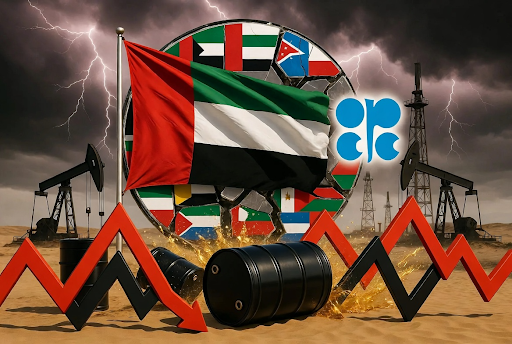
The United Arab Emirates has officially exited OPEC, a move that fundamentally alters the landscape of global crude oil supply management. This departure removes a key member from the cartel's quota system, effectively ending the coordinated production restraint that has defined the group's strategy for years. As the UAE shifts to an independent production policy, the market faces a transition from a centralized supply regime to a more fragmented competitive environment.
Erosion of Production Quotas
The primary impact of this exit is the dissolution of the unified front previously used to manage global inventory levels. Without the UAE adhering to OPEC production caps, the group loses a significant instrument for influencing price floors through collective supply cuts. This shift increases the likelihood of a production surge as the UAE seeks to maximize its market share, potentially leading to a supply glut if other producers maintain their current output levels. The loss of coordination complicates the ability of the remaining members to respond to shifts in global demand, as the total supply available to the market becomes less predictable.
Geopolitical Risk and Transport Volatility
Geopolitical tensions in the Middle East remain a critical factor for energy logistics and transport security. The UAE's decision to operate outside the OPEC framework introduces new variables into regional energy politics, particularly regarding the security of transit routes through the Strait of Hormuz. Increased competition for market share may lead to localized price volatility, as shipping premiums adjust to reflect the changing dynamics of regional oil exports. The market must now account for the risk that independent production policies could lead to friction between the UAE and remaining OPEC members, further complicating the stability of regional energy flows.
Market Context and Structural Shifts
Global energy markets are currently navigating a period of high sensitivity to supply-side shocks. The transition away from a unified OPEC policy mirrors broader shifts in commodities analysis where traditional supply-side anchors are losing their efficacy. As inventory data becomes more difficult to forecast without a cohesive cartel strategy, the market will likely see an increase in intraday price swings. This environment places a premium on real-time supply tracking and regional geopolitical monitoring.
AlphaScala data currently reflects a broader trend of volatility in consumer-facing and industrial sectors. Regarding Amer Sports, Inc., the company holds an Alpha Score of 47/100 and is labeled as Mixed within the Consumer Cyclical sector. You can view further details on the AS stock page.
The next concrete marker for this transition will be the upcoming production reports from the UAE. Investors should monitor whether the country immediately ramps up output or maintains a steady state to avoid triggering a price crash. Further clarity will emerge during the next scheduled meeting of the remaining OPEC members, where the group will likely attempt to recalibrate its strategy to compensate for the lost production capacity and the new competitive reality. These developments are linked to broader concerns regarding Monetary Policy Constraints Emerge as Energy Prices Anchor Inflation.