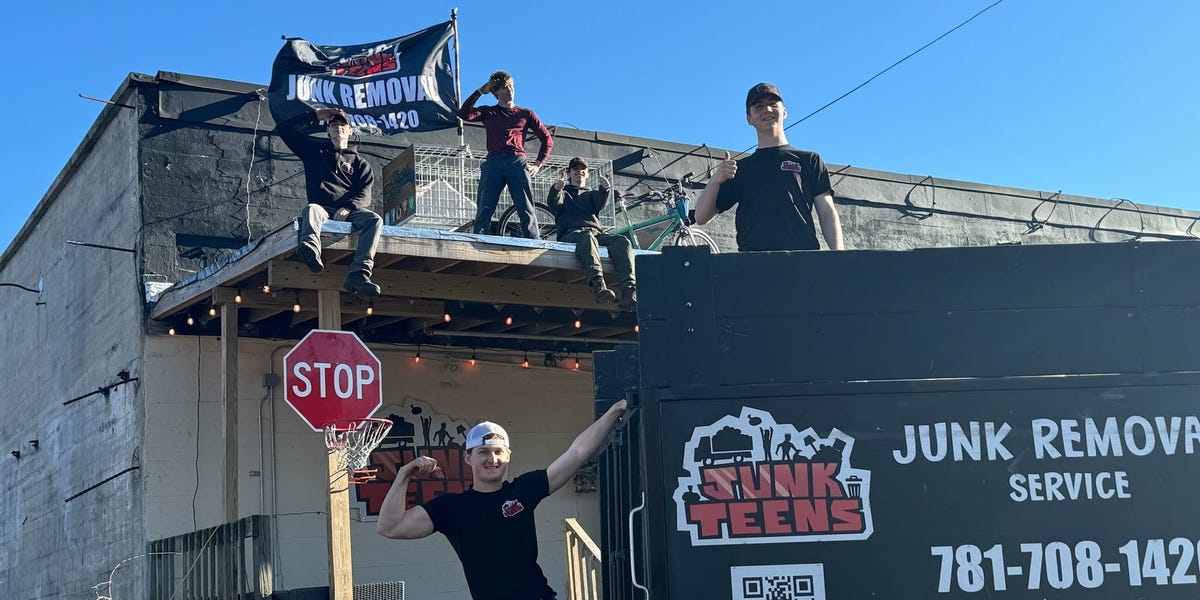
Kirk McKinney was a teenager when he discovered a dump near his home in Massachusetts. The dump became a source of free inventory. He started collecting discarded speakers, electronics, and weights, reselling them on Craigslist and Facebook Marketplace. The more time he spent at the dump, the better he got to know the local junk removal workers. Eventually he started helping them. The experience revealed the business opportunity. "I was basically doing the whole job for them," he told Business Insider. "The guy was paying me pretty well, and he was still walking away with money at the end of the job."
In 2021, Kirk, then 17, and his younger brother Jacob, 16, pooled their savings to buy a $4,000 Ford F-150. They launched Junk Teens, a junk removal service based in Norwood, Massachusetts. Kirk, now 22, and Jacob, 21, run the business full-time. By mid-2026, the company was on track to top $5 million in revenue, according to a P&L viewed by Business Insider. The business has expanded from Norwood to Cape Cod, the North Shore, and Rhode Island. It now runs 25 employees and seven dump trucks.
The total startup cost was roughly $8,000. Half bought the truck. The rest went to registration, building walls on the pickup bed, and basic business setup. The brothers held off on buying tools like a saw and drill. They borrowed from their parents or used items they found on jobs. "We were just very scrappy," Jacob said. "I don't think we've ever bought a trash barrel, a broom, or a shovel. We've always got them for free, so that definitely saved us a lot in the beginning."
Kirk and Jacob had no prior business experience. Kirk was still in high school when they started. Jacob joined after graduating. They learned by doing and by reaching out to competitors for advice. "I would just ask them, Hey, I just started my business. I'm pretty young. I'm just really looking to learn. Do you have five minutes?" Jacob said. That approach helped them figure out pricing, which they based on volume, weight, labor, odd items, and disposal fees. A pile of junk in a garage may be easier to remove than the same amount in a third-floor attic. Heavy materials, mattresses, and box springs with special disposal requirements affect the price. Kirk said transparent pricing helps customers understand what they are paying for.
Speed is another critical factor. Customers want junk removed the same or next day. "Junk removal is a very quick service," Kirk said. "People want it done the same or next day, most of the time." Junk Teens built a reputation for fast response, which helps it stand out in a crowded market.
Branding turned the brothers' youth from a potential liability into an advantage. The company was originally called K&J Removal. Kirk realized customers hired them because they were teenagers. "I just took the thing that made us stand out, our competitive advantage, and built a brand around that," he said. Good reviews and a consistent online presence with a solid logo help, he added. "When they look, and they see good reviews, a good online presence, a solid logo, solid colors, and consistency, that's going to feel like it's more put together." The company invested in a professional website and social media marketing. Kirk said many competitors have poor online presence, which gives Junk Teens an edge.
Kirk warned against competing on price alone. "The best customers are the ones that will just pay what the service is worth and aren't price shopping," he said. Junk Teens aims to deliver quality work and attract customers who value that.
Junk removal has a low barrier to entry. "Almost anyone can do it – and it's very competitive because of that," Kirk said. The brothers' growth from $8,000 to $5 million in five years shows the potential of a simple, high-turnover service with low capital requirements. The business model is straightforward. Customers pay at the time of service. The company has low fixed costs beyond vehicles and disposal fees. This generates cash that funds expansion. The brothers have not taken outside investment.
The company's fleet of seven dump trucks services four regions. The brothers have not disclosed profit margins. The business funds its own growth, they said. The model is replicable, and they have demonstrated it across multiple markets.