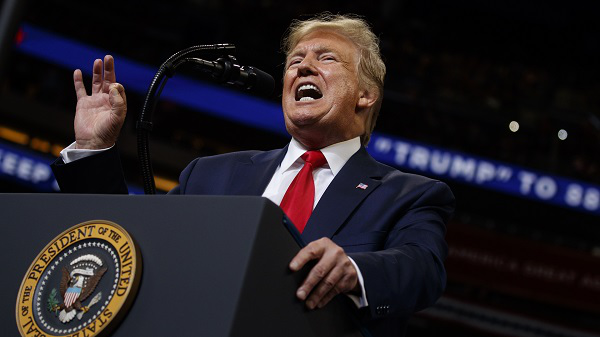
President Donald Trump said Iran remains “very much intent” on reaching an agreement to end the conflict. He added that “so far they haven't gotten there” and that the U.S. is “not satisfied” with the current state of negotiations. The remark, reported from a recent interview, confirms that nuclear deal talks between Washington and Tehran remain unresolved. For markets, the statement removes any immediate expectation of a breakthrough and keeps the geopolitical risk premium embedded in crude oil prices.
The simple read is straightforward. No deal means no additional Iranian barrels hitting the global market anytime soon. Iran currently exports roughly 1.5 million barrels per day under existing sanctions waivers and covert routes. A full nuclear deal would lift U.S. sanctions and release an estimated 1.2-1.5 million bpd of additional supply, a bearish catalyst for oil. Trump’s “not satisfied” language pushes that outcome further into the future.
The better market read touches on positioning. Oil prices have traded in a tight range this quarter as traders priced in a 50-50 chance of a deal by summer. The Trump statement tilts those odds downward. Crude futures may hold recent gains as long as the “no deal” baseline persists. The risk is asymmetric. A sudden deal announcement would trigger a quick selloff. No deal only reinforces the status quo. Traders should watch the Brent-WTI spread and Iranian crude loadings for confirmation.
The 'Not Satisfied' Signal for Oil Markets
The negotiations began in April 2021 in Vienna, with indirect talks between U.S. and Iranian officials. Multiple rounds have produced a draft agreement. Final signoff has been delayed by disputes over sanctions scope, nuclear enrichment levels, and guarantees that future U.S. administrations will not withdraw again. Trump’s comment indicates the U.S. side sees insufficient Iranian concessions.
This matters now because the window for a deal is narrowing. Iranian elections are approaching. The Biden administration faces its own domestic calendar. A failure to reach an agreement before the summer could push talks into 2024, a U.S. election year when diplomatic momentum often stalls. The longer the delay, the more the premium in crude becomes sticky.
Which Sectors Feel the Stalemate
Oil prices are driven by both physical supply balances and risk premium. A completed Iran deal would convert the 1.2-1.5 million bpd overhang from a theoretical cap to actual flow. Trump’s remark pushes that conversion out of the near term. The OPEC+ group has already factored in some Iranian return in its production planning. The official baseline remains conservative.
For equity markets, the primary read-through is to energy sector stocks. Companies with direct exposure to Middle East production – such as Exxon Mobil (XOM) and Chevron (CVX) – benefit from sustained high prices. Conversely, refiners that depend on Iranian crude feedstock, like Valero (VLO) and Phillips 66 (PSX), face higher input costs if sanctions stay. Defense contractors with Middle East exposure, such as Lockheed Martin (LMT) and Raytheon Technologies (RTX), may also see a risk-on bid if tensions persist. For a broader view of how geopolitical catalysts interact with sector performance, see AlphaScala’s stock market analysis page.
What Would Change the Setup
The next concrete catalyst is the scheduled round of talks – likely in Oman or Vienna – though dates have not been publicly confirmed. A concrete sign of progress would be a joint statement from the EU coordinator or a direct U.S.-Iran meeting. Failure to hold a new round within two months would confirm the stalemate.
Traders should watch Iranian crude exports as a leading indicator. If loadings rise above the current 1.5 million bpd without a deal, it could signal that sanctions enforcement is weakening. That would partially front-run any agreement, compressing the risk premium. A drop in loadings would reinforce the “no deal” thesis and support oil prices.
For now, the market is left with one clear fact. The U.S. is not satisfied, and the deal is not done. That is enough to keep the oil risk premium in place. It also makes the next negotiation round the single most important energy event this quarter. Traders evaluating broker options for positioning around this event can consult AlphaScala’s review of the best stock brokers.