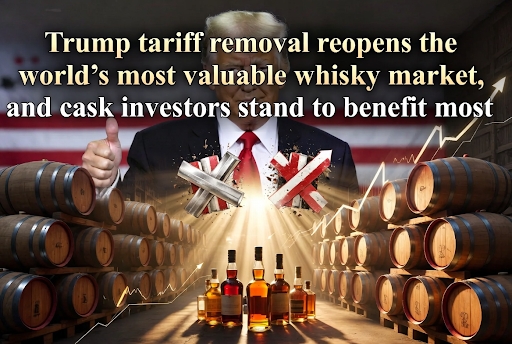
The removal of the 10% tariff on Scotch whisky exports to the United States marks a structural shift in the global spirits market. Confirmed by Donald Trump as part of a broader UK-US trade reset following the King Charles state visit, the policy change does more than restore immediate margins. It fundamentally alters the pricing ceiling for premium and aged expressions, effectively resetting the long-term valuation curve for the entire category.
The US Market as a Pricing Anchor
The United States remains the largest and most valuable export market for Scotch whisky by total value. In the spirits industry, the US market acts as the primary price-setting mechanism for premium and aged products. When a 10% tariff is applied, it creates a friction point that forces distillers and distributors to either absorb the cost or pass it to the consumer, which suppresses volume at the high end. By removing this barrier, the policy creates a cleaner transmission mechanism for price discovery. For investors in the sector, this means that the exit valuation for aged stock is no longer tethered to a tax-inflated cost structure, but rather to the raw demand of the American consumer.
Cask Investment Dynamics and Liquidity
For those holding casks, the implications are distinct from those affecting publicly traded beverage companies. Cask investment is a long-duration play; investors are not buying the market of today, but rather the market of five, ten, or fifteen years from now. The removal of the 10% tariff increases the addressable buyer pool for premium single-cask bottlings, which the US market absorbs at a disproportionately higher rate than other regions.
Increased accessibility to the US market translates directly into improved liquidity for secondary market participants. As John Kennedy, Managing Director at Decant Index, noted: "The US isn't just another export destination - it's the price-setting market for premium whisky globally. Removing a 10% tariff doesn't just improve margins today, it resets the long-term pricing curve for the entire category."
Input Economics and the Bourbon Feedback Loop
A secondary, often overlooked mechanism involves the supply of maturation vessels. Trump’s trade policy includes provisions that encourage increased bourbon production. Because bourbon must be aged in new oak barrels by law, a surge in domestic production creates a surplus of high-quality, first-fill ex-bourbon casks. These casks are the essential input for the Scotch whisky industry.
This creates a rare scenario where both sides of the investment equation improve simultaneously:
- Exit conditions: The removal of the 10% tariff improves the final sale price and volume potential for aged Scotch in the US.
- Input costs: Increased bourbon production provides a steady, potentially lower-cost supply of first-fill casks for maturation.
This dual-sided improvement is a significant tailwind for the economics of long-term maturation. While broader market volatility remains a factor, the structural removal of the tariff provides a clearer path for capital appreciation in the alternative assets space.
Risk Factors and Market Sensitivity
While the tariff removal is a net positive, investors must remain cognizant of the broader macroeconomic environment. The Scotch whisky industry remains sensitive to global trade policy shifts and currency fluctuations, particularly the GBP/USD exchange rate. Any reversal in trade sentiment or a return to protectionist policies would immediately threaten the newly established price floors. Furthermore, while the US market is the primary driver of value, demand is also contingent on discretionary spending levels, which can fluctuate based on broader economic cycles.
Investors looking for broader exposure to real estate or energy sectors may find varying levels of stability in firms like Welltower Inc., which carries an Alpha Score of 53/100, or Tsakos Energy Navigation Ltd, which maintains an Alpha Score of 73/100. These assets provide a different risk profile compared to the niche, long-duration nature of the cask market, which relies heavily on the specific supply-demand imbalances of the spirits industry.
Ultimately, the removal of the 10% tariff provides a structural floor that was previously absent. The success of this trade reset will be confirmed by sustained volume growth in premium Scotch imports to the US over the next several quarters. If the market fails to see a corresponding increase in high-end volume, it may suggest that the tariff was only one of several factors suppressing demand, potentially weakening the case for aggressive long-term cask accumulation. For now, the policy shift provides a tangible improvement to the underlying fundamentals of the asset class, setting a new baseline for valuation models in the premium spirits sector.