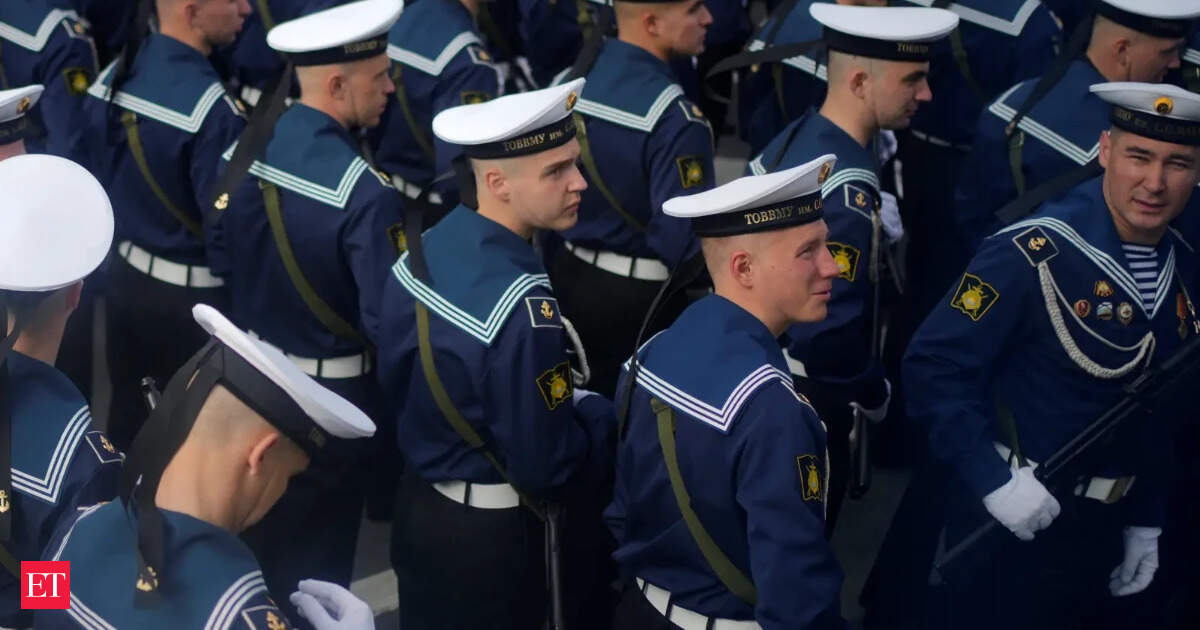
Russia's Victory Day parade on May 9 was visibly smaller, with fewer tanks, aircraft, and personnel than in previous years. The Kremlin cited security threats from Ukraine for the scaled-back display, but the real signal is one of resource strain. For markets, the parade is a data point, not a headline. It confirms that the war is consuming Russian military hardware faster than it can be replaced, and that the state is prioritizing frontline needs over symbolic projection. That dynamic has direct consequences for Russia's fiscal position, the ruble, and the risk premium embedded in any asset tied to the conflict.
Hours after the parade, US President Donald Trump announced a ceasefire supported by both Russia and Ukraine, and stated he wants a "big extension" to the deal. The announcement immediately resets the near-term catalyst path for Russian equities, the ruble, European natural gas, and defense contractors. The simple read is that peace talks are progressing and risk is coming off. The better market read is that a ceasefire extension is a necessary but insufficient condition for removing the sanctions architecture that has isolated Russian assets since 2022.
Victory Day Parade Signals Strain, Not Strength
The smaller parade is not a tactical choice; it is a balance-sheet signal. Russia's military-industrial complex is running hot, and the opportunity cost of pulling equipment from the front for a parade is now too high. That means the state is increasingly forced to choose between war-fighting and domestic stability. For traders, this translates into a higher probability of internal economic pressure forcing a negotiated settlement, but also a higher risk of escalation as a desperate move. The parade's scale is a leading indicator of the Kremlin's resource constraints, which ultimately flow into the sustainability of war spending and the ruble's managed exchange rate.
Trump's Ceasefire Extension: A Catalyst for Russian Assets?
A ceasefire extension, if it holds, opens a narrow window for a tactical re-rating of Russian-linked assets. The VanEck Russia ETF (RSX) remains suspended, but proxies like the iShares MSCI Russia Capped ETF (ERUS) in offshore markets or ruble-denominated bonds via local custody would be the first to move. The immediate mechanism is a reduction in the tail risk of a sudden escalation that could trigger harsher secondary sanctions on countries trading with Russia. That tail risk has kept a floor under the risk premium in everything from Urals crude discounts to the cost of shipping insurance in the Black Sea.
However, the gap between a ceasefire and sanctions relief is wide. The US and EU have tied sanctions removal to a durable peace settlement, not a temporary halt in fighting. Trump's desire for a "big extension" may accelerate talks, but the market needs to see concrete steps: a prisoner exchange, a partial lifting of SWIFT restrictions for agricultural payments, or a formal negotiation framework. Without those, the ceasefire is a headline that fades. The ruble's recent strength has been driven by capital controls and collapsed imports, not by genuine inflows. A ceasefire alone does not change that structure.
The Next Decision Point: Sanctions and Energy Flows
The real catalyst chain runs through energy. A ceasefire that holds for weeks could lead to discussions about easing the G7 price cap on Russian oil or allowing European buyers to resume some pipeline gas flows without reputational risk. That would compress the Urals-Brent discount, currently around $15-18 per barrel, and lift Russian government revenue. For European natural gas, any signal that Russian pipeline supply could return, even partially, would pressure TTF prices, which have been elevated by the risk of a complete cutoff. The market is not pricing this scenario yet, because the political will in Brussels remains firmly against it. But a Trump-brokered extension changes the political calculus incrementally.
For defense stocks, a ceasefire extension is a double-edged sword. European defense names like Rheinmetall and Saab have rallied on the thesis of sustained higher spending driven by the threat from Russia. A durable ceasefire could cool that narrative, but only if it is accompanied by a credible security architecture. The more likely outcome is that European governments use any pause to accelerate procurement, not slow it, because the underlying threat perception has been permanently reset. The parade's smaller scale does not change that; it merely confirms that Russia's conventional forces are degraded, which paradoxically increases the risk of asymmetric or nuclear posturing.
The next concrete marker is the follow-up diplomatic meeting where the terms of the "big extension" are defined. If that meeting produces a timeline for sanctions discussions, the trade in Russian proxies and energy will shift from a binary peace/war bet to a phased normalization trade. Until then, the ceasefire is a sentiment event, not a structural pivot. Traders should watch the behavior of the ruble in the offshore non-deliverable forward market and the volume in Black Sea shipping routes for the first real signal that capital is treating the extension as more than a tactical pause.