TomaGold Starts AMT Survey at Berrigan Mine Project in Quebec
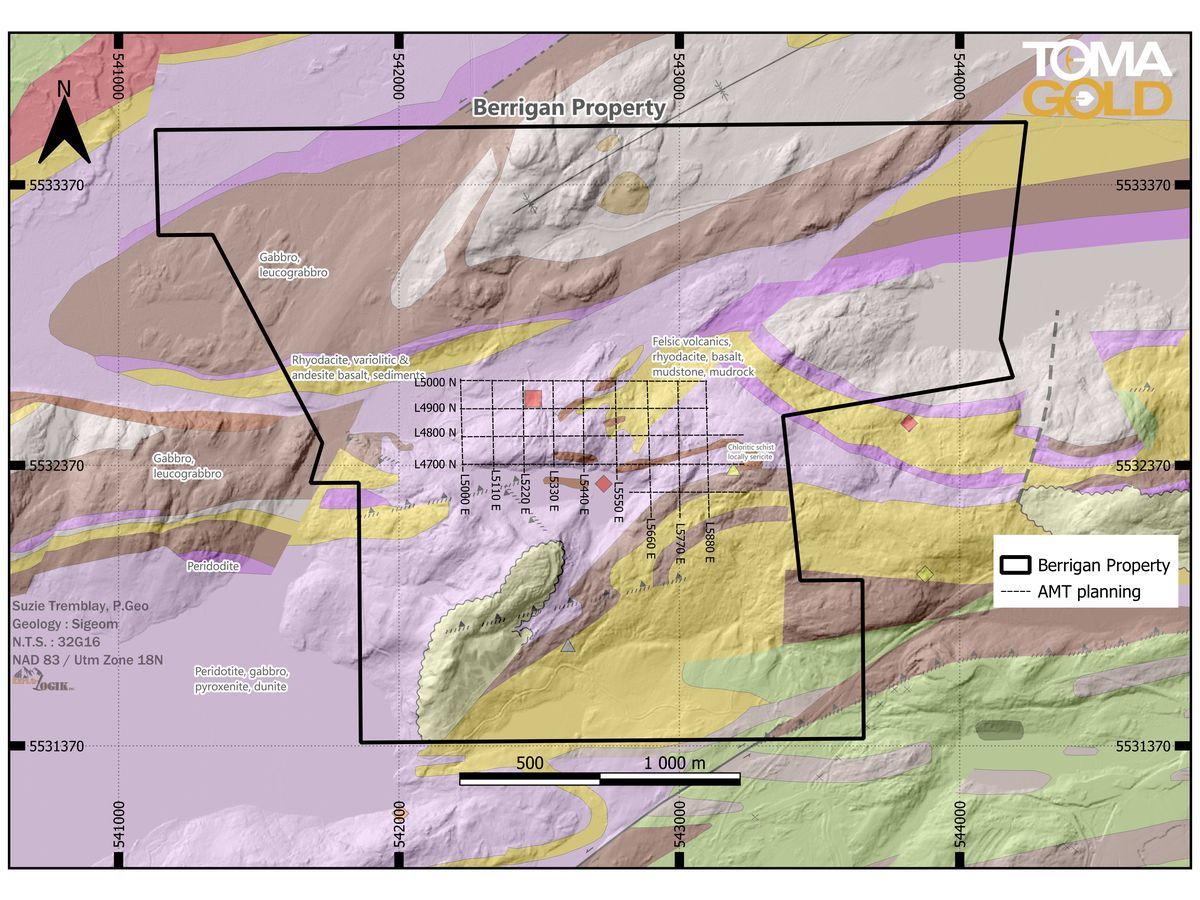
TomaGold starts an AMT survey at its Berrigan Mine project in Quebec, targeting deep conductive structures and massive sulphide zones after recent drilling hits.
Alpha Score of 52 reflects moderate overall profile with moderate momentum, moderate value, moderate quality. Based on 3 of 4 signals – score is capped at 90 until remaining data ingests.
TomaGold (TSXV: LOT; OTCPK: TOGOF) has kicked off an audio-frequency magnetotelluric (AMT) geophysical survey at its Berrigan Mine project in Quebec's Chibougamau Mining Camp. The survey, run by Géophysique TMC, follows the Phase 2 extension drilling program where assay results from all five holes are still pending. It also builds on the broader prospecting and geophysical campaign the company announced on May 28.
The Berrigan system hosts high-grade polymetallic mineralization – zinc, gold, copper, and silver – in conductive structures along major shear zones. Prior borehole electromagnetic results and recent drilling hits in the Berrigan Deep zone set the stage for this survey. The AMT work is expected to produce a district-scale 3D picture of the structural architecture controlling mineralization across the project area. It should identify new conductive corridors, possible extensions of known mineralization, and concealed massive sulphide targets at depths up to roughly 2 kilometers. Those insights will refine exploration models and guide future drill targeting across TomaGold's consolidated Chibougamau property portfolio.
Audio-frequency magnetotellurics is a passive geophysical technique. It records natural variations in the Earth's electric and magnetic fields across audio frequencies, imaging resistivity contrasts from tens of meters to several kilometers deep. That makes it useful for mapping deep structural features and conductive bodies tied to polymetallic mineralization. The current survey covers a grid of 14 lines of variable length, with measurement stations every 25 meters, totaling 7.5 line-kilometers. The contractor handles line cutting and precise chaining at 25-meter intervals. The setup should deliver high-resolution data on deep resistivity contrasts beneath the Berrigan Mine and surrounding areas.
David Grondin, President and CEO of TomaGold, said the survey marks a significant step in the company's systematic exploration strategy at Berrigan. He expects it to clarify the structural architecture controlling mineralization at depth and help identify new conductive corridors, potential extensions of known mineralization, and additional high-priority targets. The results, combined with ongoing drilling and geophysical programs, should help unlock the broader potential of the Chibougamau assets and guide the next phase of exploration.
Separately, Carbon2Green Developments Inc. – a private company where TomaGold holds a 35% interest, alongside AM Resources Corp. (35%) and certain TomaGold directors and management (30%) – has started building a portfolio of mining rights over several peatland areas in Quebec. TomaGold is evaluating these assets for carbon credit monetization through conservation, restoration, and environmental enhancement projects. Over the coming weeks, Carbon2Green plans to complete preliminary evaluations and continue discussions with stakeholders, investors, communities, and government representatives on the regulatory framework and value optimization.
The Berrigan Mine property covers 16 claims totaling 483 hectares, located 4 km north-northwest of Chibougamau. TomaGold has an option to acquire 100% of the property from Chibougamau Independent Mines Inc.
The property has several historical estimates. The most recent, from Met-Chem Canada Inc. in April 2001, reported 1.39 million tonnes grading 3.17% zinc and 1.77 g/t gold on the main Berrigan Mine zone, using polygonal estimation techniques. No resource classifications were given. That estimate is historical and not prepared under National Instrument 43-101 standards. The company does not treat it as a current mineral resource, and a qualified person would need substantial data compilation, verification, and possibly additional drilling before it could be classified as current. There is no assurance any portion of the historical resource will prove economically viable.
Drafted by a large language model from the source reporting linked above, then screened by automated publishing checks. It is not read by a journalist before publication. Some articles cite our Alpha Score. Verify prices and figures against the original source. Educational coverage, not personalized advice.