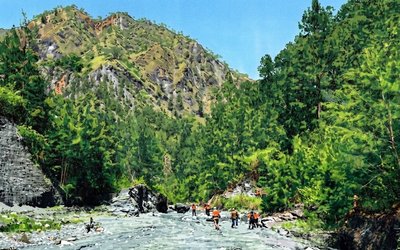
Tivan (ASX: TVN) has received stream sediment results from its Turiscai project in Timor-Leste that return 434ppm copper and 0.801ppm gold, along with anomalous silver, bismuth, and selenium. The pathfinder elements reduce the probability that the anomalies come from isolated veins or barren gossans. They strengthen the company's exploration model for a porphyry copper-gold deposit at depth.
The campaign collected 304 stream sediment samples, with 207 assays processed so far. Turiscai sits about 40 kilometres south of Dili. The project is prospective for copper-gold mineralisation. The results will guide Stage 2 prospect-scale work aimed at defining targets for a maiden drilling campaign.
Turiscai Streams Return 434ppm Copper with Pathfinder Support
Stream sediment sampling is an early-stage exploration tool that identifies geochemical signatures from mineralised rocks upstream. A peak gold result of 0.801ppm is highly anomalous for a regional reconnaissance program. The company described it as encouraging for the possible presence of a significant upstream gold mineralised system.
The sampling also returned grades of up to 0.20ppm silver, 0.62ppm bismuth, and 2.60ppm selenium. These elements are established pathfinders for porphyry-style deposits. Their presence alongside copper and gold provides three independent lines of evidence pointing toward a porphyry target.
Why Pathfinder Elements Narrow the Search
Bismuth and selenium are commonly enriched in porphyry copper-gold systems. Silver often concentrates in the upper parts of the system. The combination moves the exploration model from a generic copper-gold anomaly to a more specific deposit type.
Practical rule: pathfinder elements do not confirm an economic deposit, they narrow the search space. Tivan now has a geochemical signature consistent with a porphyry system. The next step is to test the geophysical signature.
Rock Chip Results Add High-Grade Context
The stream sediment results build on previously reported rock chip sampling that returned grades of up to 9.65% copper and 7.19 grams per tonne gold. Additional rock-chip assays from the latter part of Stage 1 and early Stage 2 fieldwork have now been received.
Sampling focused on the Ailalek area returned grades of up to 23.1% copper and 0.019g/t gold. Additional anomalous results included 35.7ppm silver, 1.86ppm bismuth, and 281ppm selenium.
| Sample Type | Peak Copper | Peak Gold | Peak Silver | Peak Bismuth | Peak Selenium |
|---|
| Stream sediment | 434 ppm | 0.801 ppm | 0.20 ppm | 0.62 ppm | 2.60 ppm |
| Rock chip (previous) | 9.65% | 7.19 g/t | – | – | – |
| Rock chip (latest) | 23.1% | 0.019 g/t | 35.7 ppm | 1.86 ppm | 281 ppm |
The rock chip results show high-grade copper mineralisation at surface. The stream sediment results indicate broader dispersion haloes. The combination strengthens the case for a porphyry copper-gold system at depth.
Stage 2 Fieldwork and the Path to Maiden Drilling
Stage 2 exploration has begun across priority target areas defined during the first regional program. Current work includes further targeted stream sediment sampling, additional rock-chip sampling, and surface programs. Field activities are expected to increase as wet-season conditions allow.
Tivan plans to expand the program to include systematic mapping, soil geochemistry, and geophysical surveys where appropriate. The company is also assessing suitable geophysical survey methods and program options to support drill targeting.
Tivan recently engaged Southern Geoscience Consultants to undertake desktop geophysical reprocessing and interpretation work across its Timor-Leste tenure, covering the Baucau, Ossu, and Turiscai projects. Collaboration with the Autoridade Nacional dos Minerais and Murak Rai Timor has provided access to airborne geophysical datasets that include heliborne electromagnetic and magnetic survey data collected under the Timor-Leste Integrated Airborne Geophysical Survey Project.
Tivan expects integration and reinterpretation of the data to improve regional geological understanding and accelerate targeting of prospective mineralised systems.
The Catalyst Timeline
The stated goal is a maiden drilling campaign at the Ossu Project in Q4. Executive chair Grant Wilson said:
Key insight: stream sediment and rock chip results are early-stage indicators. The market will re-rate TVN only when drill assays confirm continuity and grade. Until then, the stock trades on exploration optionality and news flow.
The Risk and Reward of Timor-Leste Exploration
Tivan is a pre-revenue explorer. The company has no operating mines, no production, and no guaranteed path to development. Funding for the maiden drilling program and subsequent work will require either a capital raise, joint venture, or government support.
Timor-Leste is a frontier mining jurisdiction with limited infrastructure and regulatory history. The country has no established mining sector, though the government has expressed interest in developing mineral resources. Tivan believes the work represents a foundational step in that effort with support from the local community and government.
What Confirms or Weakens the Thesis
Confirmation will come from drilling results. If the maiden holes intersect porphyry-style mineralisation with economic grades and thicknesses, the exploration model is validated. Weakness would appear if geophysics fails to identify coherent chargeability or magnetic anomalies, or if drilling returns only narrow veinlets.
Bottom line for traders: the Turiscai results improve the probability of a discovery, the stock remains a high-risk exploration play. Position sizing and catalyst timing matter more than the absolute grade of stream sediment samples.
For broader context on copper and gold markets, see AlphaScala's commodities analysis and gold profile.