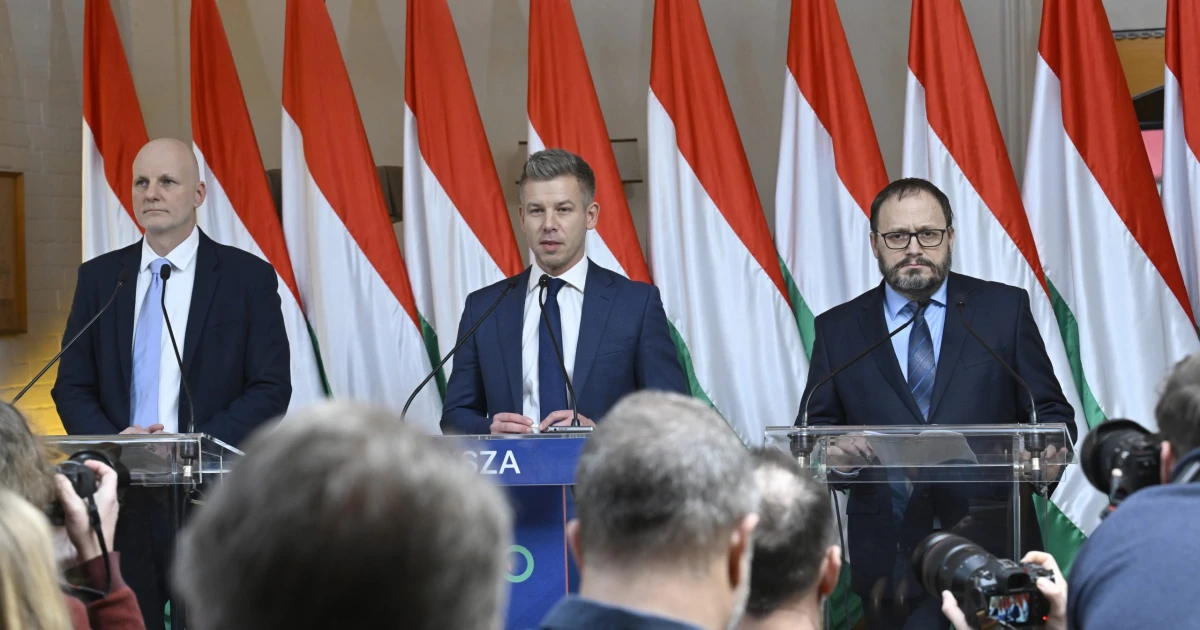
Tisza Party Eyes Euro Adoption Timeline Within Four Years

The Tisza Party has proposed a four-year timeline to begin the formal process of adopting the euro in Hungary, pending strict adherence to EU convergence criteria.
Alpha Score of 55 reflects moderate overall profile with moderate momentum, moderate value, moderate quality. Based on 3 of 4 signals — score is capped at 90 until remaining data ingests.
Alpha Score of 63 reflects moderate overall profile with strong momentum, strong value, weak quality. Based on 3 of 4 signals — score is capped at 90 until remaining data ingests.
Alpha Score of 45 reflects weak overall profile with strong momentum, poor value, poor quality, weak sentiment.
Alpha Score of 53 reflects moderate overall profile with poor momentum, strong value, strong quality, moderate sentiment.
The Tisza Party has signaled intent to initiate the formal process for Hungary’s euro adoption within a four-year horizon. András Kármán, representing the party's economic platform, confirmed the objective is to begin the integration sequence, though he noted the state must first satisfy a rigorous set of macroeconomic convergence criteria.
The Maastricht Hurdle
Transitioning to the euro is not a political choice but a technical one governed by the Maastricht criteria. Hungary currently faces significant distance from these targets, particularly regarding inflation stability, fiscal deficit limits, and long-term interest rate convergence. For traders, the primary concern remains the forint (HUF) volatility that historically accompanies discussions of monetary union. A transition to the euro would effectively remove the Hungarian National Bank’s (MNB) ability to use independent monetary policy to manage local shocks, forcing the economy to rely entirely on fiscal adjustments.
Market Impact and Currency Positioning
Institutional investors typically view euro-adoption talk as a dual-edged sword for the HUF. On one hand, the prospect of integration reduces long-term currency risk and encourages foreign direct investment (FDI). On the other, the immediate path to compliance often requires aggressive fiscal consolidation, which can curb domestic demand and impact growth-sensitive assets.
- Fiscal Discipline: Any move toward the euro requires a structural deficit below 3% of GDP.
- Inflation Targets: The MNB must align its inflation mandate with the European Central Bank (ECB) framework.
- Yield Convergence: Local bond yields would need to tighten significantly against German Bunds.
What Traders Should Watch
Market participants should monitor upcoming budget debates and MNB interest rate decisions for signs of alignment with these formal criteria. The EUR/HUF pair remains the most direct barometer of sentiment regarding fiscal policy shifts. If the government commits to a concrete roadmap, we expect a narrowing of the risk premium on Hungarian sovereign debt, though this will likely be offset by the volatility inherent in the transition period.
Investors looking for broader market analysis should note that currency integration in emerging markets often triggers a repricing of local banking stocks. Financial institutions with heavy exposure to domestic lending will face margin pressure as they adjust to lower interest rate environments and the competitive realities of a common currency zone.
Ultimately, the four-year timeline is aggressive given the current state of public finances. The burden of proof lies on the government to demonstrate that the structural reforms necessary for euro entry are politically feasible and economically sustainable.
AI-drafted from named sources and checked against AlphaScala publishing rules before release. Direct quotes must match source text, low-information tables are removed, and thinner or higher-risk stories can be held for manual review.