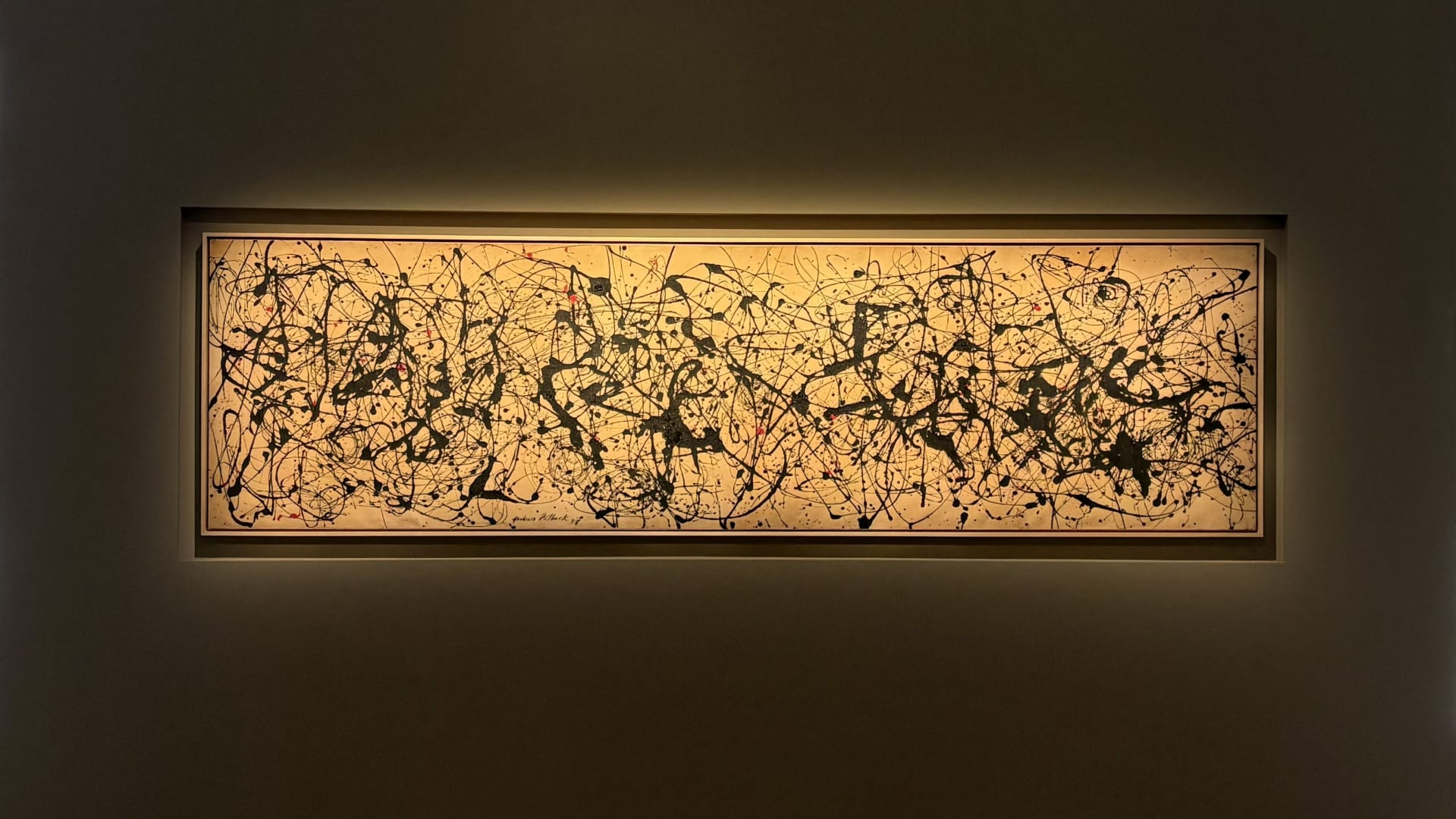
Three artworks heading to auction in New York next week carry estimates of $100 million each. The sales, which could total $1.8 billion to $2.6 billion across Christie's, Sotheby's, and Phillips, represent the largest concentration of trophy lots since the art market's rapid rebound began last fall. For equity traders, the auctions are more than a cultural curiosity. They are a real-time stress test of the liquidity and confidence that have propelled Apple (AAPL) and the broader stock market to elevated levels.
The art market's top end is a notoriously concentrated proxy for high-net-worth sentiment. When a Constantin Brancusi sculpture, a Jackson Pollock drip painting, and a Mark Rothko abstraction all carry nine-figure expectations in the same week, the outcome sends a signal about whether the wealth created by financial assets is still chasing hard assets, or whether the bid is thinning.
The Event: $2 Billion in Art Hits the Block in Five Days
The spring auction season in New York is the art market's equivalent of a mega-cap earnings week. Christie's is offering works from the collection of S.I. Newhouse Jr., the late media magnate. The headliner is Brancusi's 1913 sculpture Danaide, estimated at $100 million. A large-scale Pollock, Number 7A, 1948, carries the same estimate. Christie's is also selling Agnes Gund's Rothko, No. 15 (Two Greens and Red Stripe), estimated at $80 million.
Sotheby's counters with the collection of Robert Mnuchin, the former Goldman Sachs partner turned gallerist and father of former Treasury Secretary Steven Mnuchin. The star lot is Rothko's Brown and Blacks in Reds, estimated at $70 million to $100 million. Across the three houses, more than 20 works are estimated at $20 million or more, triple last year's count.
"Buyers are engaged and looking for opportunity right now," said Philip Hoffman, chairman and founder of Fine Art Group.
The sheer volume of supply at the ultra-high end is the event. In 2023, sellers held back top works, auction totals fell, and galleries cut back. Last fall, a few major collections unlocked the logjam. London's recent $175 million "white glove" sale at Sotheby's – where every lot sold – confirmed that bidding strength extended across price points. New York now has to prove that the momentum is durable, not a one-quarter clearance.
The Simple Read vs. The Better Market Read
The Simple Read: Art Is Booming, So Risk Appetite Is Healthy
The naive interpretation is that strong art sales equal strong markets. Marc Porter, chairman of Christie's Americas, noted that the crowds lining up to view the works are the largest in nearly a decade. "There is an energy and buzz in the rooms that we haven't seen in a while," he said. If all three $100 million lots find buyers at or above estimate, the headline will be that the global elite is still spending freely.
The Better Read: Guarantees Mask True Demand, and the Buyer Pool Is Narrowing
A deeper look shows that many top lots carry third-party guarantees or irrevocable bids. A buyer has already agreed to purchase the work at a minimum price if no higher bid emerges. This practice removes the drama of a failed auction, however it also obscures the true level of competitive demand. When a $100 million Pollock sells on a single irrevocable bid, the clearing price tells you little about the breadth of the market.
For traders, the guarantee structure means the risk event is not a headline-grabbing "unsold" lot. The risk is that works sell exactly at the guarantee level, with no bidding war, signaling that the marginal buyer has stepped back. That outcome would not make front pages, however it would be the more honest read on liquidity.
Exposure: Which Assets Are Sensitive to a Weak Auction Result
Luxury and Experience Stocks
A soft set of auctions would first pressure the luxury sector. Companies tied to high-net-worth consumption – LVMH, Hermès, Ferrari – often correlate with art market sentiment because the same cohort of global billionaires drives both. A $100 million Rothko that limps across the block at its guarantee suggests the same buyer is also pausing on a six-figure watch or a bespoke vehicle.
The Tech Wealth Link
The art market's current cycle has been powered by the fortunes of Ken Griffin, Steve Cohen, Jeff Bezos, and a new generation of Asian tech billionaires. Hoffman noted that these collectors are "sitting on massive amounts of liquidity" and that "to them, this money is peanuts." That liquidity is a direct function of equity valuations. Apple (AAPL) shares have been a primary engine of that wealth creation. A disappointing auction season would raise the question of whether tech wealth is rotating out of hard assets, and what that implies for the underlying equities.
Financials with Art Lending Books
A less obvious exposure sits with private banks that extend credit against art collections. Citi Private Bank, whose art advisory head Betsy Bickar commented on the sales, is one of several institutions that lend against fine art. A sharp repricing of top-tier works would compress loan-to-value ratios and could trigger margin calls for leveraged collectors. That, in turn, could force selling of financial assets to meet capital calls – a small channel, however one that matters at the margin when combined with other stress signals.
Timeline: When the Signal Arrives
The critical windows are the evening sales at Christie's and Sotheby's during the week of May 13. These are the marquee sessions where the $100 million lots will be offered. Results typically emerge within hours of the auction close. The sequence matters: if the first evening sale disappoints, the second will carry even more weight as a read on whether the weakness is isolated or systemic.
Key Dates
- Christie's 20th Century Evening Sale: The Newhouse and Gund collections, including the Brancusi, Pollock, and Rothko.
- Sotheby's Contemporary Evening Sale: The Mnuchin collection, headlined by the Rothko.
- Phillips Evening Sale: A smaller test of the middle market, where estimates are in the $5 million to $20 million range.
Traders should watch not just the hammer prices relative to estimates, however also the sell-through rate – the percentage of lots that find buyers. A rate below 85% at the evening sales would be a caution flag. A rate below 75% would be a clear warning.
What Would Reduce the Risk
Broad-Based Bidding Across Geographies
Betsy Bickar of Citi Private Bank said she "wouldn't be surprised if you see a lot of Middle Eastern buying in this round of sales." The governments and royal families of Saudi Arabia, Qatar, and the UAE have been building museums and acquiring Western masterworks. If Middle Eastern buyers show up aggressively, it would diversify the demand base beyond American and European collectors and reduce the concentration risk.
"There are Middle Eastern buyers who are still looking to bolster the holdings of these new museums, and making sure these museums have real quality work," Bickar said.
Strong Results Below the Trophy Level
The $100 million lots grab the attention, however the real signal on market health comes from the $5 million to $20 million range. That is where the broader collector base operates. If those works sell well above estimates with multiple bidders, it confirms that demand is deep, not just a few billionaires parking capital.
Equity Market Stability
The art market lags equities by a few months. If the S&P 500 holds its gains through the auction week, the wealth effect remains intact. A sudden equity drawdown during the auctions would be the worst-case scenario, as it would hit collector confidence in real time.
What Would Make the Risk Worse
Middle Eastern Buyers Stay Home
The wild card is the geopolitical situation. The source notes that some say the conflict could cause Middle Eastern countries to focus capital on rebuilding rather than art. If that buyer base is absent, the auctions lose a critical source of marginal demand. The Americans have been the driving force, however a one-legged stool is riskier than a three-legged one.
Guarantees Become the Only Bid
If the irrevocable bids are the sole support for the top lots, the auction houses will claim success while the market quietly reprices risk. A Pollock that sells at exactly $100 million on a single guarantee is not a $100 million market; it is a $100 million floor that was pre-arranged. The next time that work comes to market, the guarantee may not be there.
Provenance Premium Fades
Advisors say provenance – the ownership history – matters more than ever. Works from the collections of the Rockefellers, Paul Allen, or Newhouse carry ever-higher premiums. If a Newhouse Pollock struggles, it would signal that even the most vaunted provenance cannot overcome a thinning bid. That would reset expectations for the entire top end of the market.
Practical Framework for the Week Ahead
- Watch the first Christie's evening sale as the lead indicator. The Brancusi and Pollock are the bellwethers.
- Track the sell-through rate, not just the dollar total. A high total on a low sell-through rate is a weak market masked by a few big numbers.
- Monitor luxury stock reaction in the days following the auctions. LVMH and Ferrari shares often move in sympathy with art market sentiment.
- Check the Middle Eastern bid. If Saudi and Emirati buyers are active, the risk of a demand shortfall drops materially.
Key insight: The art market is a slow-moving but high-signal indicator. A weak May auction season would not crash equities overnight, however it would join other signs of a peak in risk appetite. A strong season, with broad bidding and no reliance on guarantees, would confirm that the wealth effect from financial assets is still converting into hard asset demand.
The next two weeks will show whether the $100 million trio is a celebration of liquidity or its last call.