Stocks● Neutral
Thinking With the Machine: A Blueprint for Human-AI Decision Making
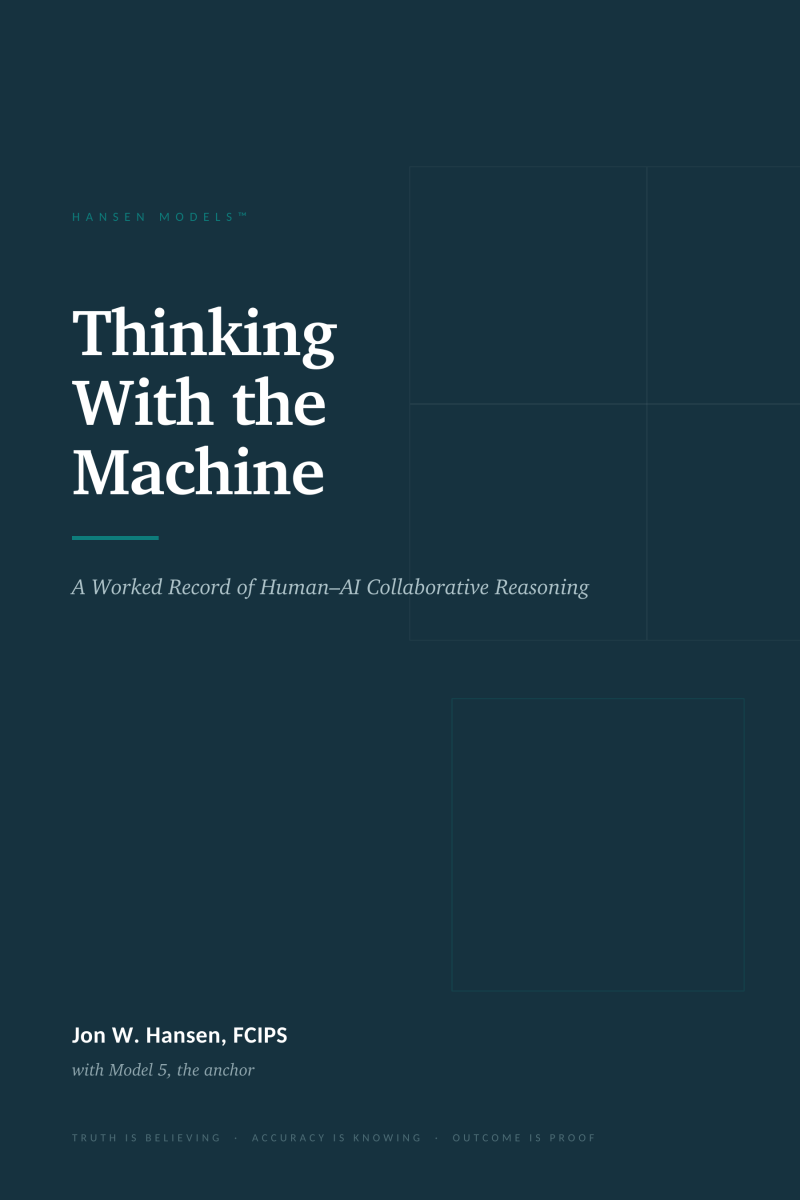
Jon Hansen's new book tests human-AI reasoning against real, pre-outcome decisions. The disciplined system of prompt, verify, and correct is the rare practical guide for decision-makers who need the machine to be a tool, not a crutch.
Continue with
Jon W. Hansen's new book, Thinking With the Machine, doesn't arrive as another hype cycle manual. It lands as a technical field guide for the messy reality of mixing human judgment with large language models. The subtitle – A Worked Record of Human–AI Collaborative Reasoning – is precise. Hansen, who has published Procurement Insights since 2007, uses the book to walk through real organizational decisions culled from dated public records, before anyone knew the outcome.
The premise is straightforward but rare in practice: the AI is a reasoning tool, not a decision-maker. The book is designed for people who have to stand behind decisions that affect others – executives, risk officers, procurement leads, auditors, systems builders. Hansen spends the first chapters establishing the core discipline. Prompt the machine, then verify what comes back. Treat fluency as a warning sign, not a signal of truth. The model's job is to surface evidence and surface contradictions. The human's job is to weigh both.
The worked-case format is the book's strongest move. Hansen does not present polished hypotheticals. Each case originates from a real dataset – a contract award, a supply chain disruption, a governance failure – with the outcome hidden. The reader and the model walk through the evidence side by side. Hansen shows where the AI hallucinates a plausible but wrong number, where it misses a context clue a human would catch, and where the human's own bias leads them to accept a bad answer. The pattern repeats: question, evidence, check, revise.