Back to Markets
Crypto▲ Bullish

The Trillion-Dollar Frontier: Why Tokenized Real-World Assets Are Poised for Hyper-Growth

April 10, 2026 at 03:33 AMBy AlphaScalaSource: Coincu
The Trillion-Dollar Frontier: Why Tokenized Real-World Assets Are Poised for Hyper-Growth

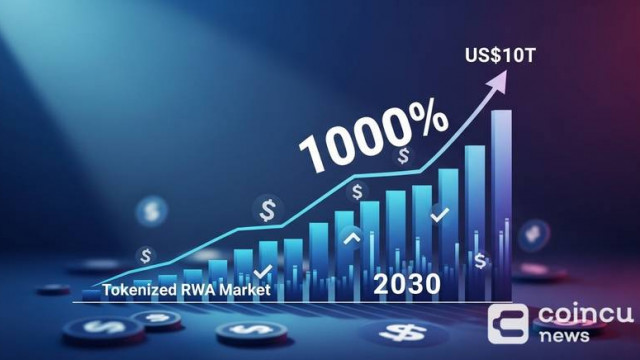
With projections pointing to a 1,000% growth in tokenized real-world assets by 2030, institutional investors are pivoting toward a future where traditional finance meets blockchain efficiency.

A Paradigm Shift in Asset Management

The digital asset landscape is undergoing a structural evolution, shifting its focus from speculative volatility to the integration of institutional-grade financial instruments. According to recent industry projections, the market for tokenized Real-World Assets (RWAs) is currently on an aggressive growth trajectory, with estimates suggesting the sector could reach a valuation of US$400 billion by 2030. This represents a staggering 1,000% expansion from current levels, signaling a fundamental change in how capital is mobilized, settled, and managed across global markets.

Tokenization—the process of converting rights to physical or financial assets into digital tokens on a blockchain—is no longer a theoretical exercise for crypto-native firms. It has become a strategic priority for traditional financial institutions looking to enhance liquidity, reduce settlement times, and democratize access to previously illiquid asset classes such as private equity, commercial real estate, and treasury bills.

Understanding the 1,000% Growth Thesis

The projected surge to US$400 billion is underpinned by the inherent inefficiencies of legacy financial systems. Traditional asset transfers often involve complex intermediary chains, manual reconciliation, and T+2 settlement cycles. By migrating these assets to distributed ledger technology (DLT), firms can leverage atomic settlement, 24/7 market access, and fractional ownership models.

Market analysts point to the increasing appetite of institutional investors for yield-bearing blockchain assets as the primary catalyst. As traditional firms begin to recognize the operational cost reductions associated with smart-contract-based asset management, the migration of sovereign debt and high-quality liquid assets (HQLA) onto public and private chains is expected to accelerate significantly over the next six years.

Market Implications for Institutional Traders

For the professional trading community, the rise of RWA tokenization marks a transition toward a hybrid market structure. We are moving away from a bifurcated system—where crypto assets and traditional securities operate in silos—toward a unified digital ledger environment.

Key implications for traders include:

  1. Increased Capital Efficiency: The ability to use tokenized government bonds or real estate as collateral in DeFi protocols introduces a new layer of liquidity for institutional portfolios.
  2. Reduced Counterparty Risk: Blockchain-based settlement provides transparent, immutable records of ownership, mitigating the risks associated with traditional clearing processes.
  3. Fractionalization: Retail and institutional players alike will gain access to high-barrier asset classes, potentially compressing risk premiums and altering yield curves.

However, the transition is not without friction. Regulatory compliance remains the primary hurdle. For the US$400 billion target to be met, global regulators must establish clear frameworks for custody, KYC/AML integration, and cross-border digital asset recognition. Investors should remain cognizant that while the technological outlook is bullish, the pace of adoption will be dictated by the speed of legislative alignment in major jurisdictions like the EU, the US, and Singapore.

What to Watch Next

As we look toward the 2030 horizon, the primary metric for traders is the volume of 'on-chain' value locked in institutional-grade protocols. Keep a close watch on the deployment of central bank digital currencies (CBDCs) and institutional 'stablecoin' initiatives, as these will likely serve as the foundational on-ramps for the tokenized economy.

Furthermore, monitor the shift in asset manager behavior. When tier-one investment firms begin to report significant portions of their AUM in tokenized format, it will serve as the definitive signal that the 'experimental phase' has concluded and the era of mass institutional adoption has begun. The next 72 months will likely be defined by the race to build the infrastructure that will host this multitrillion-dollar migration.