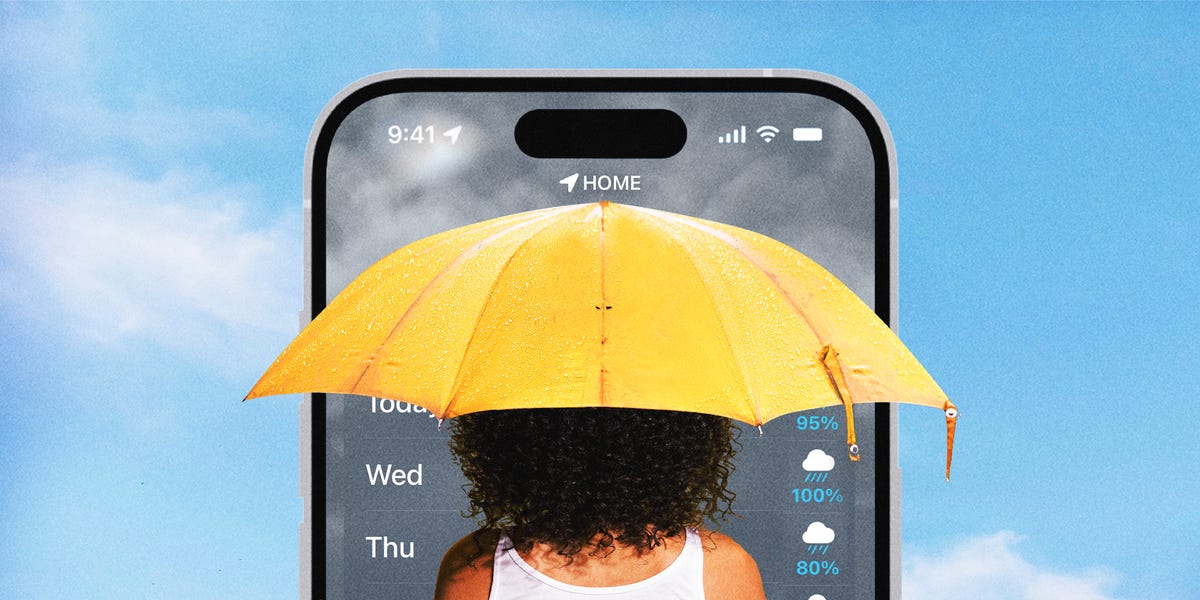
Maya Haddad Miller has spent a decade tracking how a single weather app icon cuts her sales in half. She and her father own Brooklyn Beach Shop in Coney Island, New York, selling souvenirs and beach gear. When a little rain icon pops up on the default weather apps, business drops by 50%, she says, whether any rain falls or not. “When you talk about weather forecasts, that’s our life – we eat, breathe, everything the weather,” she told me.
The problem is not the meteorology. It’s the translation. Behind every tiny icon sits enormous data: physics-based models, satellite observations, radar, weather stations, and increasingly AI systems that process it all. Forecasters blend multiple models for the most accurate reads. That complexity largely disappears once it reaches your phone. A single image represents the dominant conditions for an entire day, even if those conditions vary widely. Apps often skip the complex analysis human meteorologists do.
Daniel Swain, a climate scientist at UCLA, says the science behind forecasting has never been better. “Rather than leveraging the sum and totality of this incredible wealth of sophisticated meteorological information that’s out there, they’re just kind of saying, ‘Eh, screw it, let’s just pick one of these data sources,’” he said. “When you do that, you’re kind of wedded to that one data source, which may or may not be the single best option in a given context.”
Basic weather apps are fine for a first glance, said Jason Furtado, an associate professor of meteorology at the University of Oklahoma, but they fall short on details. Weather can be hyperlocal – a storm hits one part of town and not another. Generic apps also don’t track rapidly evolving weather well. People need to know timing and severity, not a vague 100-mile radius forecast. “These apps, if you actually look at it, let’s say hour to hour, it’ll change,” Furtado said. “That’s not really helpful, especially if you’re trying to make a decision.”
The economic cost is real. A study presented at the American Economic Association found that when precipitation is overpredicted, local businesses suffer a measurable drop in foot traffic and consumer spending, even when the weather is fine. Retail, food service, and entertainment are particularly hurt. The researchers concluded that investment in improving forecasts could have “significant downstream benefits for local economies.”
Business owners across the country feel it. Rob Bryn, a musician in Rockaway Beach, New York, said he started bartending by the beach in 2011 and families would show up on rainy days anyway. Now, Mom sees the rain cloud on her phone and cancels the trip, even if the rain is only forecast for half an hour late at night. “They don’t take the chance anymore,” Bryn said. “It’d be a beautiful day, and there’d be nobody there, and I’d be like, ‘Damn, these sheep are so easily controlled by this icon on their phone.’” He follows a local Instagram account for weather updates because “the weather apps are always wrong.”
Steven Cohen, vice president of the Brooklyn Cyclones minor league baseball team, said he wishes fans would use more detailed apps. “There are days when we get nothing, it’s beautiful out, and the rain storm may clip the Bronx and the Yankees get it,” he said. If people see a cloud days out, they make other plans. “It’s already in people’s heads that it’s going to be bad weather.”
Adam Rinn, director of Coney Island Inc., a nonprofit hosting events, told me his weather app forecast rain all afternoon. It was 3 p.m. and no rain had fallen. “If you look at the radar, the rain just skirted us.”
Mike Bengston, general manager of Splish Splash Water Park on Long Island, said people worried about app forecasts should realize it may be a great time to visit. Shorter lines. “The days where it does look a little bit iffier, you are going to have shorter lines if things work out,” he said.
Nick Ribeiro, who runs Preserved Links, a private golf club, said he gets texts days before events from people asking if it’s still on, given the forecast. Often he’s already paid the course. “There’s always a reason not to play, so if the weather gets between you and the tee, it’s an easy route to bail on your round of golf,” he said.
This is not just an American problem. In March, over 100 British attractions wrote an open letter to the Met Office, the UK’s national weather service, warning that misleading rain icons on popular apps cost them thousands of pounds a day.
Developers face a tough balance. Dan DePodwin, director of forecast operations at AccuWeather, said people want to spend 30 seconds or less checking the day. The challenge is delivering that information in a straightforward, helpful way. “Within just one screen, you can get a lot of information, but there’s still a lot of blank space to let your eye not be totally consumed,” he said.
Not all apps are equal. Some have real depth; others cover basics. Eric Floehr, founder of ForecastWatch, which monitors forecast accuracy, said there’s a wide gulf between a developer using a $9-a-month API and an enterprise weather intelligence company. “You often do get what you pay for,” he said.
The stakes extend beyond lost revenue. The benign version is a rain icon on a sunny day. The scary version is someone missing a lightning strike or tornado because they focused on a single number or image.
Meteorologists advise treating standard apps as a cursory check, not gospel. They recommend looking to local meteorologists or the National Weather Service, or calling the golf course or amusement park ahead of time. Human expertise still matters.
The day I spoke with Haddad Miller, the forecast showed a string of sun-filled days. She was cautiously optimistic. “Saturday should be spectacular,” she said. “Theoretically. Unless they come in and put in a rain emoji the day before and then take it away.”