
The office 'big light' debate splits Gen Z and millennials at firms like Atlas Financial Solutions, where workers compromise with desk lamps and warm LEDs.
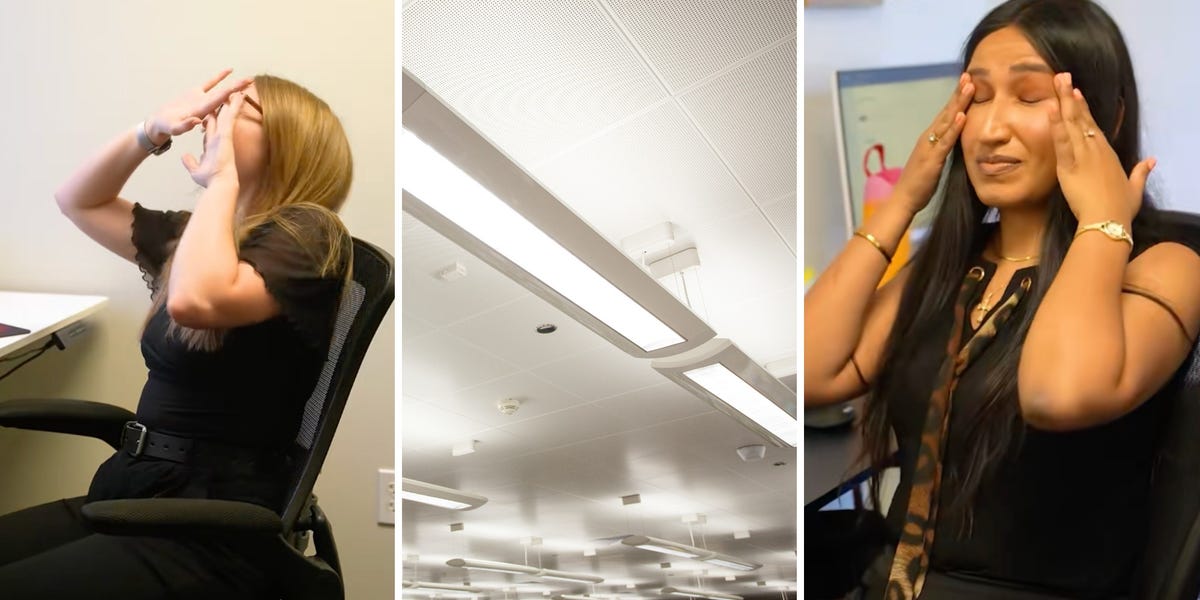
At Atlas Financial Solutions in Bakersfield, California, the flip of a switch reveals a generational fault line.
Amanda DiGiacomo, the firm's owner and a millennial, likes the overhead fluorescents on. "I just feel like I can see the computer screen better," she told Business Insider. "My eyes can focus on it more, and it feels like I'm not about to go to sleep."
Her Gen Z payroll specialist, Reyna Arredondo, sees it differently. "It makes me feel pressured, and maybe anxious," Arredondo said.
The "big light" debate has moved beyond office break rooms onto TikTok, where younger workers trade solutions like light covers, window blinds, and personal desk lamps. Business Insider spoke to 11 office workers across six companies and two interior designers about the bright overhead lighting that defines so many commercial interiors.
For some employees, the fluorescents help them stay alert and make text on a screen easier to read. For others, the glare triggers eye strain, headaches, or distraction. The disagreement poses the same kind of problem as thermostat wars: lighting preferences are personal and hard to customize in a shared room.
At Atlas, the split fell cleanly along generational lines. The office filmed a TikTok about it. Younger employees use software that warms their screen tint or ask millennial coworkers to switch off certain rows of lights. Workers at other Bakersfield businesses they know have bought window shades or diffuser covers for the ceiling strips. DiGiacomo worries those could be a fire hazard.
Desiree Posey, the office manager and a millennial, said dark rooms strain her eyes and give her headaches by the end of the day. She and Arredondo reached a compromise: the fixture over Posey's desk stays on, the one over Arredondo's stays off.
Daria Ershova, a 25-year-old marketing consultant, said she hates the big light. At a previous job she brought a lamp to her desk and started what she called an office evolution. "A few of my Gen Z coworkers noticed what I had done, and suddenly we had a whole coalition," she said. Management eventually added a budget for Gen Z staff to buy their own lamps.
The generational pattern does not hold everywhere. Brittany Blackman, 36, a millennial and founder of executive leadership consulting firm Discover Freedom, said she prefers a dark room. She spoke to Business Insider from one, calling it her "happy state." She has brought a lamp to previous office jobs and told clients with bright overheads, "Hey, I'm not winking at you. It's just that the lights really impact me."
Lucia Fuentes, a 28-year-old San Diego-based interior designer, is firmly anti-big light. She said it "washes everything out." Even at her own design studio, she brought in personal lamps. "It was weird too, because my job is literally designing spaces and yet I found myself sitting under something I wouldn't recommend to clients," she said.
Fuentes has watched the TikTok discourse and has practical advice. She does not recommend covering fluorescent tubes with paper towels or other flammable material. The most cost-effective fix, she said, is a small secondhand desk lamp or asking the company to swap the bulbs for warm-white LEDs in the 2700-3000 Kelvin range.
Her larger point: good workplace lighting gives employees options. A mix of natural light, warmer ambient sources, and task lamps beats a single uniform fixture overhead. In shared offices, one person's ideal brightness can be another's headache trigger.
Drafted by a large language model from the source reporting linked above, then screened by automated publishing checks. It is not read by a journalist before publication. Some articles cite our Alpha Score. Verify prices and figures against the original source. Educational coverage, not personalized advice.