Stocks● Neutral
The New Yorker's Catalogues: Why the Hidden Rule Beats the Trivia
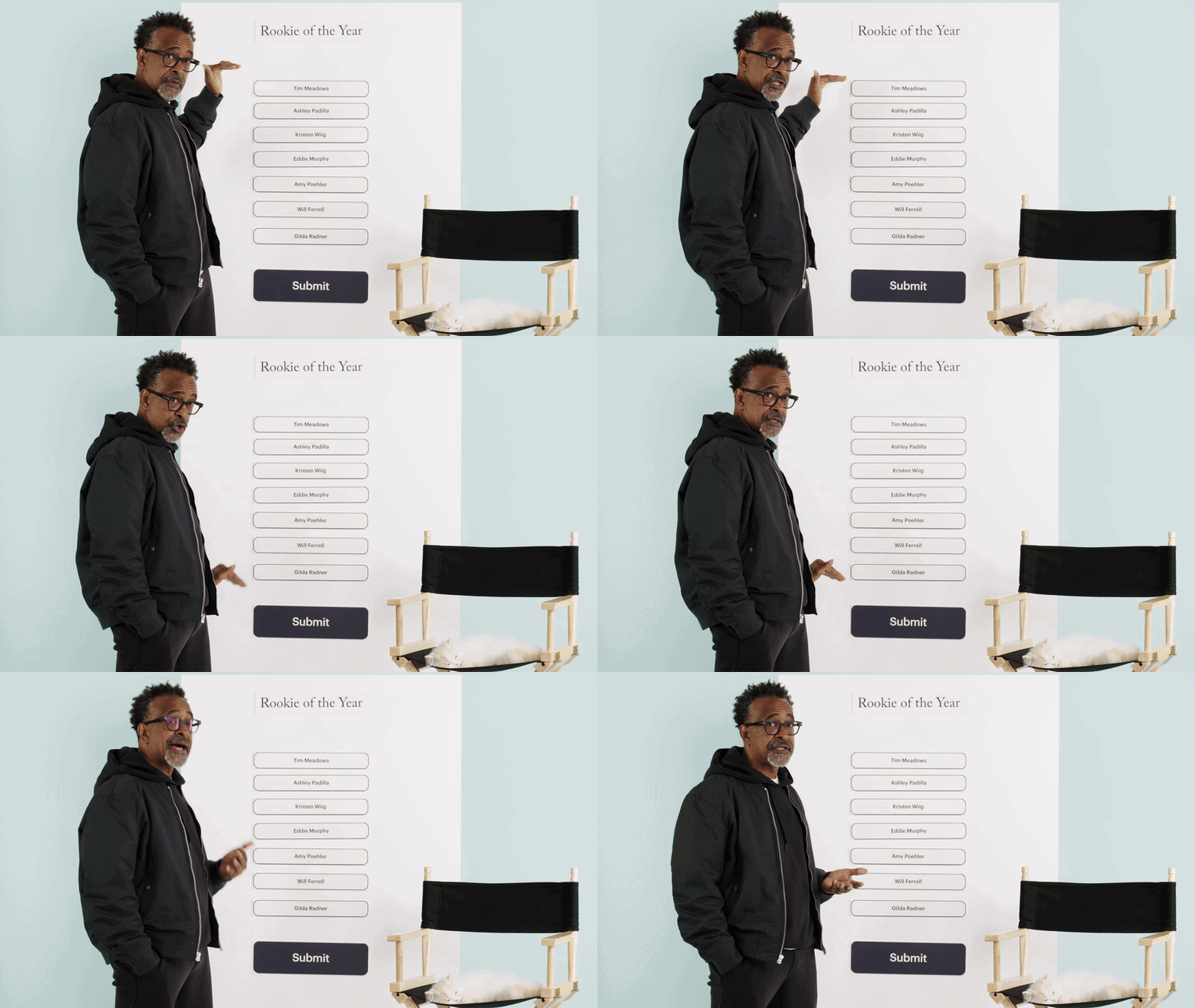
The New Yorker's Catalogues puzzle forces players to find the hidden ordering rule before sequencing clues. The same skill applies to market signals where the surface narrative misleads.
Continue with
The New Yorker launched Catalogues on Thursday, a daily ordering puzzle that asks players to sequence seven clues according to a hidden rule. Liz Maynes‑Aminzade, the publication's puzzles‑and‑games editor, described it as a mix between a trivia game and a puzzle. For a trader, the immediate question is not about the game itself but about the mechanics that separate a winning streak from a frustrating loss. The same principle applies to any systematic process–whether you are sequencing market signals or ordering clues.
The Concept: Ordering Rules Are the Hidden Variable
Catalogues always requires the same output: a correct sequence of seven items. The input varies. Maynes‑Aminzade grouped the ordering rules into three broad categories. Numerical rules ask you to rank items by height, age, or any continuous scale. Alphabetical rules require sorting by name or title. Calendar rules (like the launch game "Person of the Year") demand chronological ordering based on embedded date references.
Why the Rule Matters More Than the Trivia
A player who knows the seven items guesses the wrong ordering rule will fail. A trader who sees a valuation multiple misidentifies the relevant discount rate applies the wrong framework to the same data. The mistake is identical: the inputs are correct, the sorting logic is wrong. Maynes‑Aminzade noted that the game's titles often contain wordplay and misdirection. The signal is embedded, not announced.
The Three Rule Types in Practice
Numerical examples include a list of buildings arranged by height. Alphabetical examples include the launch game's fictional cats–"Jon's lasagna-loving pet" is Garfield, sorted by name. Calendar examples include the "Person of the Year" game, where "Meg, Jo, Beth, and Amy of 'Little Women'" are the March sisters, ordered by calendar month. The player must identify which rule applies before sequencing.
The Common Mistake: Memorising Answers Instead of Learning Categories
Most first‑time players of Catalogues try to memorise yesterday's sequence. That strategy has zero carryover to the next day because the ordering rule changes. Maynes‑Aminzade said, "You get better at it the more you play. You get a feel for the kind of wordplay and misdirection that's often involved in the titles." The practical takeaway: pattern recognition across rule types, not rote recall of individual sequences, is what compounds.
How the Mistake Manifests in Markets
A trader who memorises that a P/E contraction follows a rate hike during one cycle may buy the dip after every hike, ignoring that the ordering rule (inflation regime, fiscal stance, liquidity trap) has shifted. The error is the same: applying a historical output without re‑identifying the sorting rule. Catalogues forces the player to re‑identify the rule each round. Markets do the same, most participants default to habit.
A Better Framework: The Three‑Step Rule Scan
Maynes‑Aminzade's interview provides an implicit workflow that can be formalised. Before sequencing, a Catalogues player should run a three‑step scan:
- Identify the clue type – Are the clues dates, numbers, proper nouns, or something else?
- Test the most likely rule – Numerical first, then alphabetical, then chronological.
- Eliminate misdirection – If a title uses a pun or a secondary meaning, the rule may be hidden in the pun.
Worked Example from the Source
In the launch game "Person of the Year," the clues included "Meg, Jo, Beth, and Amy of 'Little Women'." A naive player might search for the year the novel was published. The correct rule was the month embedded in each character's name (March sisters → March). Maynes‑Aminzade said that after a few rounds, players start seeing lists everywhere–meaning the framework becomes automatic.
Practical rule: When the rule is ambiguous, start with the simplest scalar ordering (numerical or alphabetical). Only escalate to calendar or thematic rules after the simple tests fail.
The Risk Check: What Confirms or Breaks the Sequence
Catalogues does not tell you when you are wrong until you submit the full sequence. That creates a binary outcome–you either solve it or you do not. In trading, by contrast, partial signals arrive during the process. An analogue to Catalogues would be sequencing seven catalysts in their expected chronological order. A misordered early sign can invalidate the whole chain.