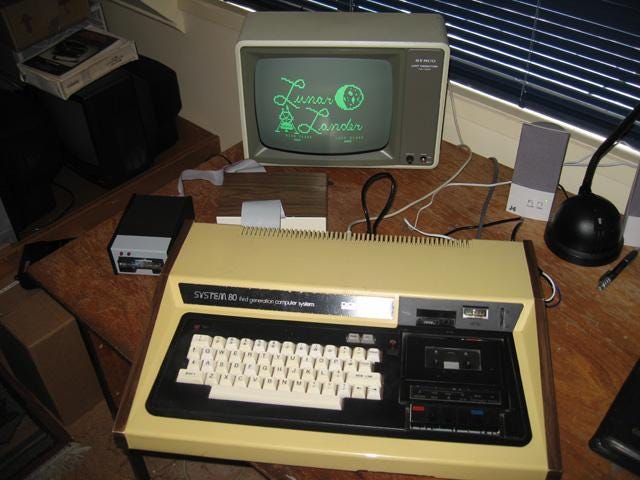
Dungeons of Daggorath ran on a TRS-80 with 8KB of memory, yet delivered a first-person dungeon crawler with a heartbeat-based health system and multiple dungeon levels.
If I had to pick one piece of code that pushed hardware limits furthest, it would be Dungeons of Daggorath. The game ran on a TRS-80, a machine with roughly 8KB of memory. That number is smaller than a single image file or a short text document. Yet within that space, Douglas J. Morgan and Keith S. Kiyohara built a first-person dungeon crawler, years before the genre took the shape most players recognize today.
What the game achieved with such simple tools is not just the 3D-ish maze structure or the multiple dungeon levels. It is the atmosphere. Instead of a traditional health bar, the game uses a heartbeat system. Your heartbeat speeds up when you run, fight, get hit, or fumble a potion. That audio feedback becomes an emotional layer on top of the gameplay. It is simple. The effect works well in building tension.
The dungeon itself is a five-level maze with corridors, doors, and hidden paths. Some doors cannot be seen unless you carry the right torch. That mechanic alone adds a layer of exploration that feels modern. Timing also matters. The dungeon is not static. Wandering monsters move on their own schedules. The player must manage light sources, because torches burn out. Running out of light in a dark corridor is a real threat, not a scripted set piece.
All of this ran on a machine with no hard drive, no graphics card, and a tape drive for loading. The programmers had to hand-optimize every byte. Assembly language, tight loops, no room for wasted instructions. The result was a game that influenced later titles like Eye of the Beholder and Might and Magic, even if those later games had more memory to work with.
The constraints forced creative solutions. The heartbeat system is the most famous. It uses the cassette output port to generate sound, because the TRS-80 had no dedicated sound chip. That hack turned a hardware limitation into the game's signature feature. It is a lesson in design that still holds: limits can drive invention more reliably than abundance.
Prepared with AlphaScala research tooling and grounded in primary market data: live prices, fundamentals, SEC filings, hedge-fund holdings, and insider activity. Each story is checked against AlphaScala publishing rules before release. Educational coverage, not personalized advice.