The Hardest Part of Building a Startup Comes After Seed Funding
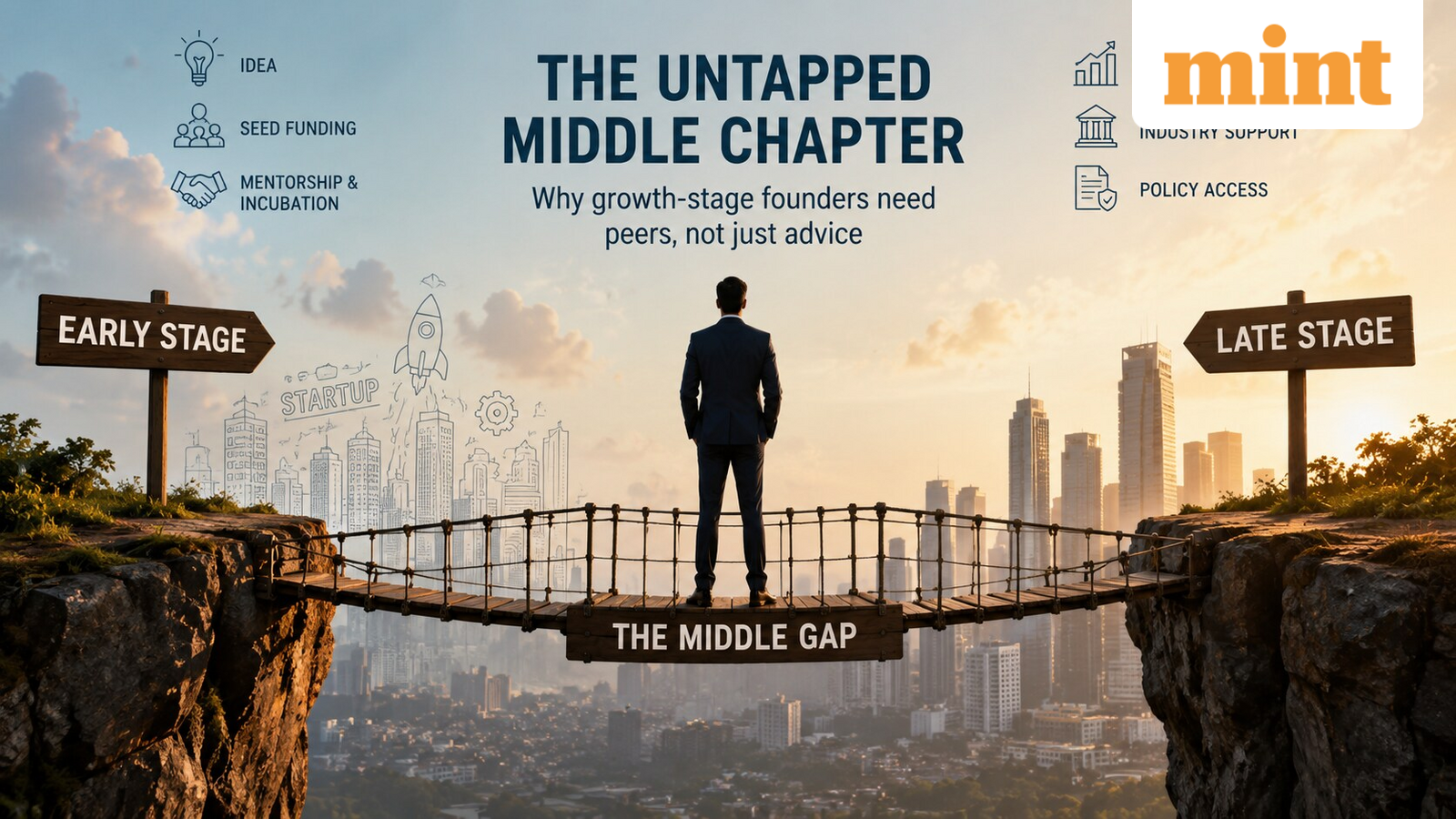
India's startup ecosystem supports early and late stages, but growth-stage founders are left to navigate the hardest part alone, according to ASCENT Foundation CEO Sagar Gosalia.
India's startup ecosystem has a clear gap, and it sits right in the middle. The country counts over 2 lakh registered startups, the third-largest pool in the world. MSMEs contribute roughly 31% of GDP and employ more than 300 million people. Those numbers show real momentum. But the support infrastructure that got the ecosystem this far has not kept pace with one critical stage: the growth phase.
ASCENT Foundation CEO Sagar Gosalia laid out the problem in a recent piece for Mint. The early stage, he wrote, benefits from a developed network of incubators, seed funds, and government schemes. The late stage, with its established businesses, has institutional capital and policy access. The growth-stage founder falls between those two poles largely alone.
That founder has crossed proof of concept, built a team, found a market, and generated meaningful revenue. Seed funds and incubators are no longer relevant. Institutional support structures have not yet kicked in. The challenges at this point, Gosalia said, are the hardest founders will face in the entire arc of building a business.
This is not a small population. It is the backbone of the Indian economy, and it is consistently underserved. The early stage offers clarity: the founder is close to every decision, every customer, every hire. The late stage brings clarity of systems and structure. The middle chapter has neither.
At this stage, the team has grown large enough that the founder can no longer oversee everything, but not so large that proper processes have taken hold. The product has found a market, but scaling it requires a different kind of thinking than building it did. Leadership challenges shift from hiring the first few people to building a culture that holds as the organisation grows. The founder, once energised by early momentum, now navigates problems that are harder to articulate, harder to benchmark, and harder to get good counsel on.
Most of the advice available to founders at this point, Gosalia argued, was shaped by someone else's context – built at a different time, in a different market, at a different scale. That advice is not useless, but it rarely fits precisely enough to be actionable.
Peer learning, he said, offers a better fit. The founders who navigate the middle chapter well are almost never the ones with the most advice or the most capital. They are the ones who had the best conversations at the right time with people who understood the territory they were crossing. A good conversation with a peer building through something similar arrives from inside the problem. It is specific, grounded, and offered without the distance that expertise can create.
ASCENT, which now counts over 1,300 entrepreneurs, organises its community around peer learning. Trust Groups of 8 to 10 founders meet every month to work through real problems in a confidential setting. The peer table is not a networking forum. It is a thinking environment designed specifically for the growth-stage founder who needs more than information and more than inspiration.
The business case for peer learning, Gosalia said, is often undersold. Founders who engage consistently with a peer group course correct faster, because someone in the room has taken the longer route and can say so plainly. They make better hiring decisions because they draw on collective experience. They build more resilient organisations because they are not carrying the weight of every uncertainty alone.
Gosalia closed with a forward-looking note: the next chapter of India's growth will be written by its entrepreneurs. No founder writes it alone.
Drafted by a large language model from the source reporting linked above, then screened by automated publishing checks. It is not read by a journalist before publication. Some articles cite our Alpha Score. Verify prices and figures against the original source. Educational coverage, not personalized advice.