My wife and I took a four-day road trip to the Hudson, New York area. We wanted to see gardens and a couple preserved homes. The first night we stayed in Hudson, a town that lost to Albany by one vote to become New York's capital. At one time it was a bustling whaling center. The Whaler Hotel, where we stayed, still carries the name. Many shops and restaurants use the word “whaler” in their titles. Today the town has lost most of its industry. There are a few decent restaurants. For some reason, there are lots and lots of boutique furniture stores.
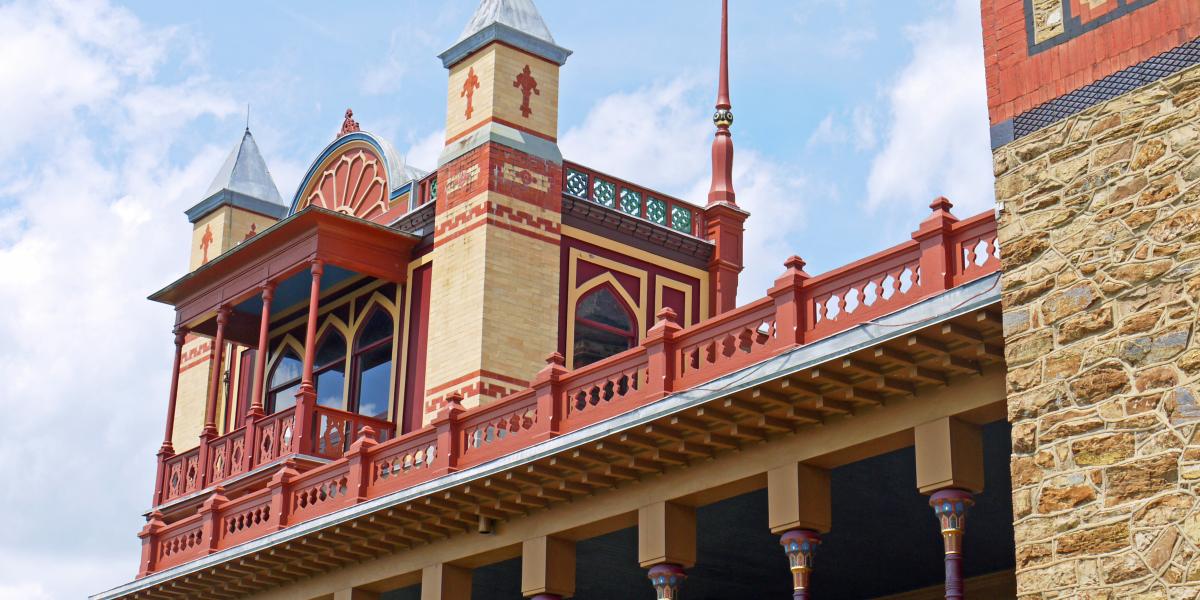
Our first stop was Olana State Historic Site, home of the restored mansion of 19th-century Hudson River painter Frederic Church. Church was wildly popular. He became fabulously rich, selling his paintings for what in today's money would be hundreds of thousands of dollars each. He took his paintings on tours of major U.S. cities. He rented a gallery and charged twenty-five cents, a very substantial fee in those days, for thousands of art lovers to view his works. He and his wife traveled widely. He painted striking landscapes of what he saw. Americans got a glimpse of the natural wonders of the world in vivid color on huge canvasses.
Church died around the turn of the century. His direct descendants eventually died out, and his large property along the Hudson fell into ruins. At the height of his fame, Church purchased a several-hundred-acre property with a very high hill. He built a mansion there. The vistas from the hilltop appealed to the artist. He created “view sheds” on his property, paths between the trees that guided the eye up and down the Hudson. We first learned of the term at the Visitors' Center. They suggested we watch a 15-minute video. The views from the hilltop home are striking even today. There is a reason for that. The modern owners of Olana have waged an unrelenting campaign to prevent any sign of industry for miles and miles in all directions. The video expects us all to be very proud of the nonprofit's influence over such a vast area in stopping industrial development in the bud.
Two major accomplishments were highlighted. The first was stopping construction of a nuclear power plant at least ten miles south of Olana on the other side of the Hudson River. Construction of the plant was perfectly legal. It violated Olana's “view shed.” From the top of the hill upon which the mansion sat, one would be able to see the cooling towers on a clear day. Can't have that. Olana successfully got the plant moved much further south, out of its view shed.
One might say the plant was eventually built, so what is the big deal? The company had spent many millions of dollars planning its construction and getting all the permits, land acquisition, and so on for the site that was abandoned. That is a dead-weight loss to the company and to its customers that can never be recovered. It is as if you had spent time and money lining up an architect and contractors to build an addition on your home. All the permits were obtained at great time and expense. Your neighbors browbeat you into abandoning the project. Instead of a larger home for your family in its present location, you had to move.
A much later accomplishment was stopping a cement company from upgrading and restarting a cement plant on the outskirts of Hudson, about five miles away from Olana. The plant had been shuttered for a time. The market for its high-quality cement rebounded. The owners planned a substantial upgrade and expansion. The plant would have some tall structures that would “spoil” Olana's “view shed.” Forget the needs of the nation that this plant would meet and the increase in employment the depressed area sorely needed. The spoliation of the 19th-century view would offend the people who now run Olana. By the way, they operate with a very substantial monetary input each year from the burdened taxpayers of New York. Our very nice guide for our two-hour tour of the house and properties burst with pride of how Olana stopped this terrible thing from happening.
Now, remember, Olana actually owns only a few hundred acres around its prominent hill with the mansion atop. Yet it claims moral authority over all it can see, its “view shed.” The business owners who never were and the employees who never were had no say in Olana's conception of a better world. That world just might include such plebeian values as a decent-paying job, a home of one's own, and a future for one's offspring.