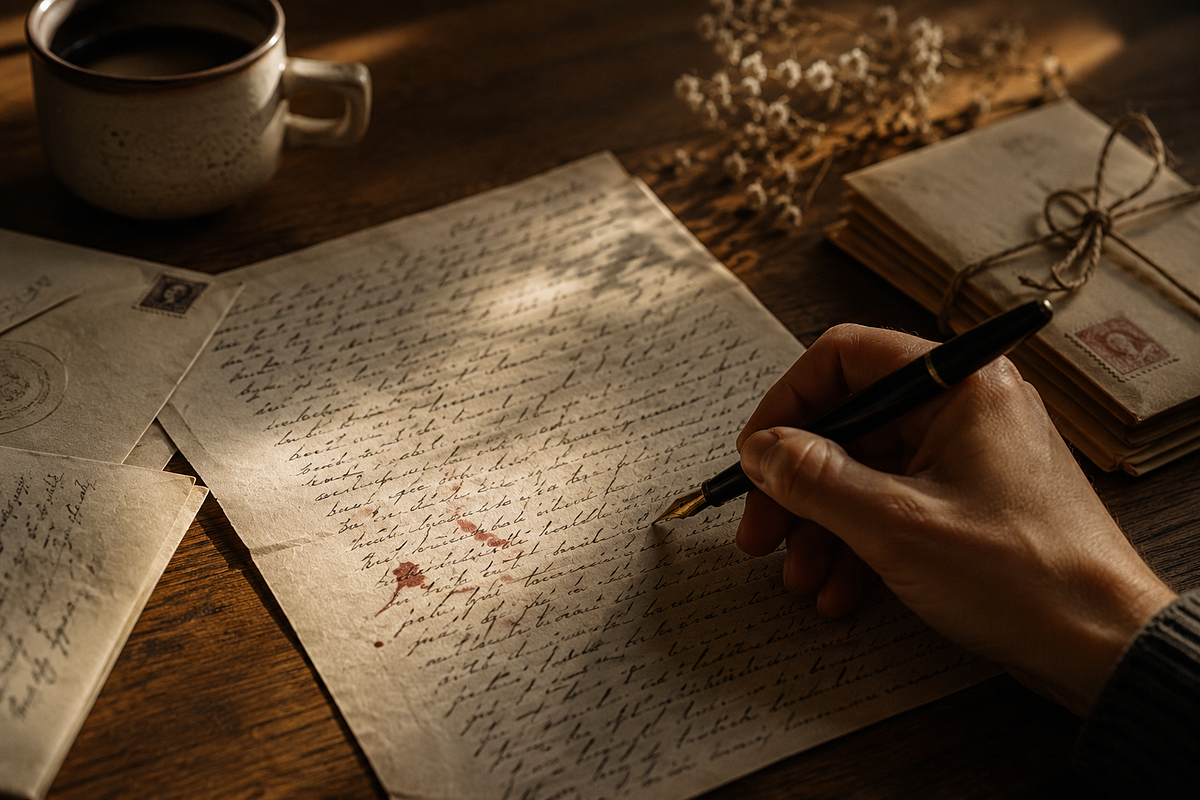
The blister breaks. The ink mixes with blood. That is the hidden beauty of a handwritten letter, it costs time you can never recover.
"The medium is the message." – Marshall McLuhan
One day, future generations may never truly know what it feels like to write a handwritten letter.
Not a message tucked inside a birthday card.
Several handwritten pages filled with thoughts, memories, questions, and emotions.
The kind of letter you wrote because there were things too important to trust to a conversation.
The kind of letter where your thoughts began flowing faster than your hand could keep up.
Where every sentence felt like it had been waiting years to be written.
You are no longer remembering the experience. You are writing it.
Midway through the page, your fingers begin to ache.
A blister starts to form where the pen rests.
You stop for a moment, rub your hand, then keep writing.
Because you know that if you put the pen down for too long, the moment may pass and with it, the words you've searched so hard to find.
Then, in the midst of the message, the blister breaks.
Hours later, you notice tiny drops of blood mixed with the ink dried on the paper.
Looking back, it almost feels appropriate.
Not because pain makes the words more meaningful.
It reminds you that some message was worth giving a piece of yourself to finish.
That is the hidden beauty of a handwritten letter.
There is no deleting a paragraph because it doesn't sound right.
No asking artificial intelligence to rewrite what you're trying to say.
Every sentence exists because you choose it.
Every page represents time that can never be recovered.
Long before anyone ever reads the first sentence, the letter has already communicated something.
Today, we can communicate with almost anyone in the world instantly.
We can write, rewrite, edit, delete, and send without ever taking our eyes off the screen.
Artificial intelligence can help us organize our thoughts, polish our writing, and communicate more clearly than ever before.
I wonder if, in making communication effortless, we've also lost some appreciation for the effort itself.
The value of a handwritten letter was never the paper.
It wasn't the ink. It wasn't even the handwriting.
Perhaps that's why old handwritten letters are so difficult to throw away.
They're evidence that, for one brief moment, another human being willingly gave up a portion of the thing they could never get back.
That's the cost and the beauty of a handwritten letter.
Drafted by a large language model from the source reporting linked above, then screened by automated publishing checks. It is not read by a journalist before publication. Some articles cite our Alpha Score. Verify prices and figures against the original source. Educational coverage, not personalized advice.