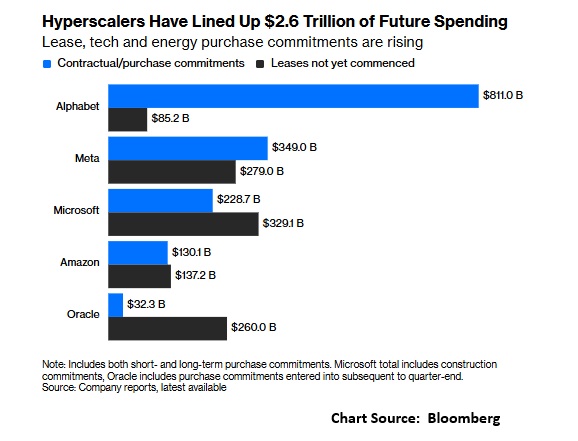
The comfortable belief that Big Tech can simply turn off the AI spending taps has taken a hit. Bloomberg Opinion's Chris Bryant dug through the accounting footnotes of the four largest hyperscalers and found more than $2.5 trillion in future commitments that never appear on a balance sheet. The number covers leases not yet commenced and contracted purchases of equipment, energy, and services. The lock-in is building fast.
Alphabet's Q2 disclosures show $811 billion in purchase commitments, including $707 billion with terms beyond one year. That's a $475 billion sequential increase. Meta's noncancellable commitments have reached $349 billion, more than double the figure at the close of 2025, alongside $279 billion in future data center leases. Microsoft sits on $557 billion combined across the two categories. Even Oracle, the smallest of the group, has $260 billion in pending leases and $19 billion of unconditional purchase commitments running five years.
The shift in supply chain power explains the scale. On GPUs, the hyperscalers kept some flexibility. Microsoft's Amy Hood and Amazon's Andy Jassy both stressed this week that chip purchases can be slowed if demand softens. Memory is a different story. Micron has locked customers into roughly five-year agreements covering at least $100 billion of future revenue. Sandisk extracted $42 billion from just three clients. Samsung may dedicate up to 70% of capacity to customers on long contracts secured by deposits and guarantees that make exit punitive. Suppliers, scarred by past cycles, are forcing customers to carry the downturn risk.
A clue sits in Meta's filings: nearly $11 billion of its money market cash is now restricted from general corporate use, collateralizing infrastructure purchase agreements through 2030.
The credit market has moved from noticing to trading. A record $127 billion of AI-linked corporate bonds changed hands in July across the eight largest names, a more than fourfold rise from a year earlier. That lifted the complex to 14.5% of total US investment grade volume, up from an average of 4.5% in 2025. Much of that paper is only months old, the residue of the bond flood Meta, Nvidia, SpaceX, and Oracle unleashed to fund their buildouts. After absorbing the deluge, investors pushed funding costs sharply higher and reached for protection.
Credit default swaps tell the story in miniature. Oracle single-name notional stands at a record $25.1 billion, up from $6.9 billion a year ago, with five-year protection spreads at 218 basis points, junk pricing for an investment grade name. Meta CDS, which began trading regularly only in November, has already amassed $5.8 billion notional. SpaceX hit $1 billion within weeks of its debut bond. Even the picks and shovels are getting hedged: Nvidia's five-year CDS touched 82 basis points this week, double its level in the middle of June. Tech now accounts for nine of the ten widest names in the CDX investment grade index. As S&P Global's Gavan Nolan puts it, "Hyperscalers are the big driver of the investment-grade CDS market right now."
Traders say the activity reflects repricing, not panic. Flow is healthy in both directions, with protection buyers offset by investors selling CDS on the view that the selloff is overdone. Bid/offer spreads have held stable even as credit spreads widened. Hedge funds are working relative value between bonds and CDS and across the capital structure. Insurers and asset managers are returning to single-name CDS for the first time in years. A functioning hedging market is a feature, not a bug. Its very emergence confirms the thesis: credit risk is now central to the hyperscaler investment case.
Step back and the macro picture is uncomfortable. Silicon Valley has abandoned its capital-light DNA and converted variable spending into quasi-debt, precisely as its funding shifted from internal cash flow to public bond markets. If cheaper open source models undercut OpenAI and Anthropic, the contracted revenue backing these pledges erodes, yet the pledges remain. Bryant argues that the structure creates negative convexity at the heart of the market's largest concentration of equity value.
The capex put is smaller than advertised, the exit doors are narrowing, and the CDS market is now quoting the cover charge. Markets are growing impatient for returns on the invested capital, and the pressure is building.
Sources: Chris Bryant, "AI's Wildest Spenders Are Hitting the Accelerator," Bloomberg Opinion, July 31, 2026; IFR/market reporting on AI-linked credit trading, July 2026.