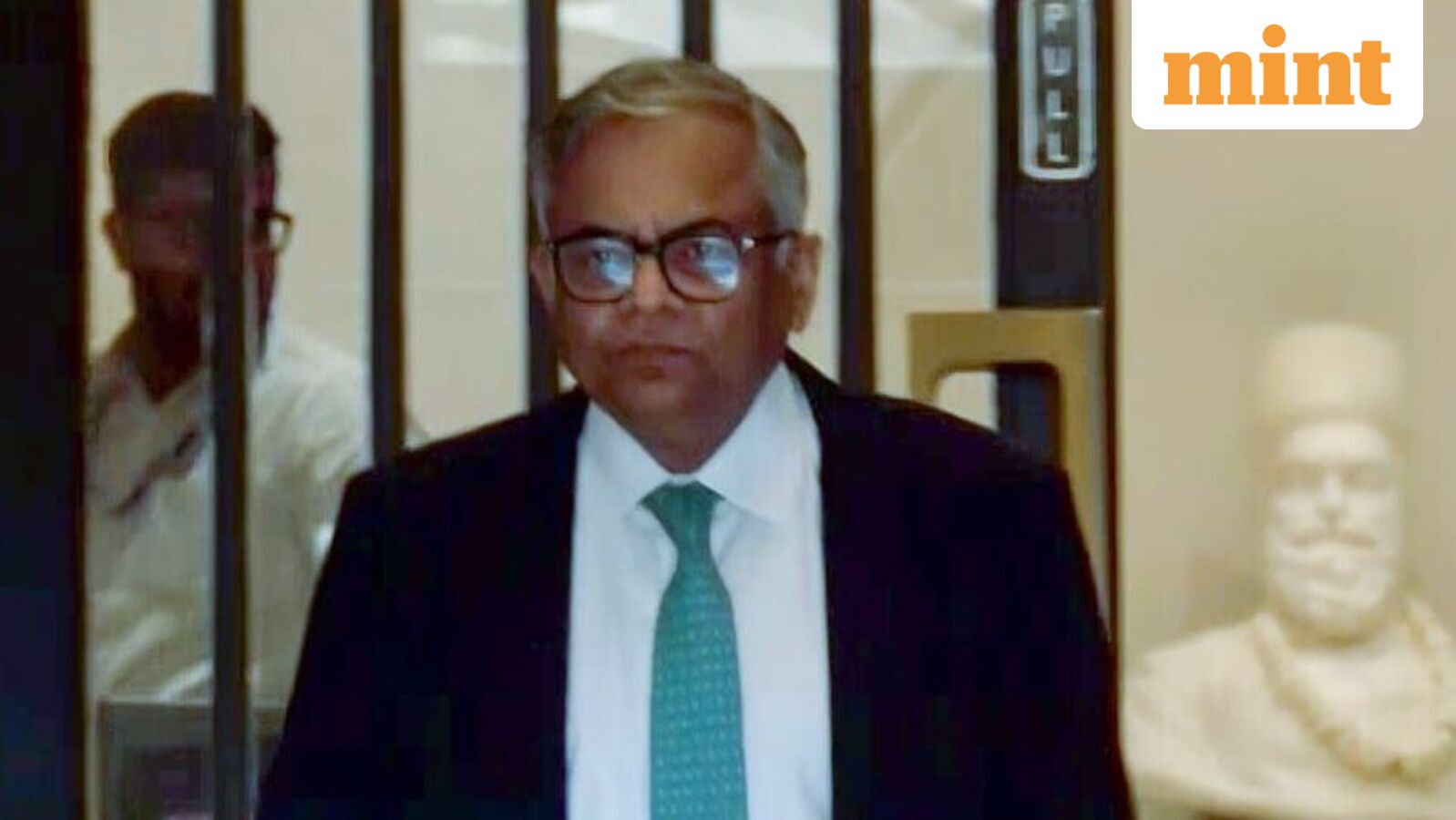
The government sees no grounds to intervene in the Tata Sons leadership crisis as shares fall. A former corporate affairs secretary warns succession pick will test India's global credibility.
The Indian government is not planning to step into the leadership crisis at Tata Sons following chairman N. Chandrasekaran's resignation threat, viewing it as an internal matter for the conglomerate's shareholders and management to resolve, two officials said.
The Centre would consider intervening only if the Tata Group or related stakeholders formally asked for its involvement, said the first official, speaking on condition of anonymity. As a matter of policy, the government generally stays out of private company governance, the person added.
The second official said there are currently no grounds to get involved, since the issue is one for the group's owners and board to sort out.
Queries sent Wednesday evening to spokespeople for the Prime Minister's Office, the ministries of finance and corporate affairs, the Securities and Exchange Board of India, and the Tata Group went unanswered.
The turmoil at India's largest conglomerate erupted Wednesday when Chandrasekaran said he would not seek reappointment after his current term ends Feb. 20, 2027. He said the Sir Dorabji Tata Trust and Sir Ratan Tata Trust had unanimously recommended a third five-year extension, backed by the board's nomination and remuneration committee. But at a board meeting on Feb. 24, 2026, one director withheld support. Without unanimity, Chandrasekaran said he deferred the decision. "It has been six months since that board meeting, and no resolution has been reached till date," he said.
The Tata Group spans information technology, automobiles, steel, consumer products, aviation, electronics, power, and financial services. Its scale means leadership uncertainty is closely watched by investors and policymakers. Shares of several listed Tata companies fell after Chandrasekaran's announcement, reflecting market sensitivity to succession risk.
"This news has very deep implications," said Dinesh Kumar Mittal, former secretary at the ministry of corporate affairs. "Tata Sons is a highly respected and important company, and its management has a significant bearing on the broader Indian economy."
"Beyond that, there is also a global dimension," Mittal added. "International investors will be looking at the stability and continuity of large Indian companies. If Mr. Chandrasekaran, who has done a wonderful job, were to step down, it would be imperative for Tata Sons to announce a successor who is equally capable, if not better. That would be important not only for ensuring stability and confidence in the market, but also for maintaining India's reputation and credibility globally."
Tata Sons, the group's principal investment holding company, reported net profit for the financial year ended March 2026 rose 21.8% year-on-year to ₹31,961 crore, while revenue grew 9.1% to ₹42,367 crore, according to its annual report. The conglomerate's aggregate revenue rose 7.8% to ₹16.24 lakh crore in FY26, equivalent to about 4.7% of India's nominal GDP of ₹346.36 trillion, based on provisional estimates from the statistics ministry.
The Centre has intervened in corporate affairs in the past when public interest or serious governance concerns were involved, but does not ordinarily wade into routine corporate disputes, the second official said.
Tata Sons' board now faces the task of finding a successor to Chandrasekaran, who has led the group for nearly a decade. The trust shareholders that control Tata Sons hold the ultimate say in the succession process.
Drafted by a large language model from the source reporting linked above, then screened by automated publishing checks. It is not read by a journalist before publication. Some articles cite our Alpha Score. Verify prices and figures against the original source. Educational coverage, not personalized advice.