Stocks● Neutral
Taiwan is training its Abrams tank crews to hide and refuel inside its bustling urban sprawl
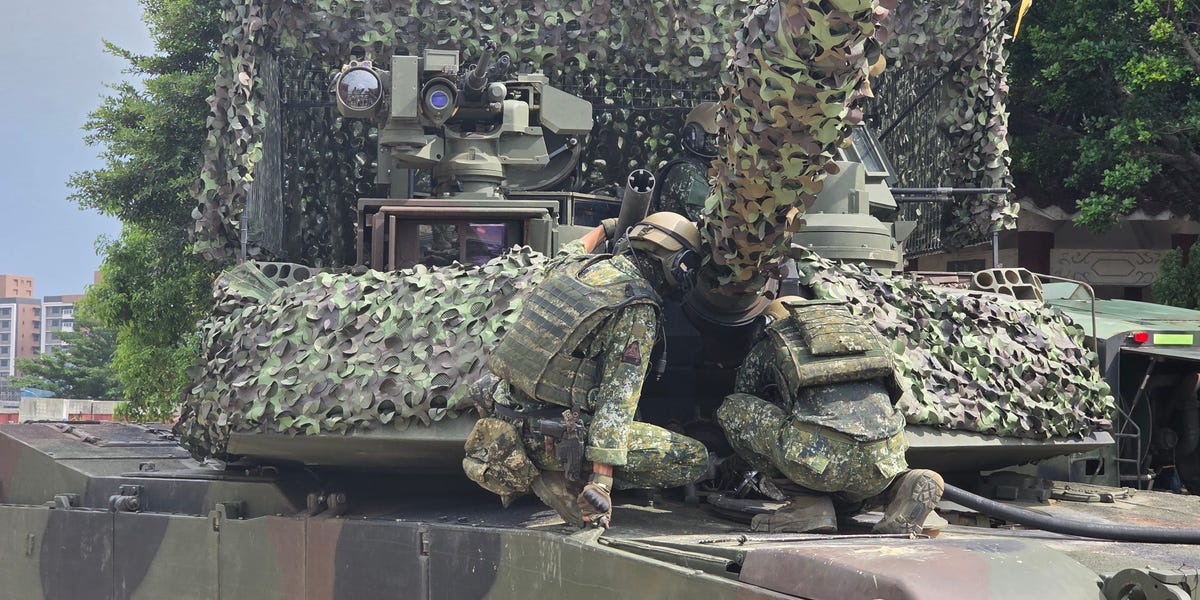
Taiwan's 584th Armored Brigade hides and refuels its new M1A2T Abrams tanks in urban Taoyuan during Han Kuang exercises, testing ambush tactics against China's 6,000-strong tank fleet.
Continue with
A platoon of M1A2T Abrams tanks sat hidden under tarps and debris in a construction yard about a mile from Taiwan's main airport. One tank, fitted with a metal anti-drone cage, roared forward as crews prepared to refuel its Honeywell AGT1500 gas-turbine engine under the August sun. Civilian cars and vans passed by as the Abrams braked in the courtyard, allowing troops to connect the American-made tank to an M978 fuel truck.
The scene unfolded during the major Han Kuang military exercise, which simulates a Chinese invasion. Months after Taiwan received the last of 108 third-generation tanks from the US in April, the 584th Armored Brigade put its Abrams crews to the test in an urban setting. Space was tight in the Taoyuan courtyard. A temple known for its giant statue of Guan Yu, the Chinese military general later deified as a god of war, stood next door. A village with alleys and tourist-friendly murals sat about a football field away. The nearest metro station was a 10-minute walk.
An escort of Taiwanese Clouded Leopard infantry fighting vehicles and Humvees armed with anti-tank missile launchers monitored the approach on a two-lane street from a nearby parking lot. The Abrams took about 15 minutes to refuel before lurching onto the narrow road and looping back to join the rest of the platoon in their concealed position.
These tanks, assigned to Taiwan's northern theater command, are responsible for defending the island's capital and its main airport. Over two-thirds of Taiwan is covered by mountains and forested hills. Much of the rest is packed with urban infrastructure. The American-made armor would likely be most effective in cities and around vital chokepoints if Beijing launched a ground invasion.
Erich Shih, a Taiwanese military analyst who runs the website Military and Aviation News, said Taipei should primarily use the Abrams to ambush Chinese forces on roads leading into major cities. Going "head-to-head with PLA tanks is not a good idea," Shih, who has observed the Han Kuang exercises for over a decade, told Business Insider.