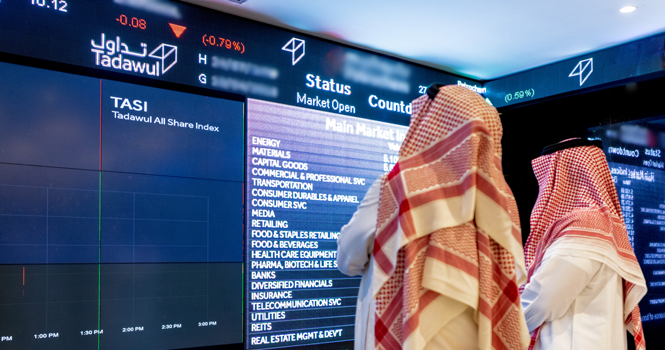
Institutional investors accounted for most of the SAR 172B decline, cutting holdings by SAR 170B. Foreign ownership held at 4.65%. The concentrated outflow signals risk-off among large Saudi accounts.
Tadawul’s weekly market capitalization dropped 1.74% to about SAR 9.75 trillion in the week ended June 4, shedding more than SAR 172.4 billion on a week-on-week basis. The data from the exchange shows that the sell-off was not broad-based. Institutional investors drove nearly the entire decline, while non-institutional and foreign holders barely moved. The profile points to a concentrated reduction by large accounts, not a market-wide rout.
Institutional ownership on the Saudi exchange fell SAR 170.43 billion to SAR 9.33 trillion over the week. Non-institutional holdings dropped only SAR 2.02 billion to SAR 421.79 billion. The disparity is the key signal: large funds, sovereign wealth vehicles, and other institutional accounts were the marginal sellers. This pattern often emerges when those players rebalance sector weights, reduce leverage, or trim beta exposure before a macro catalyst such as an OPEC+ meeting or the start of quarterly earnings season. The 1.74% market cap contraction reflects roughly the same magnitude as the institutional flow, confirming that smaller holders were not the source of pressure.
Foreign investors’ ownership accounted for 4.65% of the total market capitalization, unchanged in practical terms from prior weeks. The stability of international allocation suggests that the selling was not driven by a global rotation out of Saudi equities or emerging markets. If foreign holders had also trimmed, the decline would have likely been steeper and the recovery path longer. The fact that foreign ownership held steady reinforces the interpretation that the move was domestic institutional rebalancing rather than a broader shift in investor sentiment toward the kingdom.
Non-institutional ownership – primarily retail and smaller private investors – fell by only SAR 2.02 billion, a negligible move relative to the total. This is a meaningful liquidity signal. Retail holders showed no panic and did not add to the selling pressure. When large accounts unwind positions, the risk of a cascading sell-off rises if smaller holders also rush for the exits. In this case, the order book absorbed the institutional flow without triggering a wider liquidation. That limits the short-term downside risk but also means that any recovery will likely require the same institutional accounts to return, not a retail-driven bounce.
The weekly market cap release from Tadawul next week will be the first concrete test of whether the institutional selling was a one-off rebalance or the start of a longer reduction. Traders should also watch for sector-level breakdowns if the exchange publishes them – the data may show which industries absorbed the largest hits. An upcoming catalyst such as an index rebalancing date, a sovereign fund announcement, or a shift in oil prices will determine whether the large accounts rotate back in or continue to trim. Until that catalyst appears, the institutional-led decline sets a cautious tone for Saudi equity exposure.
Prepared with AlphaScala research tooling and grounded in primary market data: live prices, fundamentals, SEC filings, hedge-fund holdings, and insider activity. Each story is checked against AlphaScala publishing rules before release. Educational coverage, not personalized advice.