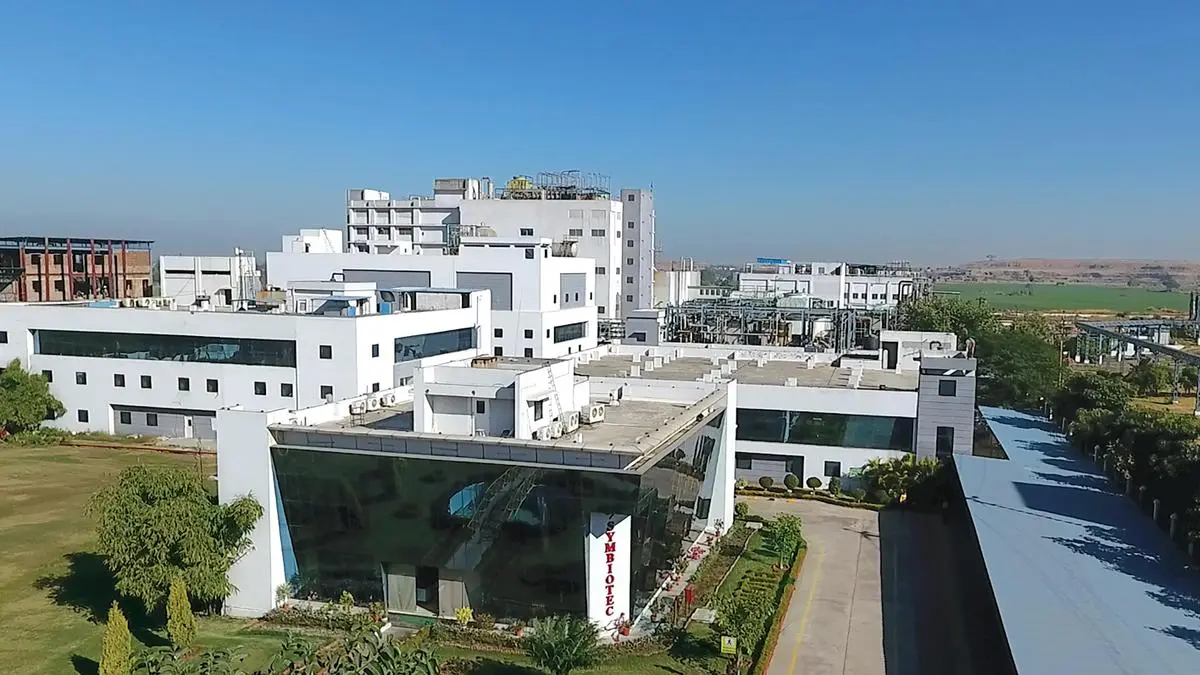
Symbiotec Pharmalab, a fermentation-based steroid and hormone API maker, opens its IPO on August 24. At the upper price band of ₹988, the issue values the company at 57.8 times FY26 earnings. That is a premium to most Indian pharma peers. The company's own rights issue in December 2025 priced at ₹276 per share, heavily subscribed by promoters. Rights issues carry a standard discount, but the gap between ₹276 and ₹988 narrows the margin of safety for public-market buyers.
The IPO stacks ₹150 crore in fresh capital – most of it repaying ₹112 crore of debt – against an offer-for-sale of ₹1,607 crore. Promoters sell ₹144 crore of the OFS; the rest comes from Rosewood Investments and India Business Excellence Funds. Post-issue, net debt drops from ₹377 crore to roughly half, trimming leverage from 1.6 times EBITDA toward 0.8 times. The balance-sheet improvement is real, but the headline fund-raising is tilted toward existing investors cashing out, not toward funding the expansion.
Symbiotec's core argument is integration. It transforms raw materials through fermentation and organic chemistry into 60-plus APIs, then moves those APIs into complex injectables using double-chamber vials and syringes it is still developing. Two products – Methylprednisolone Sodium Succinate and Hydrocortisone Sodium Succinate – are undergoing studies for DCV launch, expected in FY27-28. Three more are in earlier stages. The company has a U.S. marketing partner on a 50-50 profit share that includes milestone payments. That structure reduces distribution risk, but the timeline means revenue from formulations is at best two years away.
The CDMO story has a more concrete timeline. Symbiotec has commissioned 400 kilo-litres of fermentation capacity for contract manufacturing on top of its existing 300-kl base. It has signed take-or-pay contracts for five to ten years covering a significant portion of that new capacity, including a 10-year agreement for alternative-protein CDMO work and another 10-year deal for fermentation-based APIs. Revenue from CDMO should start in late FY27 and ramp sharply in FY28. The contracts de-risk the capacity, but the capacity is large – total fermentation now stands at 700-kl, up from nowhere near that two years ago. If end-market demand softens or if accreditation takes longer than planned, the fixed-cost drag hits margins first.
Insulin and GLP-1 represent the furthest-out bet. Symbiotec has a 14-kl fermentation line for recombinant insulins, with bio-equivalence studies expected to finish by FY27. It is also waiting for DCGI approval to shift GLP-1 manufacturing from chemical synthesis – currently sourced from China – to a recombinant method. Domestic insulin and GLP-1 markets are growing, but by the time revenue materialises, competitors with established pipelines may have moved first.
The base API business remains the anchor. Symbiotec holds a 38.2% global volume share in corticosteroids and 23.8% in steroidal hormones. Revenue grew at a 10% CAGR over FY24-26 to ₹869 crore. EBITDA margin averaged 26%, supported by backward integration that covers 80% of the fermentation portfolio, replacing Chinese intermediates. That integration also qualifies the company for the PLI scheme for domestic bio-pharmaceutical production. The business is real, cash-generative, and defensible against Chinese competition, which dominates fermentation but loses on complexity in Symbiotec's product set.
The wildcard – and the one that could alter the valuation case – is the Premarin API. Symbiotec's generic application for conjugated equine estrogens is under regulatory evaluation. The innovator product still books $1 billion in U.S. sales more than 15 years after patent expiry, because manufacturing complexity has blocked generic entry. If Symbiotec wins approval, the revenue swing is material. If it does not, the stock still carries the base business plus the CDMO ramp, but the IPO multiple would look less justified with the optionality priced in.
At 57.8 times FY26 earnings, the IPO prices in a smooth execution of the CDMO, injectables, and insulin timelines. The rights-issue discount to promoters at ₹276 – even allowing for standard discounting – suggests that insiders saw a different risk-reward balance for themselves than the public is being offered. Investors need to decide whether the next two years of FDA filings, DCGI approvals, and DCV launch dates will validate that spread or close it from the wrong direction.