Inside the Bruce Springsteen Center for American Music: $12M Telecaster, 45,000 documents, and a big-hearted vision of the old, weird America.
It is odd, when you think about it, that there is no major, comprehensive museum devoted to American music. One can make a very strong case that music is the form of creative expression that has been America’s greatest gift to the world. American cinema, literature, and visual art are all formidable. But the music. Folk, blues, jazz, spirituals, country and western, Broadway, hip-hop. The variety, ingenuity, and passion feel endless.
No single great temple to that rumbustious genius exists. Genres have their halls of fame, like country music’s in Nashville. The Musicians Hall of Fame and Museum there expands beyond country and was outstanding on a visit a few years ago. It does not claim to be exhaustive. The Rock & Roll Hall of Fame in Cleveland is international in scope.
The Bruce Springsteen Center for American Music is not that great temple, executive director Bob Santelli will readily acknowledge. With exhibition space of roughly 8,600 square feet, it could not be. What the center lacks in comprehension, it makes up for in love. The center opened June 13 on the campus of Monmouth University in the Boss’s lifelong Jersey stomping grounds. He wrote the lyrics to “Born to Run” at a coffee house just up the street. The museum is a down-to-earth bear hug of every genre and of the country that produced them, of the “old, weird America” in Greil Marcus’s phrase.
The museum is the product of Santelli’s execution, but it reflects Springsteen’s heart and vision. Santelli, architect Rick Cook, and director Eileen Chapman showed me around on a late July Friday. Santelli was a longtime Rolling Stone rock critic who turned to museum curation in the 1990s. He has known Springsteen since they were teenagers. He first saw Bruce play in 1968. “He was so good, and so far ahead of everyone else,” Santelli said. When Woodstock came, they both skipped it. Led Zeppelin was playing the Asbury Park Convention Hall that weekend, and they went instead.
Nine years ago, Santelli went to Jon Landau, Springsteen’s producer, with an idea for a museum and archives built around Springsteen’s life. Landau agreed and said go to the man himself. “I brought it to Bruce,” Santelli said. “And he listened, like he does, paying attention. And he finally said, ‘You know, Bob, I am honored, humbled that you would think this.’ But he says, ‘I’m just a chapter in the ongoing story of rock and roll. I’m a link of a long chain. And if you would make it bigger, the story bigger, and I’m a part of it, then I’d be interested.’ And that’s how we became the Bruce Springsteen Center for American Music.”
With that blessing, Santelli raised the $53 million needed. He did not ask Springsteen for a dime because “I didn’t want him to think, or anyone to think, this was in any way a vanity project.”
Santelli enlisted architect Rick Cook of CookFox Architects in 2019. Cook first saw Springsteen live at Albany’s Palace Theater in 1977, but he was not one of those Boss concertgoers screaming every word of “Backstreets.” Music, Cook told me, “just wasn’t my thing.” He admitted to being intimidated at first. “I thought, my goodness, how do you find a physical way to express the story of American music and Bruce’s place in it? We make things in space, and music is this magic act that happens in time.”
For someone not immersed in the Springsteen legend, Cook offered a design that captured his aesthetic. The exterior of the low-slung two-story building uses weathering steel rainscreen panels, rusted like the mills where some of Springsteen’s protagonists worked. Cook explained the care taken to reinforce the proletarian ethos. The end-grain block flooring in the 240-seat Powell Soundstage “recalls the old factory floors, the nineteenth-century factory floors.” The seats are clad in workingman’s denim.
In the Powell theater, the visitor’s journey begins with a 25-minute film by Thom Zimny, the director who has worked with Springsteen on many projects. The film is a tour of American music with mind-blowing footage, including a teenage Aretha Franklin belting one out in church. Springsteen narrates, talking about legendary figures and his own youthful hunger for success. “I wanted to hear all that screaming again,” he said of watching The Beatles on Ed Sullivan. “But I wanted it to be for me.”
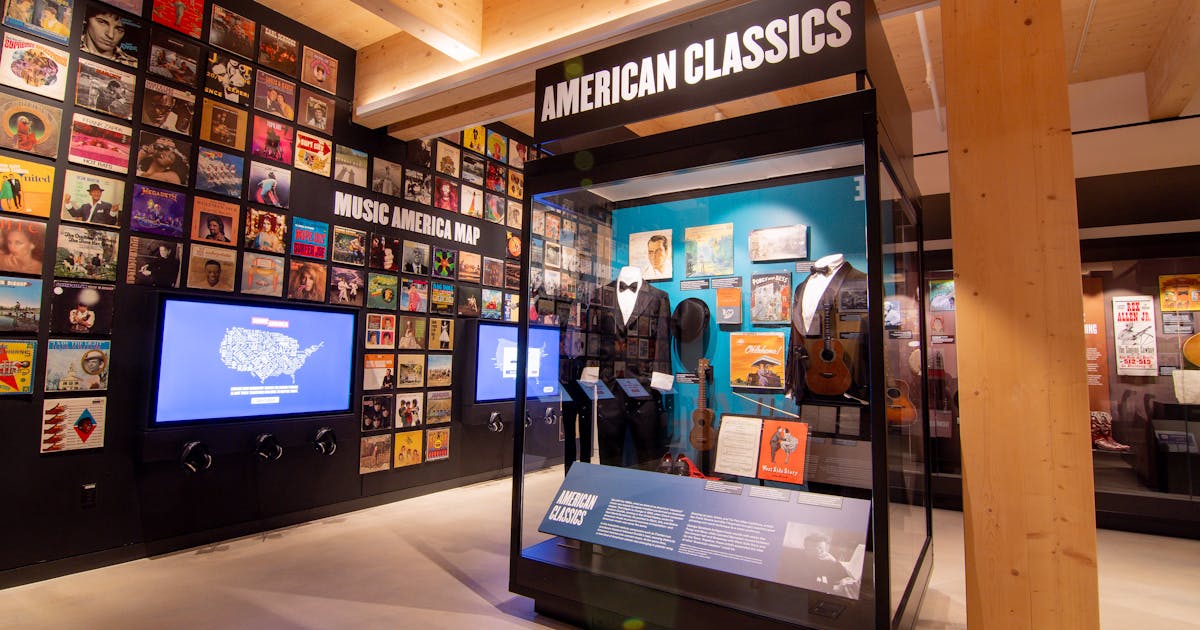
The whole place is a joyous visual celebration of American music. There is a wall of album covers: Nat King Cole, Chet Atkins, the Bye Bye Birdie Soundtrack, The Beastie Boys, Connie Francis. “I had kids pick out album covers that they thought were cool,” Santelli said.
The exhibition halls are not large, so the ground covered is impressive. The gallery surveying the history of American music is just 2,200 square feet. It packs in sections on 11 music genres (American classics, pop, soul, jazz, Native American) and six themes (race, gender, technology, geography). Display cases hold some of the earliest electric guitars from the 1920s and 30s. A suit of Frank Sinatra’s. Louis Armstrong’s and Dizzy Gillespie’s trumpets. A Chuck Berry guitar. An Elvis Presley jacket. Odetta’s guitar from the 1963 March on Washington. A Michael Jackson glove. Lady Gaga’s space helmet.
The ground floor also holds a space for temporary exhibitions. When I visited, the installation was “Chimes of Freedom: Protest, Patriotism, and the Power of Song.” It tells the story of American political songs from “Yankee Doodle Dandy” to Springsteen’s “The Streets of Minneapolis,” written after the Immigration and Customs Enforcement shootings of Renee Good and Alex Pretti. There was a Woody Guthrie guitar and a handwritten set of lyrics to “This Land Is Your Land.”
Upstairs, it is all about Bruce. The E Street Band gets its due, as do Bruce’s pre-fame bands: The Castiles, Child, Steel Mill. It is interesting to be reminded of the racial diversity of The E Street Band in its early days. Clarence Clemons, obviously. At different times the band included David Sancious, the keyboard player whose stamp is clear on 1973’s The Wild, the Innocent, and the E Street Shuffle. Vini Lopez played drums on that record. Ernest “Boom” Carter laid down the drum track on “Born to Run” before leaving with Sancious to form a jazz fusion group. They all remained friends. The last time I saw him live, he played a song written as a tribute to George Theiss, The Castiles’ founder, who had been diagnosed with cancer. Springsteen remained close to him until he died in 2025.
There is a recording studio where you can listen to Max Weinberg or Gary Tallent explain a drum or bass part. There is a partial recreation of Springsteen’s old home library in Rumson, where the autodidact college dropout devoured volumes like Howard Zinn’s A People’s History of the United States.
And there is the archives room, Chapman’s domain. Springsteen wrote lyrics in Walgreens spiral-bound notebooks, many of which he held onto. Visitors cannot handle them directly, but many have been scanned. Chapman estimates the center has 45,000 to 50,000 documents. “His mom had scrapbooks,” Chapman said. “So we were gifted his mom’s scrapbooks, about six of them, plus other newspapers and correspondence.” You can sit at computers and browse through lyrics and old posters while listening to Steel Mill play live from 1970.
The Mona Lisa of this Louvre is The Guitar. The Fender Telecaster, natural finish with black pickguard, strapped across Springsteen’s back in the famous Born to Run cover shot by Eric Meola. It is badly gashed in at least two places. You can practically smell the flat beer and tobacco smoke. I, and nearly every other visitor I observed, lingered over it. “That’s probably worth about $12 million,” Santelli said. “That was the last thing we put in.”
Someday, the mandarins of the Smithsonian will decide that American music needs its proper home on the National Mall. Until that day, we have this modest, big-hearted, meticulously curated tribute to the America that has earned our love. Within these walls you might believe that our America will win, and that the old, weird America is the America that matters. You might believe, for an hour or two, in the promised land.
Prepared with AlphaScala editorial tooling from the source reporting linked above. Indexable analysis may include a cited Alpha Score value. Publishing checks screen each story before release. Educational coverage, not personalized advice.