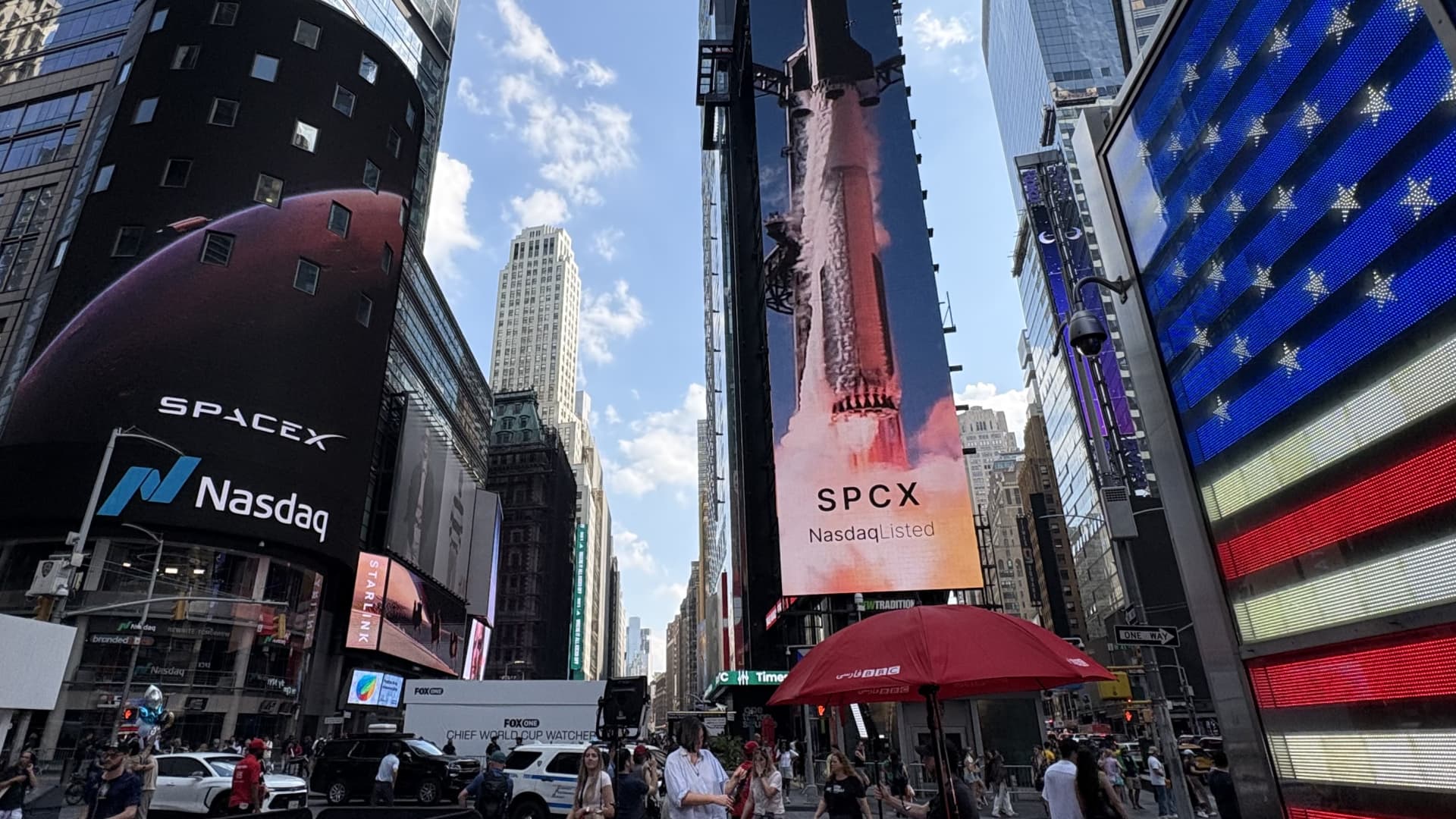
SpaceX has been a public company for three days. The stock is already 55% above its $135 IPO price. The move has little to do with SpaceX's business lines or the broader economy. It comes down to supply and demand mechanics in the stock market.
Only 555.6 million shares sold in the IPO, about 5% of outstanding stock. Underwriters can add 83.3 million shares through the overallotment option. Even with that, the public float represents a sliver of the company. Insiders hold roughly 911 million shares, double the current float. They cannot sell until two days after the first earnings report, expected in early August, according to Morningstar. Most institutional IPO buyers are holding, not flipping.
SpaceX will enter the FTSE Russell and MSCI indexes over the next few weeks. The Nasdaq-100 addition is also scheduled. Index funds must buy. The gap between available stock and required purchases is wide. Dan Niles of Niles Investment Management told CNBC it will be “really hard to be negative on this name until you at least get out to the Nasdaq-100 add.” He added that valuation will matter later.
Options on SpaceX started trading Tuesday in heavy volume. Michael Khouw, an options trader, explained the mechanics. Market makers that sell call options hedge by buying the underlying stock. The hedging itself pushes the stock higher. Leveraged ETFs amplify the effect. Direxion launched a Daily SpaceX Bull 2x ETF on Monday, using borrowed capital to multiply exposure.
Hedge funds and arbitrageurs are also piling in ahead of the index rebalancing. Concretum Research, a Switzerland-based firm, wrote that these participants, “anticipating the passive trackers’ demand, collectively buy the entrant ahead of time.” They can sell the stock back to the index funds at a premium once the rebalancing hits.
Payal Shah, writing for CME Group on June 10, described the collision: “When this mechanical, price-agnostic buying of passive funds collides with a constrained public float, it creates intense liquidity strain. This can result in significant price distortion, forcing passive funds to buy shares at elevated valuations shortly after listing.”
Once the index additions are complete, analysts expect the stock to start tracking sector and macroeconomic forces. George Karamanos at Rothschild & Co. noted that “share price momentum is likely to be underpinned by passive fund flows that reflect household savings trends and asset allocation decisions dependent on thematic fundamentals rather than stock-specific ones.”
There is also a pattern that Renaissance Macro Research calls the “hype tax.” IPOs that open spectacularly often underperform. Renaissance studied 20 recent IPOs and found that from the opening trade the median one-year return was minus 15.6%. Only 8 of the 20 posted gains after a year. Jeff deGraaf and his team published that analysis on June 11.
SpaceX's first earnings report, expected in early August, will unlock insider shares. That could be the moment the technical pressure reverses. For now, the mechanical forces are in full effect.